News

Woman wins suit against SBS Transit after head & neck got trapped between MRT doors
She had been running out of the train when it went out of service without any announcement, she claimed.
August 20, 2025, 06:50 PM
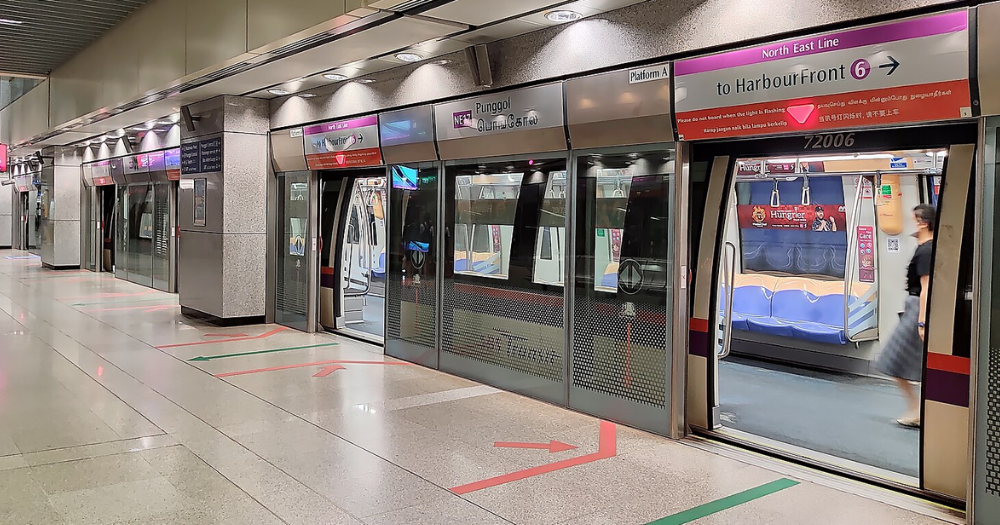

 A woman sued SBS Transit for an incident in 2022 where her head and neck were trapped between MRT train doors at Punggol MRT station.
She claimed that she tripped and fell while in a hurry to leave a train that was being withdrawn, but no announcement was made about the suspended service.
The court found SBS Transit 100 per cent responsible for the incident, according to a judgement released on Aug. 20.
It also found that the company, which operates the North East Line, breached its duty of care to the woman, Ng Lai Ping.
Ng's account
In the morning of Jun. 27, 2022, Ng boarded the MRT at Sengkang station going towards Punggol on the North East Line, as written in the judgement.
She had planned to take the train to Punggol station, then ride back to Little India station.
After the train arrived at Punggol, the lights in carriage five, where she was seated, switched off suddenly and without any warning, Ng said.
She had not been wearing headphones or using her phone.
She heard beeping sounds coming from the train's doors, indicating that the doors were about to close.
Then, five passengers seated near her suddenly got up and went out of the train, prompting Ng to feel she needed to do the same.
At the time, the train was poorly lit, and the floor was reflective and grey, Ng said.
It caused her to trip as she exited the train, she said.
Her face struck the gap between the platform and the train, and the platform doors and train doors closed on her head and neck.
She received assistance from an MRT employee and a passerby.
Service announcements
According to Ng, when the train was travelling from Sengkang to Punggol, she heard an announcement informing passengers that service had resumed.
The same announcement was repeated when the train arrived at Punggol station, she said.
However, SBS Transit denied playing such an announcement.
They added that the train Ng was riding had been planned to be withdrawn, and would terminate at Punggol station.
Ng said she did not hear any announcement about the train being taken out of service, or any instructions from the staff asking passengers to disembark.
She told the court she heard only one informing passengers not to board the train at the other platform.
Thus, she remained seated, waiting for the train to start moving again.
SBS Transit's response
SBS Transit explained that following its operational procedure for withdrawing trains, an announcement about the train being taken out of service at Punggol would be played in the train about 20 seconds after it left Sengkang.
A "do not board" announcement would also be played continuously in intervals at the platform of Punggol station.
There would also be staff members who would enter the train at carriages two, three, and six to ask any passengers remaining to leave the train.
SBS Transit acknowledged that no staff member entered carriage five of the train Ng was riding that day.
However, they added that the staff member in carriage six had asked the passengers in carriage five to exit the train, including signalling to them with his hands.
Three of the passengers noticed him after the lights dimmed, the company said.
The court also saw CCTV footage from the train and the platform of Punggol MRT station, though no audio was recorded.
According to the judgement, the footage showed that two SBS Transit staff were already in the train Ng was riding before it had reached Punggol station.
One of them was in carriage five. He alighted when the train arrived at Punggol, then stood on the platform looking at his phone.
No staff member was seen entering carriage five at Punggol station.
The lights in the train dimmed about 31 seconds after the train doors opened at Punggol.
Ng said she was trapped between the train doors for 12 seconds, but the CCTV footage showed that it was "at best" one to two seconds.
Negligence
Ng's lawyer argued that the negligence of SBS Transit and its staff included failing to pay sufficient heed to the presence of passengers in the train before closing the doors.
He added that SBS Transit failed to play any announcement before switching off the train lights, nor any warning to passengers that the train would be withdrawn when the it was travelling from Sengkang to Punggol station.
In defence, SBS Transit's lawyer argued that Ng ought to have known not to remain in the train, from the "out of service" and "do not board" announcements.
The dimming of the lights could not therefore come as a surprise to her, he said in court.
According to him, the interior of the train was still lit by emergency lighting, and other passengers had ample time to disembark safely.
He thus asserted that the incident was caused by Ng's own negligence, for failing to pay attention to the announcements, exiting the train when she knew the doors were closing, and running out in a reckless manner.
The first such incident
There had been no other incident like the one involving Ng at Punggol MRT station to date, SBS Transit told the court.
Given the "miniscule" risk of such an incident, the measures taken at the station must have been sufficient, the company's lawyer argued.
However, no documents were produced at the court to support the figures.
The SBS Transit duty operations manager who gave these figures on the stand claimed he did not even know if they were correct.
The judge, while acknowledging that the probability of a train door closing on a passenger during train withdrawal is low, said that it was not sufficient to invalidate Ng's claim.
SBS Transit tried to submit that Ng was not a credible witness, but the judge found her evidence "nonetheless consistent on the whole".
As five other passengers in carriage also remained seated until the lights went out, the judge believed that SBS Transit "more likely than not" played the announcements about the resumption of service instead of the "out of service" announcement.
The court concluded that the company had breached its duty of care.
Top image from Wikimedia