
News

Woman, 73, loses S$30,000 to MAS officer impersonation scam, helps police catch runner when scammer asks for another S$30,000
The scammer tried to con the woman out of another S$30,000 the next day.
July 22, 2025, 02:03 PM
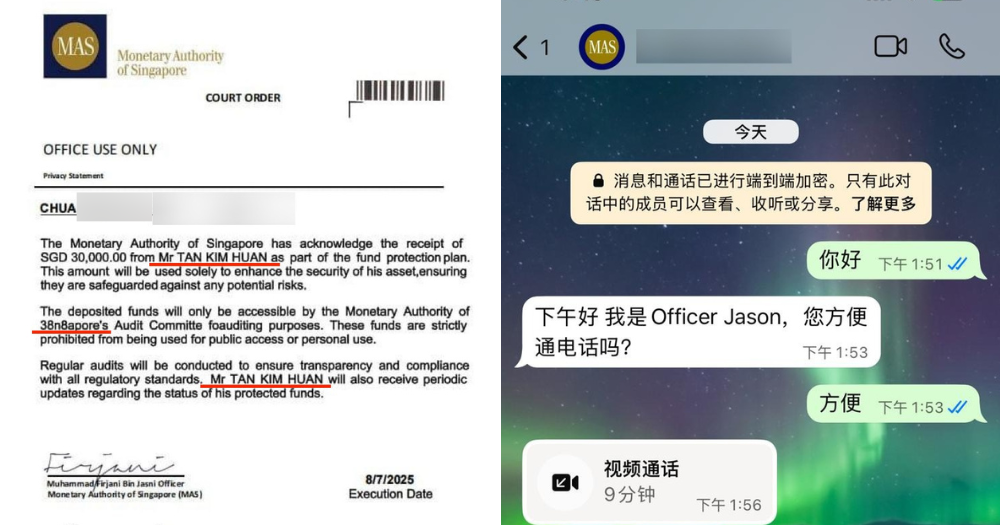


Chua Gek Liang, 73, received a call on Jul. 8 from a person pretending to be a Monetary Authority of Singapore (MAS) officer.
The elderly lady was told that she was suspected of money laundering.
She also received a message from an "Officer Jason" who claimed to be from MAS.
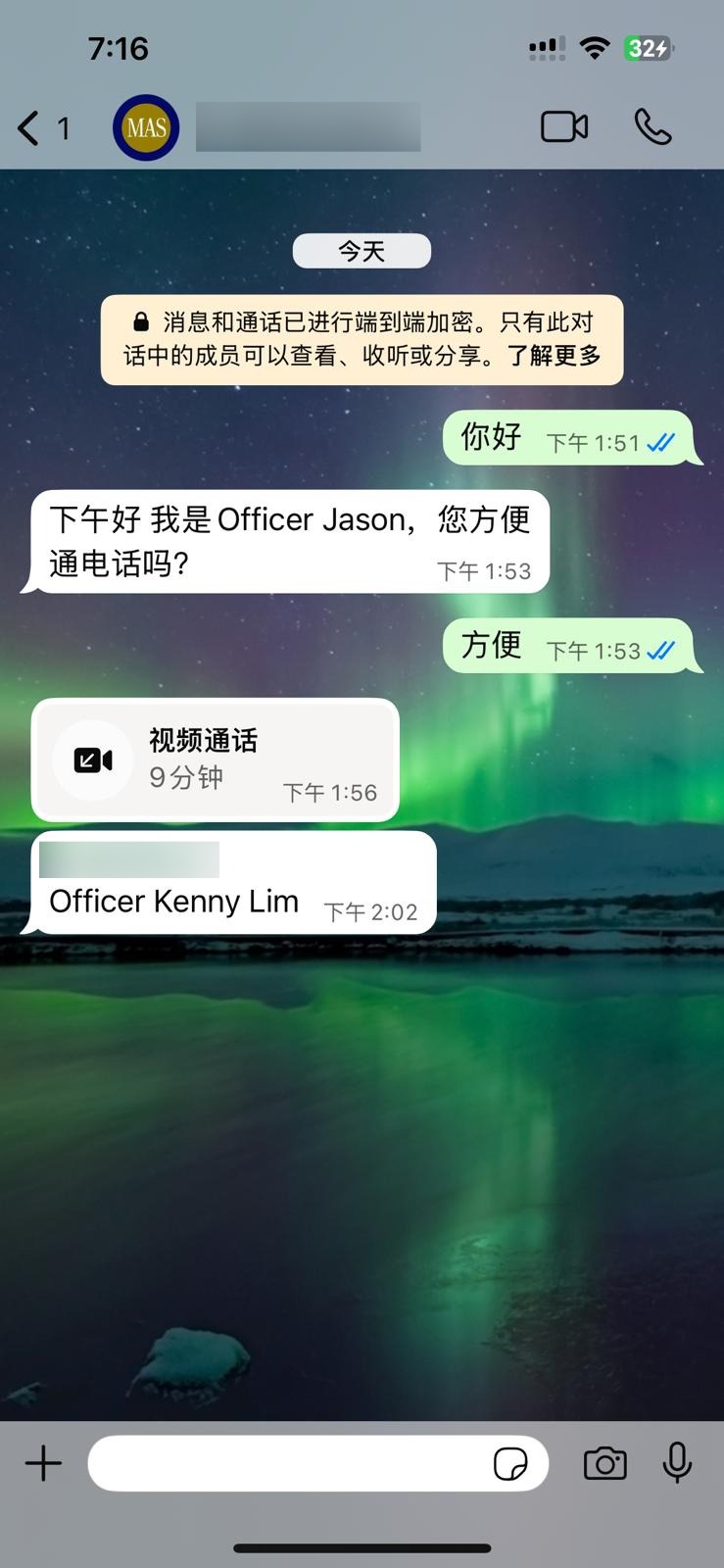 Screenshot courtesy of Ivy Yeo
He then transferred her to an "Officer Kenny Lim" after a nine-minute phone call.
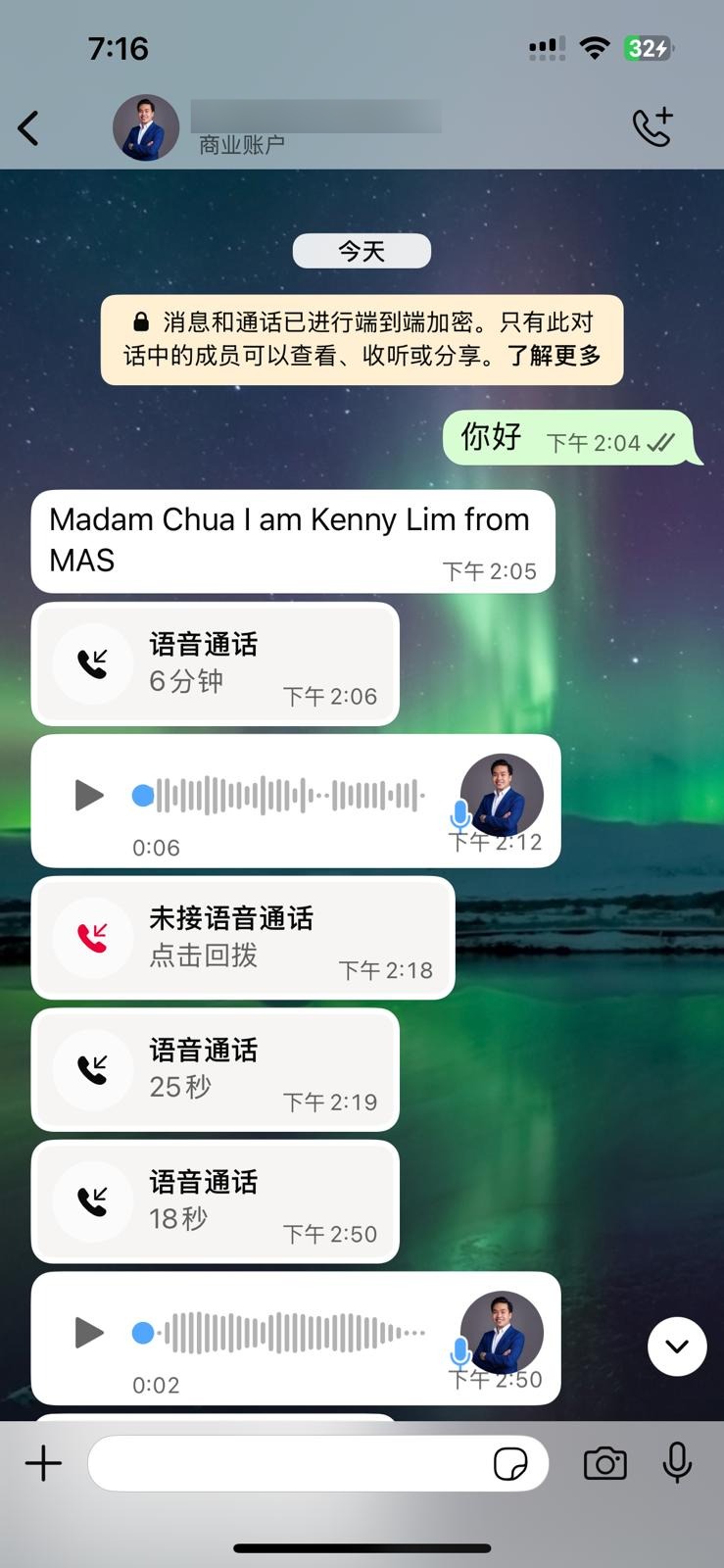 Screenshot courtesy of Ivy Yeo
Needed to withdraw S$30,000
Speaking to Mothership, Chua's daughter, Ivy Yeo, shared that the scammer told Chua that she needed to withdraw S$30,000 and provide the cash to a MAS officer as the money had to undergo checks.
Yeo said it sounded quite suspicious and ridiculous to her, but for her mother, who is Chinese-speaking, it appeared as though the scammer used "hypnotic language on her".
To prove her innocence, Chua went down to the Clementi Central branch that provides DBS and POSB services to withdraw the money.
She then handed the cash over to a runner and was given a fake MAS letter to confirm that the money had been received.
"MAS letter" filled with mistakes
It was not until much later in the evening, around 6pm, when her grandson spotted the MAS letter riddled with mistakes, that Chua realised she had been scammed.
The letter provided by the scammer had grammatical errors, spelling mistakes, and even included a different person's name.
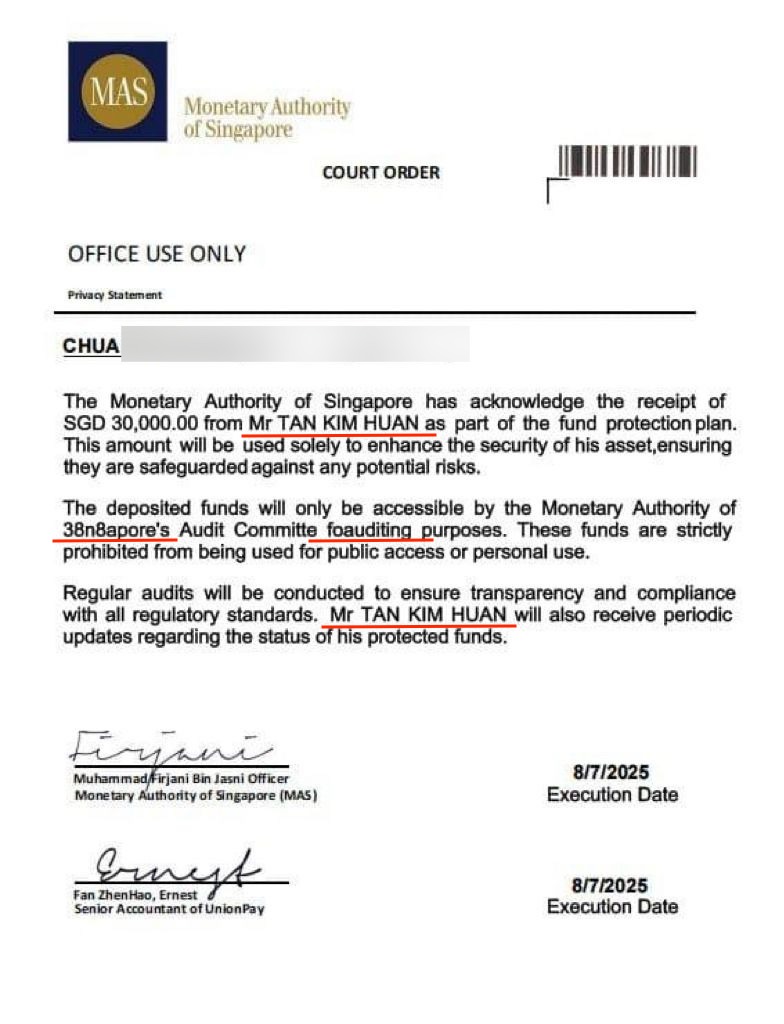 Photo courtesy of Yeo
The family filed a police report on Jul. 8.
On Jul. 9, Yeo's sister accompanied their mother to the branch to make a report.
Tried to get another S$30,000
On the same day, the scammer tried again to get Chua to provide another S$30,000.
When Chua used her mobility issues as an excuse to not go to the bank to withdraw the money, the scammer apparently hired a Grab to take her to another bank at Clementi Mall.
The scammer instructed her to go to the counter and withdraw S$30,000.
If she was asked what the money was for, she was told to tell the staff that she was buying gold for her grandchildren.
As Yeo's sister had been holding on to her mother's phone after the initial scam, she decided to devise a trap to catch the runner.
"If they have the cheek to come back to us, we should actually catch them the second time," Yeo said, despite the police warning them not to engage with the scammer anymore.
A trap
Yeo's family informed the police that the runner would be returning to pick up more cash.
The police stationed officers from the Singapore Police Force Commercial Affairs Department outside the drop-off point.
The envelope supposedly holding the cash was filled with paper instead.
Yeo said three police officers in plain clothes were on scene to wait for the runner's arrival at 3:30pm that day.
Scammer demanded release of runner
When the scammer realised that the runner had been caught, he called Chua, demanding the release of his man.
The scammer was unaware that the police had arrested the runner and was under the impression that Yeo's sister was keeping the man captive.
They asked Yeo's sister to let the man go, and Yeo asked the scammer to return the money.
The scammer then shared a screenshot of a bank transfer as proof that he had returned the money, stating that he had made a Giro transfer and that it would take about a day for the transaction to be reflected in her bank account.
This whole exchange lasted for a couple of hours before the scammer realised that his runner had been arrested.
And it turned out that the screenshot the scammer provided was fake.
No money had been returned.
Withdrawal limit
What left Yeo frustrated about the whole incident was what she described as a "banking lapse".
She noted that on the POSB/DBS website, it stated that the daily withdrawal limit from ATMs was S$15,000, regardless of the number of cards owned.
For customers who wish to withdraw more than S$15,000 within the same day, they are required to seek branch assistance.
 Screenshot via DBS website
Chua made two withdrawals of S$15,000 six minutes apart, both times at the ATM.
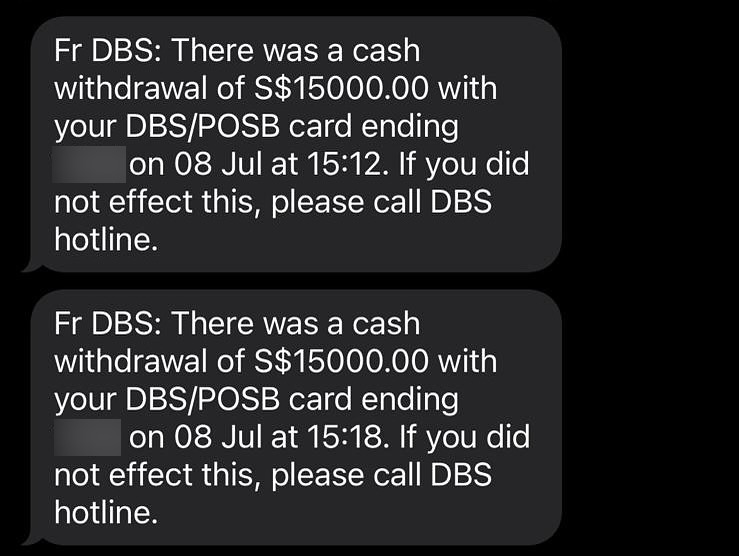 Photo via Aileen Yeo/Facebook
Yeo said she assumed that a customer who needed to withdraw more than the daily limit would be halted from doing so, and questions would be asked of the customer's identity and the purpose of the withdrawals.
She claimed that the staff onsite at the Clementi Central POSB branch did not apply the protocol when her mother was making the withdrawal the second time at the ATM.
"They didn't ask her questions and when she was withdrawing the second time, they just let it happen," Yeo said.
When asked how her mother has been coping with the whole incident, Yeo shared that Chua feels very disillusioned.
For Yeo, she believes that the banks are "custodians of our money, especially the older generations".
DBS responds
In response to Mothership's queries, a DBS spokesperson said its branch staff are trained to identify signs that may indicate a customer is at risk of falling prey to a scam.
Such signs include appearing anxious, confused or reluctant to engage.
In those cases, the staff will intervene with further questioning, share scam advisories, and escalate the matter to their fraud risk team if necessary.
In Chua's case, the customer approached the branch staff to request authorisation for an additional withdrawal exceeding the S$15,000 daily limit.
According to their CCTV footage, the staff verified the customer's identity.
"Throughout the interactions, the customer remained calm and engaged and confirmed her intent to proceed with the withdrawal. As no red flags were observed, the transaction was authorised accordingly," the spokesperson explained.
MAS protocols
A MAS spokesperson told Mothership that major retail banks have implemented a host of measures to prevent and detect scams.
These include implementing multi-factor authentication, setting default transaction limits for online funds transfers, requiring additional confirmation from customers to process high-risk transactions identified through banks’ surveillance, and imposing a cooling-off period when a digital security token is activated on a new device.
In addition to these measures, banks have also trained their staff to identify concerning behaviour when interacting with customers and may ask customers additional questions, the MAS spokesperson said.
"The government will continue to step up public education efforts to provide useful tools and tips that can help members of the public avoid falling prey to scams," the spokesperson said.
"Notwithstanding these efforts, scams involving self-effected transfers account for the largest proportion of scam losses in 2025. We encourage members of the public to be highly sceptical towards any request to transfer or withdraw money," the spokesperson added.
Advice
The MAS spokesperson stressed that government and MAS officials will never ask you to transfer money, withdraw money or disclose bank login details.
"Do no trust someone just because he/she has your personal information( e.g. name or NRIC)," the spokesperson added.
Here are some precautionary measures members of the public can take:
- ADD
- Add the ScamShield App to block calls and filter SMSes
- Set transaction limits that are adequate for daily expenses
- Lower transaction notification thresholds
- Alert the bank immediately of any suspicious activity in your bank account
- Activate the Money Lock feature of your bank to digitally secure your money
- CHECK – Check against the 24/7 ScamShield Helpline at 1799 or other official sources.
- TELL – Tell your bank immediately if you suspect that you have fallen victim to a scam to block any fraudulent transactions, and then make a police report. Report any scams to the authorities, family, and friends if or when you encounter scams.
If unsure about any request involving your money or bank account, MAS encourages the public to call the 24/7 ScamShield Helpline at 1799.
Top photos courtesy of Yeo