News
Asean Summit in summary: Members adopt 20 year vision-statement, Timor-Leste to join Asean
Asean members also held summits with GCC members, as well as with the GCC and China.
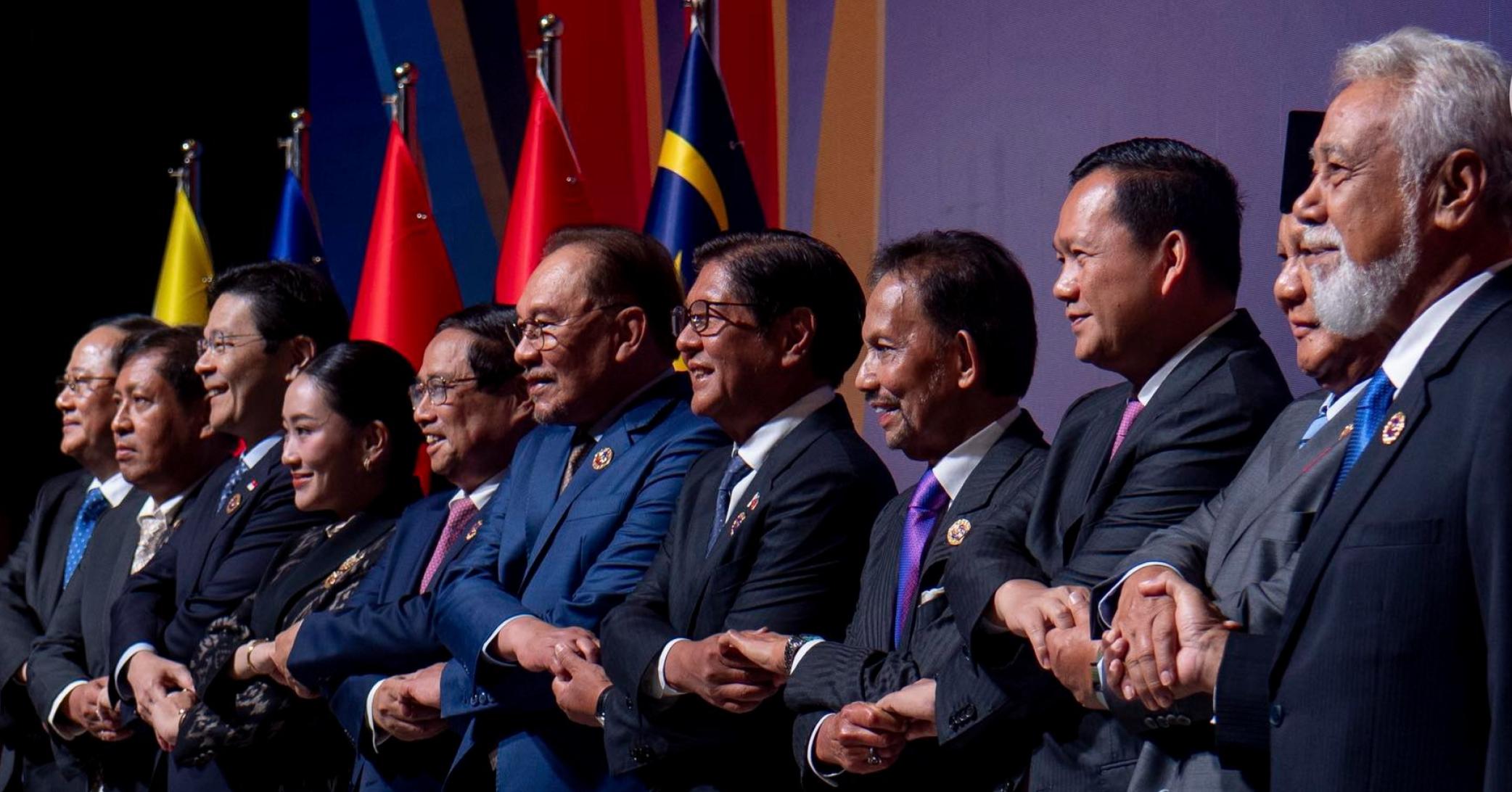


Asean leaders met in Kuala Lumpur, Malaysia from May 26 to 27 for the 46th Asean Summit, chaired by Malaysian Prime Minister Anwar Ibrahim.
In attendance were the leaders of the 10 Asean member states, including newly re-elected Prime Minister Lawrence Wong, but without the political leaders of Myanmar.
Also in attendance was the Prime Minister of Timor-Leste, Xanana Gusmão, the prospective 11th member of the bloc, which currently holds observer status.
Asean generally holds two summits a year, providing an opportunity for leaders to discuss regional and international issues, such as the ongoing crisis in Myanmar, and the changing global economic landscape.
Asean 2045
Asean members signed the Kuala Lumpur Declaration, documenting the bloc's long-term vision, called "Asean 2045: Our Shared Future".
It replaces the previous vision document, adopted in 2015, "Asean 2025: Forging Ahead Together".
Rather than a ten-year plan, the declaration lays out an ambitious 20-year vision charting Asean's long-term direction, formalising aspects of Asean's approach, such as the need for deeper integration within the bloc, as well as working with external partners to support Asean's long-term goals.
The declaration reaffirmed the bloc's commitments to the shared principles, purposes, values and norms of the Asean Charter, as well as those of the United Nations Charter, as well as Asean instruments and international law.
The declaration also laid out Asean's commitment to inclusivity, mentioning women, youth, and marginalised communities in particular, as well as sustainability and development.
Timor-Leste to become 11th full member
Anwar announced at a press conference on Tuesday (May 27) that Timor-Leste will become ASEAN's 11th member state, with full membership to be granted at the next regional meeting in Kuala Lumpur.
Anwar said that Timor-Leste has worked hard to meet the requirements for Asean membership, and Malaysia is satisfied with the country's efforts.
"I would say we are quite satisfied. The decision is to agree that they will be accepted as a full member by the next session in October," Anwar said during his exit press conference after the 46th Asean Summit and Related Summits at the KL Convention Centre.
PM Wong told Singapore media that Asean leaders agreed to try and expedite the outstanding issues and provide full support to Timor-Leste, as they aim to welcome Timor-Leste as a full Asean member by the October summit.
"Given the progress that has been made so far, the leaders agreed at this meeting that we will try and expedite the outstanding issues, provide full support to Timor-Leste, and we look forward to welcoming Timor-Leste as a full member of Asean by the end of this year," he said.
PM Wong said that Singapore will do its part to support this process.
Engagement, integration, and deepen links
PM Wong spoke at the leaders' retreat session, reiterating that the tariffs represented a "retreat from multilateralism" towards a more "might make right" environment, which was more transactional in nature.
PM Wong, as quoted by CNA, said that there were three things Asean could do to respond.
Constructive engagement
Firstly, to "constructively engage with the US", both bilaterally and collectively as Asean.
Anwar had earlier said on May 26 that he had invited Trump to attend an Asean-U.S. Special Summit, and Malaysian Foreign Minister Mohammad Hassan told the press that they were awaiting the U.S. response.
Integration
Secondly, PM Wong said that Asean should strengthen integration efforts, such as by turning the Asean Free Trade Area from one that is "virtually tariff-free" to one that is totally tariff-free.
Moving towards that objective was the goal of Singapore's Deputy Prime Minister and Trade and Industry Minister, Gan Kim Yong, when he attended the 25th Asean Economic Community Council meeting on May 25.
There, Gan and his Asean counterparts concluded negotiations for an upgraded Asean Trade in Goods Agreement (ATIGA), which aims to eventually eliminate import duties on all goods traded between Asean members, baring certain categories such as arms, ammunition, and alcoholic beverages.
Gan said in the press statement that the upgrade demonstrated the bloc's commitment to "building a more seamless and resilient economic region and to preserve a rules-based trading environment".
PM Wong also advocated for other opportunities for further integration in areas such as the digital economy and the establishment of a regional power grid.
On May 26, PM Wong, Anwar, and Vietnam's PM Pham Minh Chinh witnessed the signing of a Joint Development Agreement between several of the countries' energy companies, Sembcorp Utilities, the Malaysia Energy Consortium, and Vietnam's PetroVietnam Technical Service Corporation.
Together, they will assess the feasibility of exporting renewable energy from Vietnam to Malaysia and Singapore, as well as the viability of a direct subsea link from Vietnam to Singapore.
This is in addition to other similar projects, such as the importation of renewable energy from Laos to Singapore.
Deeper Links
PM Wong said that the bloc must also deepen external partnerships with other regional economic groupings, and enhance existing trade pacts.
PM Wong gave the example of the Comprehensive and Progressive Agreement for Trans-Pacific Trade, of which six Asean members are already signatories.
But PM Wong also said that strengthening links with the Gulf Cooperation Council (GCC) would be a "massive plus".
Asean had held its inaugural Asean-GCC summit in 2023 in Ridiyah, and the second summit was held on May 27.
The GCC comprises Middle Eastern countries such as Bahrain, Kuwait, Oman, Qatar, Saudi Arabia, and the United Arab Emirates.
Right after that summit, a further meeting was held between Asean, the GCC, and China, represented by China's Premier Li Qiang.
Li's visit was significant, not only because of the Asean-GCC-China summit but also because negotiations for an upgraded China-Asean Free Trade Area (CAFTA) had been concluded on May 20.
The upgraded "version 3.0" of CAFTA will include nine new aspects, with sections on the digital economy, green economy and supply chain connectivity.
It also features a section on small and medium-sized enterprises, allowing smaller businesses access to trade opportunities by simplifying customs procedures and promoting credit data sharing between Asean nations and China.
Free Malaysia Today quotes Anwar saying that there were "vast opportunities" for the two blocs and China, which together had more than 2.1 billion people, and a GDP of US$24.87 trillion.
"I hope this summi will stand as a new chapter in Asean's journey of outward-looking engagement", Anwar said.
Li said the the summit represented more than a quarter of the world's population and economic output and that "by fully connection out markets, we will surely unleash even great developmental potential and generate more significant economies of scale".
Bilateral meetings
PM Wong also took time to meet with Asean leaders on the sidelines of the summit, such as with Asean Chair and Malaysia's PM Anwar Ibrahim, as well as Indonesian President Prabowo Subianto.
Top image via Tengku Zafrul/Facebook