




News

S’pore not retaliating to Trump’s tariffs: DPM Gan Kim Yong
DPM Gan warned of "rough waters" ahead.
April 03, 2025, 05:34 PM
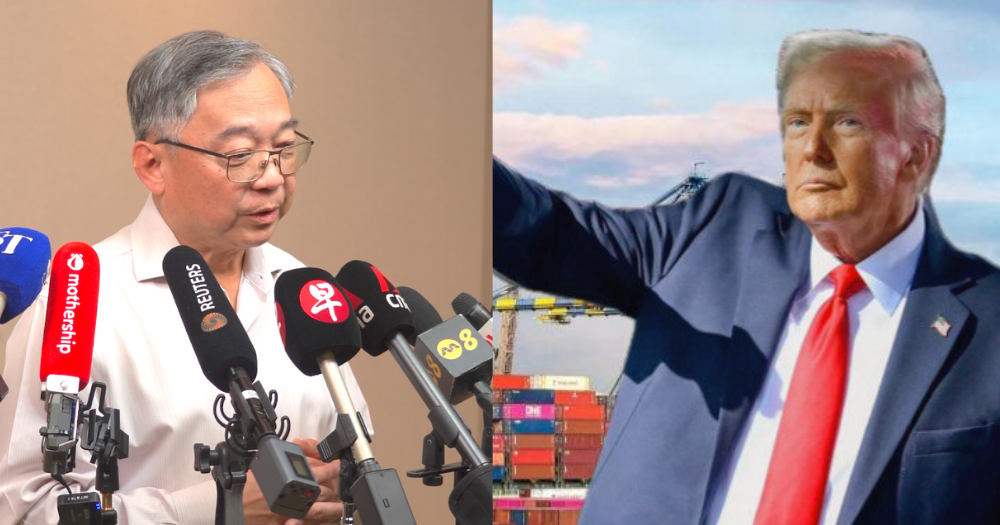


"I think our households and our businesses have to be prepared for rough waters ahead of us", Deputy Prime Minister (DPM) and Minister for Trade and Industry Gan Kim Yong said on Apr. 3, 2025.
DPM Gan was commenting on tariffs imposed by United States (U.S.) President Donald Trump on America's trading partners on Apr. 2, including Singapore.
Though one of only 11 countries to be spared from higher "reciprocal" tariffs, Singapore was still hit with a 10 percent "baseline" tariff.
This means a 10 percent tariff on the import of goods from Singapore to the U.S.
The U.S. enjoys a trade surplus with Singapore.
The tariffs, all the same, are likely to exacerbate fears of a global trade war, and unravel decades of trade liberalisation.
Superseding of free-trade agreement
Singapore and the U.S. have a free-trade agreement in place, intended to eliminate customs duties on imports from either country, but this has been superseded by the Trump tariffs.
DPM Gan said:
"We are naturally disappointed that, despite our economic and commercial relationship with the U.S., under the U.S.-Singapore free trade agreement, we are also subjected to the same 10 percent baseline tariff."
DPM Gan noted that although, under the agreement, Singapore is able to take counter measures and seek dispute resolution, the government will not be doing so.
"What we are going to do is to reach out and engage the US counterparts, and to better understand the concerns and to see how we can work together constructively to address some of these concerns, so that we can have a longstanding, long-lasting partnership," DPM Gan said.
Disruptions to international trade
While Singapore was spared higher tariffs from the U.S., disruptions to international trade could have negative knock-on effects.
Singapore is widely considered Asia's largest transshipment hub. Singapore's trade is also more than three times the size of its Gross Domestic Product (GDP).
Imports from about 60 partners that the White House deemed as the "worst offenders", including Canada, Mexico, and China faced higher rates.
China, for instance, has been slapped with an additional 34 percent tariff on top of their existing tariff rate of 20 percent, bringing their total tariff rate to 54 percent.
DPM Gan also highlighted the danger of escalatory retaliatory tariffs by other countries.
"You can see that some countries are already announcing retaliatory tariffs, and if these tit-for-tat tariff measures continue, it may escalate into a situation where you end up with a global trade war," he said.
DPM Gan noted that such a trade war would have a "significant impact on the global economy" and, by extension, Singapore:
"When you have tariffs on products, and you have retaliatory tariffs at some countries, tariffs will just add cost to the products, and overall, someone will have to pay for these additional tariffs. So I think goods and services will then become more expensive."
Government to provide additional help for businesses and households
The American Chamber of Commerce in Singapore conducted an online poll on Apr. 2 assessing the perceived impact of the tariffs on businesses here in Singapore.
Over 70 percent of companies surveyed believed that Trump's reciprocal tariffs will have a negative impact on their operations.
Nearly half of the survey respondents planned on passing on increased costs to their consumers.
Other strategies include diversifying supply chains to reduce dependence on high-tariff markets, and leveraging these disruptions to increase market share where competitors are slower to adapt.
DPM Gan said:
"I think going forward, I think there will be choppy waters, but we'll continue to monitor the situation, and we will extend additional help where necessary to support our businesses and households."
Deepening integration within ASEAN
Singapore was hit with the lowest tariff rate amongst members of the Association of Southeast Asian Nations (ASEAN).
Many other Southeast Asian countries saw quite a sizeable amount of so-called "reciprocal tariffs" levied against them.
Cambodia was hit with a 49 per cent tariff, Laos 48 per cent, Myanmar 44 per cent, Vietnam 46 per cent tariff, Thailand 36 per cent, Malaysia and Brunei both struck with 24 per cent, and The Philippines 17 per cent.
DPM Gan said: "We will be having a conversation with our fellow ministers to see what we can do, how we can come together to even further deepen our integration within ASEAN."
DPM Gan added:
"From Singapore's perspective, we will have to double down on our efforts to continue to keep our economy open, continue to uphold this open, fair and free trade among other countries."
Top photo from Mothership