News

WP's Jamus Lim pushes for smaller class sizes, DPM Heng cautions against '1-size-fits-all' solution
"On class sizes, MOE adopts a thoughtful, needs-based approach," DPM Heng said.
March 23, 2025, 05:50 PM


Could our class sizes be smaller, and would that benefit students?
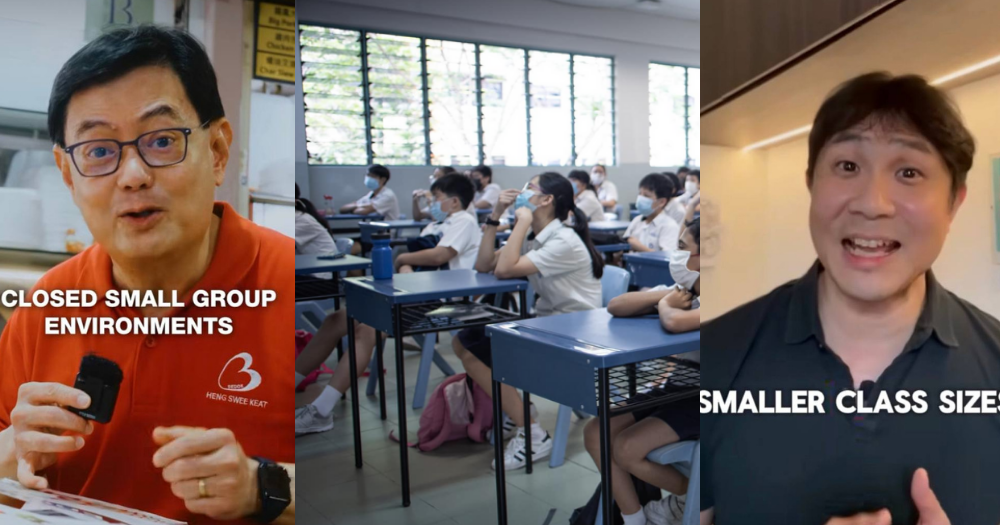
A video uploaded by Deputy Prime Minister (DPM) Heng Swee Keat, and a reply to it by Workers' Party (WP) Member of Parliament (MP) Jamus Lim, sparked a discussion online about whether schools should consider reducing the number of students in classrooms.
Both DPM Heng and Lim appeared to concur that closed, small-group environments benefit students.
Lim, in turn, argued that schools should consider smaller class sizes.
DPM Heng, however, contended that the existing student-to-teacher ratio in schools is "healthy", and that the Ministry of Education (MOE) already has a tailored approach to meeting students' needs.
How it began
DPM Heng posted a video to Instagram on Mar. 20, 2025, about a free weekly tuition programme held in Bedok.
In the video, DPM Heng explained that the tuition programme conducts lessons in closed small-group environments as students tend to perform better in such settings:
"In smaller focused groups students get the extra guidance they need, and gain the confidence to keep going.
But this isn't just about academics, it's about creating a space where every child feels supported, inspired, and excited to learn. When students have this foundation, they start believing in their potential."
Workers' Party MP Jamus Lim, in a video uploaded on Mar. 22, seized on Heng's statement about the benefits of small group environments for students to argue that class sizes in schools should be reduced:
"I couldn't agree more. In fact, this has been the consistent reason why the Workers' Party has for years advocated for smaller class sizes."
Smaller class sizes to reduce need for tuition
Lim, in his video reply to DPM Heng, argued that parents make up for "poorer learning outcomes" with tuition.
This would mean that students from parents and households that are less able to afford tuition "tend to be left behind".
In his caption to the video, Lim quoted a view expressed by his friend that, in Singapore, "we are rather capricious when it comes to learning modes".
"We go from a class size of 40 in the day (in school) to a class size of one in the evenings (during tuition)," Lim wrote.
According to Lim, smaller classroom sizes, together with assistive learning technologies could allow teachers to better provide for the "individualised learning needs" of students.
Lim said: "If you believe that we should ensure that our students, regardless of income or ability, get as much learning in the classroom as possible, then you will push for smaller class sizes."
A "healthy" Pupil-Teacher-Ratio
DPM Heng made another post on Mar. 22, responding to comments on his video about the tuition programme in Bedok.
In the caption to his post, he highlighted that Singapore has a "healthy Pupil-Teacher-Ratio (PTR)".
"On class sizes, MOE adopts a thoughtful, needs-based approach", he said.
DPM Heng then made reference to learning support programmes for primary school students, full subject-based banding in secondary schools, and smaller class sizes for primary one and primary two students as instances of this needs-based approach.
DPM Heng wrote:
"So, with the limited manpower resources in Singapore, instead of adopting a one-size-fits-all solution, we tailor class sizes strategically and according to our students’ needs, as part of our student-centric values-driven education.
At the same time, we focus on recruiting quality teachers who have the passion for teaching, and enriching our students outside of the classroom, such as through CCAs."
"I am glad for these discussions, for it is a sign that we care deeply for our students’ well-being and education outcomes," he added.
Do smaller classroom sizes actually help?
It is actually quite hard to conclude if smaller classroom sizes really benefit students.
Data collected by researchers on the topic tends to be unreliable, since they often depend on observations of students who are not randomly assigned to different classrooms.
In 1985, however, a four-year social experiment conducted in schools in Tennessee, U.S. at the kindergarten, first, second, and third grade levels appeared to demonstrate that "smaller classes did produce substantial improvement in early learning and cognitive studies".
This study was quoted in 2017 by then WP Non-Constituency Member of Parliament Leon Perera in Parliament, who then called for a "large randomised trial" to study the impact of having fewer students in classes.
Then Minister for Education Ng Chee Meng responded that class sizes are not indicative of the learning support and attention students receive.
Manpower issues
Then, there's the issue of manpower allocation. MOE has argued that smaller class sizes would have "significant trade-offs" for students.
Smaller class sizes could mean less time for teachers to get involved in co-curricular activities (CCAs), help students who need one-on-one teaching, prepare for lessons, or pursue professional development programmes.
What about hiring more teachers to make up for the manpower crunch?
MOE argued that this could mean pulling manpower from other key sectors, and that given Singapore's falling birth rate - with smaller cohorts entering the workforce each year - such an approach "would not be sustainable".
Singapore's standards
According to the 2024 Education Statistics Digest (ESD), the average form class size for primary and secondary schools is 34 and 33 respectively. The form class size for primary one and two is smaller, at up to 30 students.
Singapore’s Pupil-Teacher-Ratio (PTR) is at about 15 students per teacher at the primary level, and 12 students per teacher at the secondary level.
This more or less matches respective Organisation for Economic Co-operation and Development (OECD) averages.
Check out our video series with Education Minister Chan Chun Sing here
Part 1
Part 2
Top photo from Heng Swee Keat/Instagram, Jamus Lim/Instagram & Chan Chun Sing/Facebook.