News

Differing details of call between China's Wang Yi & US' Marco Rubio may reveal their govt's priorities
Longstanding U.S. position.
January 27, 2025, 04:06 PM


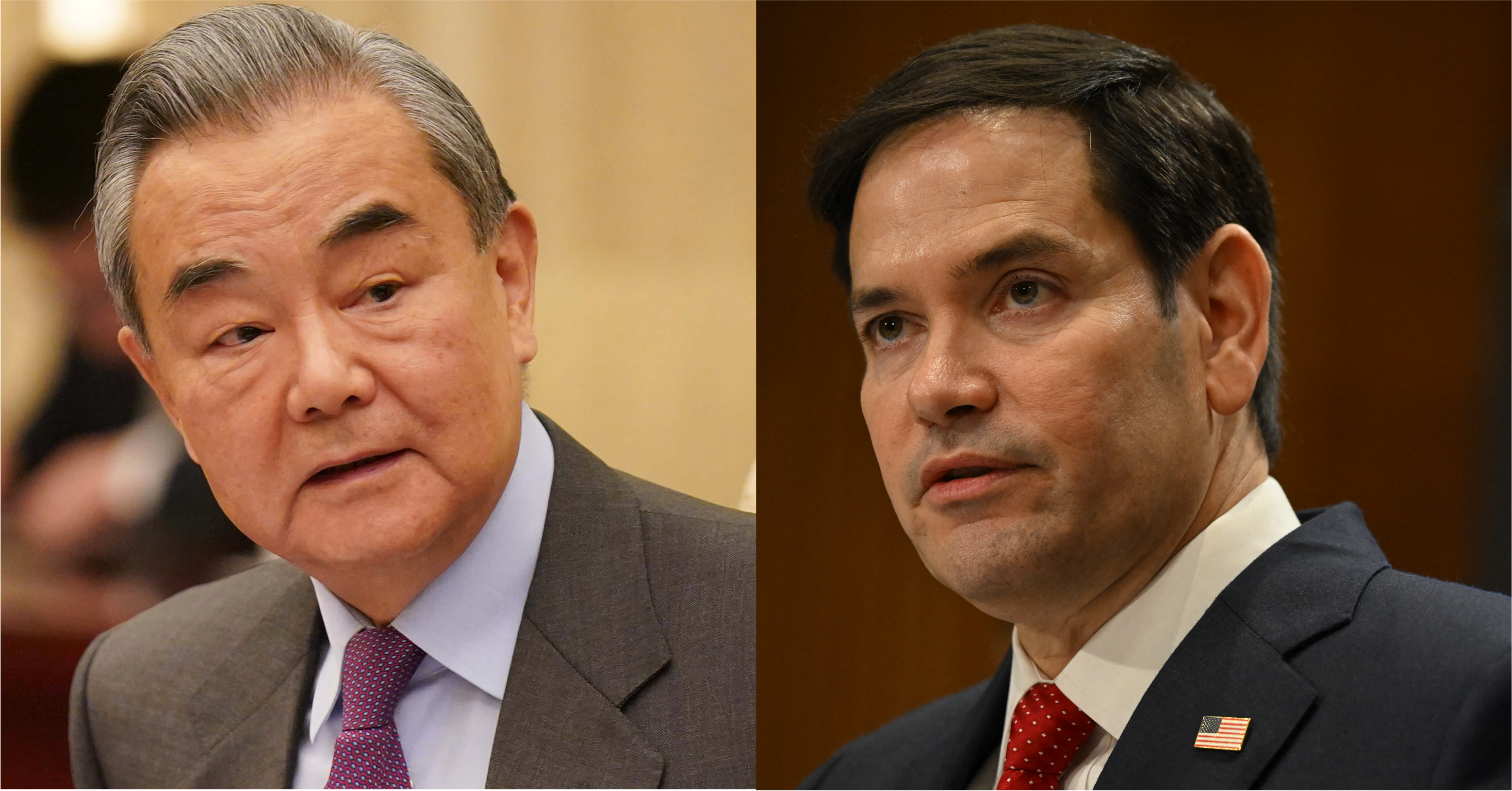
U.S. Secretary of State Marco Rubio and China's Foreign Minister Wang Yi held their first official call on Jan. 24, 2025.
However, reports of what was said in that call differ according to each country's official media statement, perhaps shedding light on the priorities of the respective governments in U.S.-China relations.
U.S. State Department readout
The State Department released a short statement of only four sentences from spokesperson Tammy Bruce. It can be read in its entirety below:
"Secretary of State Marco Rubio spoke today with China’s Director of the CCP Central Foreign Affairs Commission and Foreign Minister Wang Yi.
Secretary Rubio emphasised that the Trump Administration will pursue a U.S.-PRC relationship that advances U.S. interests and puts the American people first.
The Secretary also stressed the United States’ commitment to our allies in the region and serious concern over China’s coercive actions against Taiwan and in the South China Sea.
The Secretary also discussed other issues of bilateral, regional, and global importance with his Chinese counterpart."
The statement placed a clear order on the points discussed — President Donald Trump's slogan of "America First", U.S. commitment to allies in the region (i.e. Japan and South Korea), concern over "coercive actions" against Taiwan and in the South China Sea (where another U.S. ally, the Philippines, has disputes with China) and a general reference to other issues.
Trump's conciliatory Davos speech on China
The pugnacious tone of the statement stood in contrast to Trump's speech at the World Economic Forum in Davos, Switzerland, where he struck a somewhat conciliatory tone towards China.
In his Jan. 23 speech (U.S. time), Trump railed against the U.S.' trade deficit with China, but also spoke of his "very good" relationship with China's President Xi Jinping and said he looks forward to "getting along" with China.
Singapore's President Tharman Shanmugaratnam pointed out in his later appearance at Davos that Trump's speech suggested a desire for a "new understanding" with China.
While Rubio may be known as a "China hawk" in Washington circles, it is unclear whether Trump would run foreign policy out of the White House instead of allowing his Secretary to handle foreign affairs.
During his first term, Trump clashed with his first Secretary of State, Rex Tillerson, and has seemingly fallen out with his second, Mike Pompeo.
If so, Rubio's instincts may have to take a backseat to Trump's own inclinations.
China MOFA statement
Meanwhile, China's Ministry of Foreign Affairs released a statement that had quite a bit more detail than the U.S. State Department's.
After outlining what was said in a previous call between Trump and Xi, and emphasising "cooperation", "mutual respect" and "managing differences", the statement touched on Taiwan:
"The United States has made solemn commitments on abiding by the one-China policy in the three joint communiques, and it should not renege on them. [...]
Wang Yi elaborated on China's principled position on the Taiwan question and urged the U.S. side to handle it prudently. Wang emphasised that Taiwan has been part of China's territory since ancient times, and we will never allow Taiwan to be split from China."
U.S. does not support Taiwan independence: MOFA said of Rubio
It then lists what Rubio apparently said:
"Rubio said the United States and China are two great countries. The U.S.-China relationship is the most important bilateral relationship in the 21st century and will determine the future of the world.
The United States hopes to have candid communication with China, resolve differences, manage the bilateral relationship in a mature and prudent manner, and work together to address global challenges and maintain peace and stability in the world.
The United States does not support 'Taiwan independence' and hopes that the Taiwan question can be resolved peacefully in a manner acceptable to both sides of the Taiwan Strait."
The part about the U.S. not supporting Taiwan independence made headlines in Nikkei Asia and South China Morning Post, with the latter noting that this detail was not included in the State Department readout.
However, this would be consistent with longstanding U.S. foreign policy, as former President Joe Biden has also said the same thing.
It is the U.S.' long-held position to maintain "strategic ambiguity" over Taiwan, and oppose any unilateral changes to the status quo from either side.
Meanwhile, Taiwan's own Foreign Affairs Ministry welcomed Rubio's remarks on China's "coercive actions" against Taiwan and in the South China Sea.
The Taipei Times quoted the ministry as saying, "We solemnly emphasise again that our country and the People’s Republic of China are not subordinate to each other, and it has been an objective fact for a long time, as well as the status quo of the Taiwan Strait."
Top image via AFP.