



News


Woman taken to hospital after attacked by 'swarm of bees' while cycling in Jurong West
Sting.
November 17, 2026, 12:27 PM
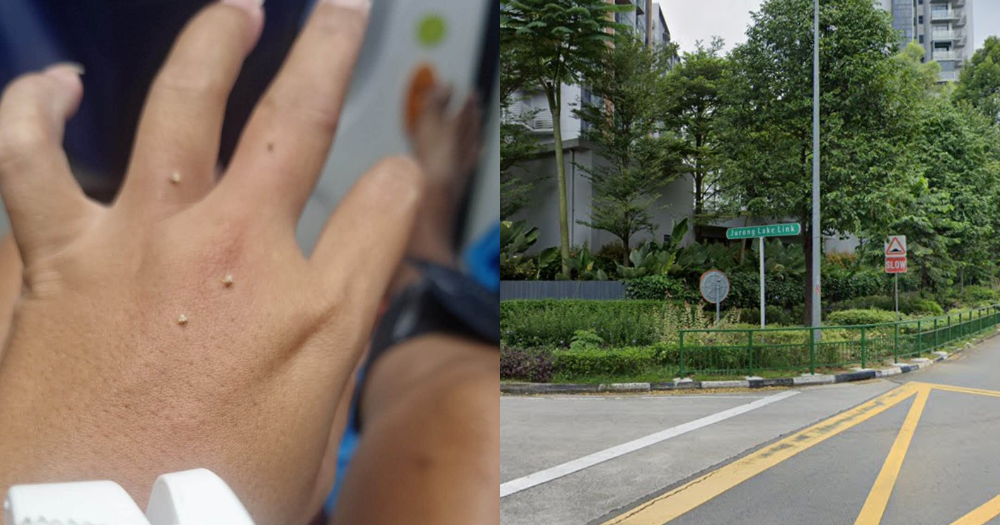
Photos from Complaint Singapore/Facebook and Google Street View.


A woman was taken to hospital after being stung repeatedly by bees while cycling in Jurong West on Nov. 15.
What happened
The incident came to public attention through a Facebook post by a man who identified himself as her fiancé.
According to him, the attack took place at the junction of Jurong West Street 41 and Jurong Lake Link.
He said his fiancée was "attacked by a swarm of bees" and stung repeatedly across her body.
"What began as an ordinary journey turned into a terrifying ordeal when she was chased by bees and repeatedly stung across her body," the man wrote.
In response to Mothership's queries, the Singapore Civil Defence Force said it received a call for assistance along Jurong Lake Link at around 11:20am on Nov. 15.
SCDF conveyed one person to Ng Teng Fong Hospital.
The man said his fiancée experienced vomiting and persistent diarrhoea after the incident, and doctors are monitoring her for possible complications from the extensive stings.
Security guards praised
In his post, the man also thanked security guards at Lake Grande, saying they did not turn his fiancée away when she sought help.
They allowed her to use a water hose to wash herself, called an ambulance and stayed with her until she received medical attention.
They also kept her e-bike keys safe, which he later collected.
"I want to publicly commend these security guards for their professionalism, humanity and willingness to help someone in distress," he wrote. "Their actions demonstrated what public safety, compassion and community responsibility should look like."
Beehive removed
Separately, the National Parks Board (NParks) said its contractors surveyed the area around Jurong West Street 41 after the incident and found a beehive about 20m up a tree.
The hive was later removed at about 1:30pm on Nov. 16.
Oh Cheow Sheng, NParks’ group director for streetscape, identified the bees as Malayan honey bees, which are often found in forests or densely planted parks but may stray into urban areas.
They forage actively after dusk and are often attracted to artificial light.
Their hives are a single large comb, usually under a sloping branch of a tall tree.
"Honey bees are social insects that form colonies. They will readily sting to protect their hive when threatened or disturbed," he said, adding that they are generally more docile when foraging among flowers away from the hive.
Beehives in public areas are typically removed by trained animal management operators to prevent stinging incidents, he said.
"If you encounter a beehive, do keep a distance and refrain from disturbing the hive," he said.
The public can call the 24-hour Animal Response Centre on 1800-476-1600 for wildlife-related issues.
More information on what to do during bee encounters is available at go.gov.sg/bees-and-wasps.