





Branded
S’porean stand-up comedian Rishi Budhrani, 42, shares close shave with scammer impersonating SPF
“They try to catch you at vulnerable moments,” said Rishi.
Photos courtesy of Rishi.
It started like any other day for Singaporean stand-up comedian Rishi Budhrani.
He was in the middle of a cardio workout on a treadmill when his phone rang.
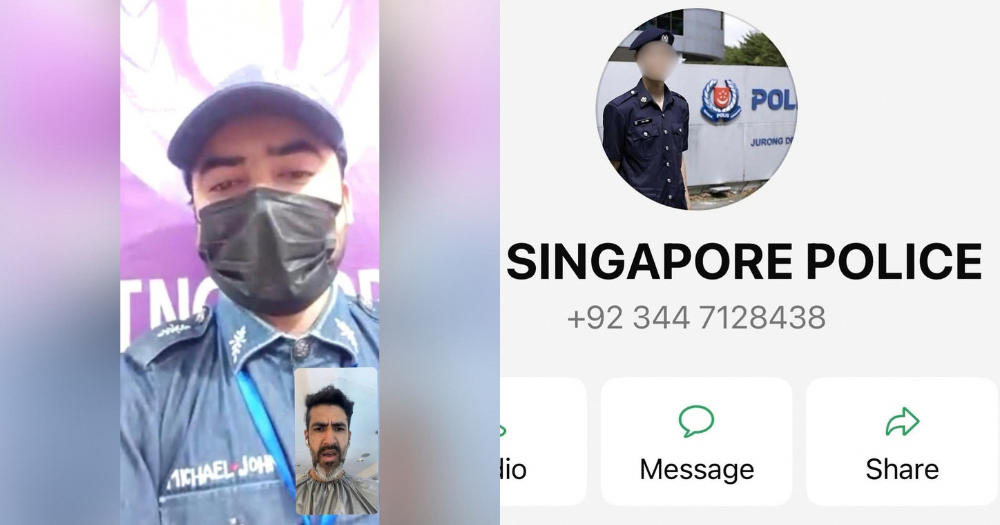
The call initially appeared to be from the Singapore Police Force (SPF), but there was one detail that immediately raised a red flag: the number began with +92, the country code for Pakistan.
The caller’s profile photo also showed a Chinese man in what appeared to be an SPF uniform, standing in front of what looked like a neighbourhood police station.
Rishi knew something was off, but he decided to answer the call anyway.
Person on the other end of the call asked to switch to a video call
Speaking to Mothership, Rishi said the incident took place sometime in 2024.
When he picked up, the man on the other end introduced himself as “Michael John” and claimed to be from SPF.
“Hello, this is Singapore Police. My name is Michael John. You know the Singapore police?” the man said.
Rishi then asked him what the problem was.
The caller told him there was an issue with his bank account and that there had been “many scams”.
“He told me ‘You need to go in now, there’s an issue with your bank account. You need to go in and give me your bank details’,” Rishi said, adding that the man spoke with a sense of urgency.
The man subsequently asked him to switch to a WhatsApp video call, and that was when the scam became even more obvious.
Person was wearing a fake police uniform and mask
On the video call, Rishi saw that the man was wearing what appeared to be a fake SPF uniform, with the name “Michael John” printed on it.
He was also wearing a cap and a mask, and appeared to be standing in front of a fake SPF banner.
Rishi added that the man spoke with a “very thick” accent and did not sound local.
The caller then demanded that Rishi provide information relating to his bank account, saying there was an issue with his account.
“Go into your account and give me the passcode,” Rishi recalled the man saying. “Send me your bank details. I will help you investigate the problem.”
At this point, Rishi was certain it was a scam and decided to play along.
He pretended that he did not know how to access his bank account, prompting the caller to start giving him instructions.
However, Rishi said that at that point, he was not actually paying attention to the instructions. Instead, he was trying to get a photograph of the man on the other end of the call.
“I thought it’d be an important warning sign if I shared it on my platforms and with my friends and family, especially those with elderly folks,” he said.
Rishi added that the scammer appeared increasingly frustrated.
“I think he was frustrated that I was not a good victim,” he quipped.
Tried to turn the tables on the scammer
Rishi said the scammer’s approach was typical of scams that rely on catching victims off guard at “vulnerable moments”.
This could take the form of text messages arriving in the middle of the night, or phone calls made with a strong sense of urgency, he added.
“If you don't take this step now, you stand to lose a significant amount of money. That's generally the ploy or the vibe that I was getting from this person.”
As such, he decided to try and turn the tables on the scammer instead and send him a link and phone number.
When the man asked what they were, Rishi said it was a link and a toll-free number for tickets to his upcoming comedy show, Can I Make You A Suit, Mate?, which was scheduled to be held at Wild Rice Theatre.
Eventually, the scammer gave up and hung up.
Rishi said he tried calling back a few times, but the man never picked up.
Warned his family members and the public
Despite being able to identify the scam, Rishi said the incident made him realise that given the right circumstances, the warning signs may not be immediately apparent to everyone – seniors in particular.
“Not all of them are able to quickly and fully adapt to technology, and sometimes they may be caught in a vulnerable moment,” he said, adding that factors such as living alone without support can make seniors easier targets in his opinion.
The first thing he did was call his parents and in-laws to warn them.
“I’m like, hey guys, just be careful of this. You never know,” he said.
“If they got my number, chances are they might get someone else’s in the circle. So just be cautious. Don’t give any information.”
Rishi said he was particularly concerned about whether older members of his family would be able to recognise similar scams.
“Fortunately, I managed to pick up on it,” he said.
“But who knows? We have this interview, we have this conversation, and then next year you read about me in the papers and I got scammed because I was complacent about it.”
He also took to Instagram to share his experience and warn his followers about the scam.
Slow down and check, ask questions to verify
More recently, some government officials impersonation scam (GOIS) calls have even adopted deepfake AI technology to appear more convincing.
Rishi said phone scams in the past were arguably easier to identify.
He pointed out that in his case, the caller’s overseas phone number, request to switch to a WhatsApp video call and share his bank account log-in details, and the overall “production value” of the scam raised questions.
“Bro, put in some effort (to your production),” he joked.
But ultimately, Rishi said the most important thing is not to panic.
“If someone receives a similar call tomorrow, I would say: breathe. Take a moment,” he said.
“Don’t rush into clicking anything or giving any information.”
While members of the public can ask the caller questions to determine if it is a scam, SPF advises people to hang up if they are unsure and check with an independent source like 1799 to verify the caller’s identity.
The SPF also suggests for members of the public to examine the caller’s request: are they asking you to transfer money, cryptocurrency, disclose your bank account, and/or crypto-wallet log-in details, or install mobile apps from unofficial app stores? Furthermore, is your call being directly transferred to the “Police”?
These are all warning signs one can look out for, as government officials will never do these things over a phone call.
The key, Rishi said, is to pause before doing anything. Hang up first to check.
If unsure, the public can also call the 24/7 ScamShield helpline at 1799 to check if it's a scam.
Moreover, since Nov. 2, outgoing phone calls from the SPF will now come from the single caller ID ‘6000 0999’.
This will be followed by an SMS from the ‘gov.sg’ SMS Sender ID informing the phone call recipient of how they may contact SPF for further assistance.
For Rishi, the incident was a reminder that even people who consider themselves alert to scams can still be targeted.
“I picked up on these signs, and to me, it didn’t seem right,” he said. “But I don’t know if the next person would (have done so).”
What to do if you encounter such a scam
According to the mid-year Scams and Cybercrime Brief 2026, Government Official Impersonation Scams (GOIS) are among the top five scam types in Singapore, with losses exceeding S$90.8 million in the first half of 2026 alone.
Such scams undermine public trust in government agencies and have become increasingly sophisticated with the use of social engineering and deception tactics by scammers to convince victims to transfer money, and even handover valuables to scammers in some cases.
Victims are often deceived into believing that their bank accounts have been compromised before being manipulated into purchasing valuables or transferring money as part of a fabricated investigation.
The SPF reminds members of the public that government officials will never ask you over a phone call to transfer money or cryptocurrency, disclose sensitive information such as bank account log-in details, install mobile applications from unofficial app stores, or transfer your call directly to the Police.
Scammers may also use personal information such as your name and NRIC number to appear legitimate.
However, having access to such information does not mean that the person on the other end is authentic.
ADD:
- Scamshield app and security features like anti-virus and MoneyLock to enhance the resilience of mobile devices and bank accounts against scams
CHECK:
- Slow down and take a moment to check if you are unsure if something is a scam
- Call and check with the 24/7 ScamShield Helpline at 1799
- You can also check suspicious numbers, text messages and weblinks with the ScamShield app
- If you receive a call from the Police, check that its from 6000 0999
- If you receive an SMS from the government, check that it was sent from the official gov.sg SMS Sender ID
TELL:
- Tell authorities and your loved ones about scams. Your sharing can help prevent others from being scammed
- If you think you have fallen victim to a scam, contact your bank immediately and make a police report.
The SPF strongly discourages members of the public from engaging or communicating with scammers, as doing so could expose them to manipulation and increase the risk of revealing sensitive information.
You can learn more here.
This branded article by the Singapore Police Force has made this writer a little more wary about phone calls from “government officials”.