



Parliament


'Little more than a tap on the wrist': WP's He Ting Ru on S$50,000 one-off fine related to haze information requests in THPA amendment
Environment minister Grace Fu later responded in her closing speech.
November 04, 2026, 08:38 PM
Top photo from MDDI/YouTube and Darth Yvonne/Instagram


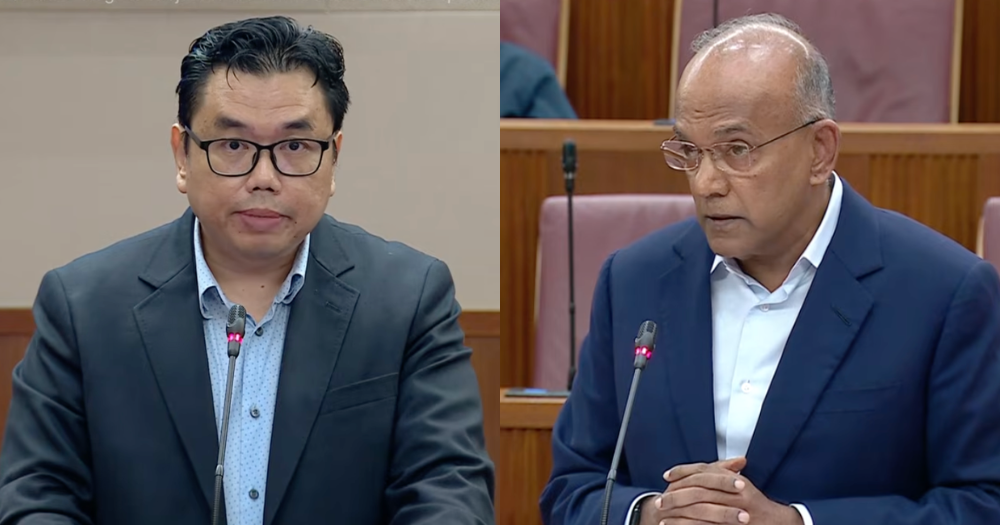
"A S$50,000 fine is little more than a tap on the wrist", said Workers' Party Member of Parliament (MP) for Sengkang, He Ting Ru, in parliament on Nov. 4 in regard to the proposed fine for individuals who fail to comply with requests for information on entities that cause or contribute to the haze.
He questioned whether the figure was "sufficiently punitive to send a clear signal of accountability to senior decision makers", proposing that the fine for individuals who intentionally suppress information should be increased to S$200,000 instead.
On Nov. 3, He had raised the motion "Strengthening Singapore’s Role in Regional Clean Air Amid Transboundary Haze".
He's comments came after the Minister for Sustainability and the Environment and Minister-in-charge of Trade Relations, Grace Fu, announced the Transboundary Haze Pollution (Amendment) Bill on Nov. 4.
'Tap on the wrist'
He probed the fine for an individual's failure to comply with requests for information.
He highlighted the different maximum penalties for individuals and entities, and pointed at the "jarring" gap between the fine figures.
"Under the newly proposed Section 5, entities face fines of up to S$1 million for every day of haze pollution, S$500,000 for every day they fail to comply with (the) preventive measures notice.
Yet a non-compliant individual faces a one-off fine of S$50,000."
He also questioned whether the S$50,000 penalty is scaled to the senior executives who make the decisions.
Citing the annual reports of several of the 10 companies linked to the haze-causing fires, He said these reports showed that the annual pay of the executives was "well in excess of a million dollars".
On traceability, He noted hearing "a lot about the difficulty of obtaining good data" and subsequently information on who is responsible.
He stated: "Amending our laws without strengthening our information gathering capabilities would make it significantly more difficult for our authorities to enforce them."
Singapore should make use of its Asean chairmanship in 2027 to strengthen information sharing efforts at the Asean level, she said.
She added that while the Asean Coordinating Centre for Transboundary Haze Pollution Control (ACCTHPC) was recently established in Indonesia, the centre not does not appear to have the legal muscle to carry out its duty.
There must be a more concerted effort to addressing such limitations, said He.
Part of a bigger problem
He also called for a “two-way street” in combatting transboundary haze, which she said takes place against the backdrop of the climate crisis.
The haze and its ill effects are just one instance of a wider pattern in modern supply chains, with harm “created up and downstream of the chain, and sometimes far away from where goods are ultimate consumed”, she said.
“The same fires that choke our skies also release greenhouse gases and destroy forests and peatlands. Haze, climate, and biodiversity are bound together.”
She urged for the new legislation to see the haze issue as a planetary health issue.
Tackling this problem effectively would require addressing harms across borders and industries to encourage compliance and mitigate harms, she added.
He cited Europe’s Convention on Long Range Transboundary Air Pollution as an example of successful cooperation and shared surveillance between neighbouring countries.
Particulate and sulphur emissions in Europe fell by 30 to 80 per cent in that case, she noted, but added that traceability and affecting change on the ground works best “when it supports the farmers who depend on it”.
Enforcement must be linked with financing support, shared data, and a mechanism for review, she emphasised.
Penalising financial institutions
He also called for financial institutions that finance haze-linked companies to be held accountable as indirect enablers.
Singapore's position as a major financial hub gives it leverage over companies responsible for the haze, she said.
For instance, Singapore's three major banks, OCBC, DBS and UOB, have sustainability-linked loan frameworks and made commitments to stop financing thermal coal projects.
These systems can be extended to verify whether an entity's fire risk is controlled, she said.
Acknowledging the Monetary Authority of Singapore's (MAS) recent call for banks to review their financing ties with haze-linked companies, she questioned whether it would already be too late "given that fires have been started and damage already done".
"Banks should report in aggregate how many haze-linked clients they reviewed and what is the follow-up action taken," said He.
She also posited that entire corporate groups, including contractors and subcontractors, should be scrutinised instead of individual projects or entities.
Grace Fu responds
Fu responded to He's comments in her closing speech on the Bill, stating that the penalties were pegged carefully to ensure proportionality and that policy objectives are met.
The S$50,000 fine penalty for individuals is intended to increase the deterrent effect of the Transboundary Haze Pollution Act, she reiterated.
It is also already several times higher than similar offences in other regulatory contexts.
"We should not focus on this particular offence alone," Fu said.
As the Act's section that this penalty falls under relates to an individual's general power to obtain information, including from third parties, it means that anyone could be liable to this offence, including those not related to the entities that conduct the burning.
"The culpability can be quite low," she explained.
Furthermore, offences that attract higher culpability have correspondingly higher penalties, such as that for directors and officers of companies that do not comply with assessors' directions.
These offenders could face penalties of up to S$20 million.
"The penalties framework in this Bill needs to be seen as a whole," she reiterated.