



Parliament


Almost 30% of eligible S'poreans collected free N95 masks, govt to continue prioritising vulnerable residents: Grace Fu
Update on the haze situation.
November 03, 2026, 03:38 PM
Image via Mothership

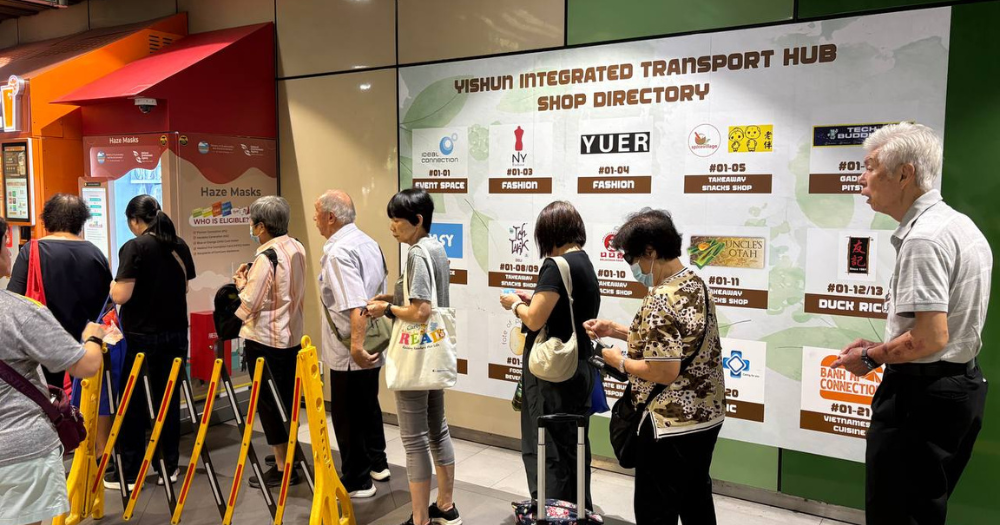
 As the haze situation in Singapore improves, almost 30 per cent of eligible Singaporeans have collected free N95 masks as part of the government's mask distribution exercise as of Oct. 29.
According to environment minister Grace Fu, nearly one-third of Singapore's population are now eligible to collect the masks after the eligibility age was lowered from 67 to 60 on Oct. 23, during the second round of distribution.
She was speaking in parliament on Nov. 3 in response to questions from Members of Parliament about Singapore's response to the haze crisis, including the take up rate of the free N95 masks.
Vulnerable individuals prioritised
In response to a question on whether her ministry will consider extending distribution to all residents if the haze persists, Fu said the government will continue prioritising Singaporeans who are more vulnerable to the health effects of the haze, or who may have limited means.
This includes senior citizens, pregnant woman, children, individuals with specific medical conditions, or holders of Chas orange and blue cards.
As haze does not involve the risk of people-to-people transmission, it does not require all Singaporeans to wear a mask.
The government will therefore consider the severity and predicted duration of the haze, prevailing health risks and the needs of vulnerable groups when deciding on the activation of mask distribution, said Fu.
She also expressed her gratitude towards those who have been involved in the distribution of masks, including People's Association's (PA) staff, grassroots volunteers, contractors and retailers.
No plans to change air quality readings
Fu also responded to queries on whether her ministry would consider including more granular air quality readings by increasing the number of PM2.5 forecasts.
The National Environment Agency's (NEA) current system of using daily forecasted 24-hour PSI readings and hourly PM2.5 readings have worked well, she said, pointing out that they can be used to plan for next-day outdoor activities.
She explained there is no need to include 12-hour, 24-hour, or 48-hour PM2.5 forecasts, as having too many indicators may "complicate our public messages".
"NEA will continue to review how its forecasting and public information services can be enhanced to provide more useful guidance."
Using climate vouchers
Lastly, Fu responded to concerns about ensuring good indoor air quality during periods of haze, particularly in centres serving vulnerable groups.
Indoor air quality is managed through standards, guidelines and advisories, as well as sector-specific measures implemented by premise owners, she said.
In spaces like schools, healthcare institutions and community care providers, response measures can include closing windows, deploying air purifiers and adjusting outdoor activities.
In larger air-conditioned buildings, the Singapore Standard's Code of Practice has recommendations for indoor air quality parameters and measures, including enhanced air filtration.
On that note, Fu highlighted that households can use climate vouchers to purchase eligible DC fans with air purifying functions.
These products can help improve air circulation and filtration, she said.