




Abroad


Skies are clearing, but S’pore & Indonesia’s work on the haze is only just beginning
Responsibilities and impacts in either country are not separated by a clear line.
October 29, 2026, 06:11 PM
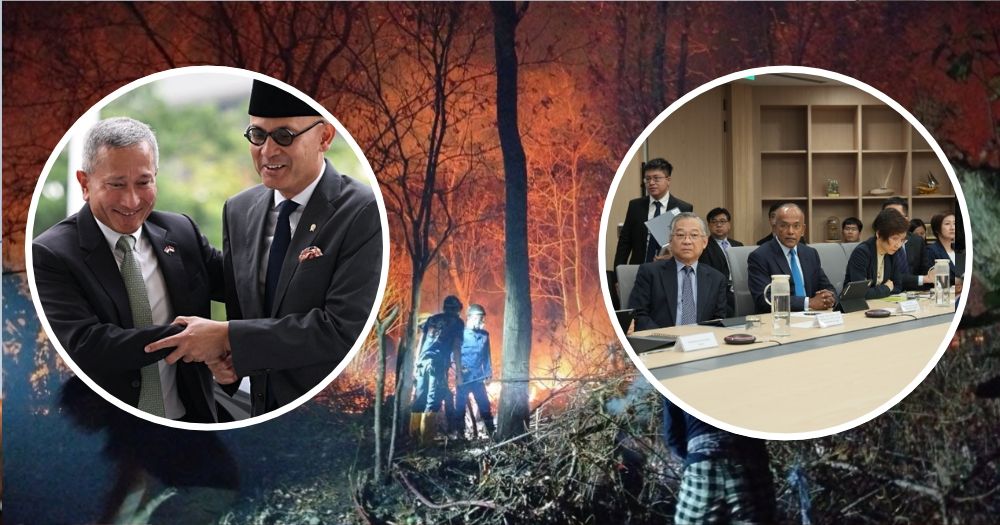
Image via Vivian Balakrishnan/Facebook, Mothership, & Badan Nasional Penanggulangan Bencana/Facebook


Videos showed monsoon-like rain falling throughout Kalimantan, greeted by thankful firefighters who fell to their knees, their efforts being backed up by the heavens.
There is a narrative that the haze is caused by forces of nature, such as a supercharged El Niño, and in that narrative, perhaps it is apt that it is the monsoon that finally calms the fires.
But it is really just one leg of a two-legged debate about the haze and how to prevent it.
Two conferences
Around the same time, videos of the rains in Kalimantan were going viral in Singapore, another video was going viral in Singapore.
Meanwhile, Singapore's ministers - Senior Minister K Shanmugam, Deputy Prime Minister Gan Kim Yong, and Minister for Sustainability and the Environment Grace Fu - were sitting in a room with the executives of 10 Singapore-based companies that were served legal notices over the haze.
Shanmugam, Chairman of the Homefront Crisis Ministerial Committee, told them that they were there because the situation was serious and that the government wanted to be clear about its position and what it expected from them.
Just a day earlier Singapore's foreign minister, Vivian Balakrishnan, was in Jakarta meeting with his Indonesian counterpart Arrmanatha Nasir.
At their joint press conference, both men emphasised what many in the haze-affected countries of Indonesia, Malaysia, and Singapore all knew to be true.
In order to tackle the haze, one had to contend with natural elements, but also with man-made ones.
And ultimately, the answer lay in cooperation between and across countries; it was not something that any one nation could currently deal with alone.
El Niño
It is perhaps a bit stark that the 2026 haze season was one of the most serious yet most forewarned we've seen in a while.
As early as May, there were warnings that the region would be affected by a 'Godzilla' El Niño, as reported by The Straits Times.
In June 2026, the Singapore Institute of International Affairs issued a red warning that there was a high risk of severe transboundary haze.
The report warned of natural causes exacerbating conditions, such as the previously mentioned El Niño conditions, causing a stronger and more prolonged dry season.
But it also warned of rising demand for agricultural commodities and biofuels, increasing land use pressures.
In what will likely go down as an oracular vision, the SIIA cautioned that price shocks for fertiliser and fuel due to the Iran war and Strait of Hormuz disruptions may increase incentives for unsustainable land clearing among some producers.
This highlighted both man-made methods and motivations for behaviour that at least increases the risk of, if not outright causes, forest fires.
In a hot spot
The Asean Specialised Meteorological Centre hotspot tracker shows that in August, hotspots spiked to nearly 13,000 in Kalimantan alone.
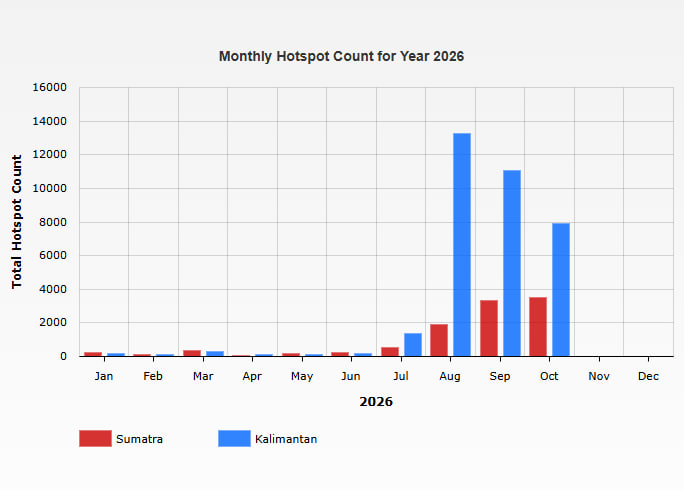 Image via Asean Specialised Meteorological Centre
This was in contrast to the 1,300 the month before and the 189 the month before that.
For context, between January and June, the monthly numbers of hotspots were all below 300 in Kalimantan.
Known problem areas like Sumatra also saw significant hotspot activity ramp up in July and August.
So when the haze began to really worry Singaporeans in September and then reached significantly unhealthy levels in October, the fires had essentially been burning for two months already.
And it should be noted that the fires burn every year.
Certainly more intensely in 2026 than in previous years, but they are never entirely absent.
Man-made fires
There might be some truth in the critique (or complaint) that Singapore and Malaysia only pay attention to the forest fires when the haze comes about, at least where the public is concerned.
Whereas the population of Kalimantan and Sumatra, and, to some extent, Sabah and Sarawak, has to live with the consequences of the fires every year.
But addressing the causes of fires in a different country is not a simple matter.
There is simply no way to point at man-made forest fires without implying that someone is doing something wrong, or at least not doing something correctly.
And to say such a thing without apportioning blame is a very difficult and delicate diplomatic task.
The SIIA also noted that Indonesia had attempted to address this issue by strengthening its institutional response to forest and land fires.
It had established a new inter-agency forest and land fire coordination desk and was continuing efforts to improve monitoring, enforcement, and community firefighting capabilities.
And again, this was before June 2026, so it can hardly be said that Indonesia did not attempt to address the issue before it really got started.
Investigative actions
But by that same measure, one cannot expect countries like Singapore and Malaysia not to seek to address the problem with the powers that they have within their grasp.
Not to lean too far into stereotypes, but Singapore has a reputation for being legalistic, and so it's not surprising that taking legal action was the primary response on the part of the Singaporean government.
Investigations have to run their course, but the first step is making sure the investigated parties disclose the critical information that is needed to determine whether or not they committed any wrongdoing.
Most of the companies so far mentioned by the Singapore government have denied that they are directly responsible for the forest fires.
Several suggested that fires occurring on their concessions or concessions belonging to their subsidiaries were caused by external sources; fires started outside that spread into areas under their control.
If the companies' accounts hold up, investigations help them too, by affirming to the public, both in Singapore and Indonesia, that the companies have complied with their civic obligations.
Even in this best-case scenario, investigations are complicated because there is no clear line where their Indonesian obligations end and their Singaporean obligations start.
Trust in the air
Conducting these investigations doesn't just require rigour; it also requires trust.
Obviously, trust between the public and the government that wrongdoers will eventually be found and adequately punished.
But also trust between governments that one side is not seeking to turn the other into a convenient scapegoat.
As Indonesia's foreign minister Arrmanatha said: “No border should shield those who profit from burning our (Indonesia's) forests.”
Long-term symbolism
This week has been a bit of a blessing, as the skies have been relatively clear, although not entirely.
There is symbolism in ministers meeting company heads, while foreign ministers meet to announce a joint task force under clear skies.
It’s a reminder that even as the haze clears, and even when the fires aren't affecting us in Singapore right away, we must continue to pursue accountability.
When the PSI drops and the N95 masks go back into the drawer, the urgency that made the eight executives sit across the table from three ministers can fade just as quickly as the smoke.
SM Shanmugam alluded to this when he told the companies that it cannot be business as usual, even after the haze is over.
The question is whether the rest of us will hold to that too.
It's not currently known what the timeframes will be for the assessment process presented to the 10 firms, or for the joint task force, but by their nature, they will likely take time to reach even a preliminary finding.
The amendments to the Transboundary Haze Pollution Act, due in Parliament in November, may be the last time the issue gets sustained attention before then.
It is possible that we will be called upon to focus our attention again on this in half a year’s time, when this year’s haze season, hopefully, will be a faint memory.
But accountability does not happen on the same schedule as the weather.
If we only care about the haze when we can smell it, errant companies responsible will have learned that all they need to do is wait for the rain.