



Abroad


S'pore & Germany unveil new Joint Work Plan for next stage of relations
Singapore and Germany's enjoy warm ties in areas such as trade and defence relations.
October 27, 2026, 06:13 PM
Image via MDDI/YouTube


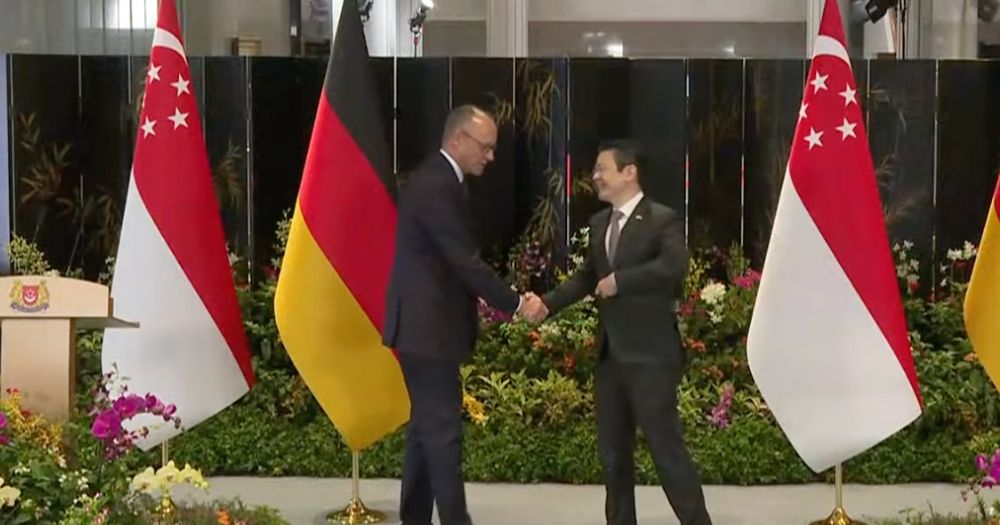
On Oct. 27, German Federal Chancellor Friedrich Merz made an official visit to Singapore’s Parliament House, where he met with Prime Minister Lawrence Wong.
This is Merz’s first visit to Singapore. The Chancellor of Germany is the head of government and equivalent to Singapore's prime minister.
While at Parliament House, Merz and PM Wong held a joint press conference, where they paid tribute to the strong ties between the two countries.
During the visit, PM Wong and Merz over saw the issuing of a refreshed Joint Declaration on Strategic Partnership between the two countries.
It also saw the release of the Joint Work Plan for 2027 and 2028, following on from the 2025 to 2026 Joint Work Plan.
The Joint Work Plan would guide Singapore-German cooperation across five pillars, namely:
- Political, Defence, Security and Intelligence
- Trade, Investment, Transport, and Urban Development
- Digitalisation and Artificial Intelligence
- Research, Science, Technology, and Innovation
- Energy Transition, Green Economy and Climate.
Warm welcome
PM Wong said that Singapore and Germany enjoyed a long-standing and substantive partnership built on mutual trust and shared interest.
Germany was an important partner in Singapore's development, and over the decades, the relationship had grown from strength to strength. Current cooperation spans many areas, underpinned by the Strategic Partnership which was agreed upon in 2024.
Germany is one of Singapore's largest trading partners in the European Union, with bilateral trade in goods and services having increased significantly since 2019, when the EU-Singapore Free Trade Agreement entered into force.
PM Wong also lauded the strong defence ties between the two countries, giving examples such as Singapore's Leopard tanks and Invincible-class submarines, and the first Sentinel-class offshore patrol vessel, all of which were built in Germany.
PM Wong said that Singapore also deeply appreciated Germany's long-standing support of the SAF’s armour training in Oberlausitz and submarine crew training in Kiel.
Future cooperation
PM Wong highlighted four areas where both countries could do more under Singapore's strategic partnership with Germany, elaborating on four areas covered by the 2027/2028 Joint Work Plan.
Digital economy and AI
The first area was the digital economy and artificial intelligence, where PM Wong said that there was enormous potential for digital technologies and AI to transform both economies and create new opportunities for businesses and workers.
Both countries wanted to go further, particularly in the development and deployment of industrial AI, where PM Wong believed the strengths of both countries could complement each other.
But he also recognised that AI brought new risks and challenges, and it was important to ensure that AI deployment is done in a way that remains “safe, trusted, and human-centred.”
Research and innovation
PM Wong recognised the strong German academic and research presence in Singapore, saying that they had brought researchers and institutions closer together, creating valuable opportunities for collaboration.
2026 also saw the launch of the Singapore-Germany Year of Innovation, and both countries intended to build on this momentum and pursue more joint research and innovation projects in areas such as AI, advanced manufacturing, green technology, semiconductors, quantum, and space technologies.
Strengthening regional cooperation
Both countries are deeply connected to the global economy, depending on open markets and strong international partnerships.
However, PM Wong warned that the world was becoming more fragmented, with the "zeitgeist" turning against openness and trade.
He said that the correct response could not be to turn inwards, but instead should be to work with like-minded partners to build new connections.
He welcomed Germany becoming an Asean sectoral dialogue partner in July and said that, as Asean chair next year, Singapore would work to deepen Asean's partnerships with both Germany and the EU.
Both PM Wong and Merz also discussed strengthening linkages between the EU and the Comprehensive and Progressive Agreement for Trans-Pacific Partnership (CPTPP).
These efforts would help strengthen integration within and across regions, allowing for the diversification of economic links and building greater resilience against global uncertainties.
International rules-based order
For the final point, PM Wong said that both Singapore and Germany were natural partners in upholding the international rules-based order.
PM Wong said that Singapore would continue to work closely with Germany and other like-minded partners to uphold international law and the UN Charter, and strengthen multilateral institutions, including the WTO.
He said that he acknowledged the international order was far from perfect, but the answer was to reform and strengthen it rather than abandon it.
Questions and answers
During the Question and Answer portion of the press conference, PM Wong was asked what opportunities Singaporean businesses would see from the partnership, to which PM Wong said Singapore and Germany brought complementary strengths to the table.
He gave the example of Germany being a world leader in industrial capabilities and engineering, and Singapore's investments in digital technologies and AI.
If the strengths of both countries were combined, it was possible to make progress in areas like industrial AI, particularly in areas such as robotics and automated solutions in manufacturing and logistics.
Opportunities for Singapore in AI application
PM Wong elaborated more in a second question, when he was asked what role middle powers had in AI and whether they would be able to compete with AI superpowers like China and the U.S.
PM Wong acknowledged that much of AI's frontier development or model building was taking place in the U.S. and China, but Singapore's focus was more on the application of AI.
He believed that in that arena, Singapore had some advantages to offer, such as being small, compact, and highly connected as a society.
Singapore also had the rule of law and clear protection for intellectual property, and saw a lot of opportunities in sectors like healthcare, logistics, finance, and advanced manufacturing.
In these areas PM Wong said it was possible to truly “push the frontiers in terms of the deployment of actual AI solutions, and that is a space where we are investing in.”
These were the areas where Singapore was making progress and was keen to work further with Germany.
Shared views
Merz for his part said that he completely shared PM Wong's view, suggesting that Singapore, like Germany, had an important industrial sector, leading to a shared perspective, especially regarding the application of AI.
He also emphasised the regulatory framework in Europe, which he said allowed the development of AI applications to proceed very quickly.
Merz said that if these projects were undertaken together, then the combined influence would be significantly greater.
In response to a question about closer ties between the EU and Asean, PM Wong said that as Singapore would be Asean Chair next year, it will find a meaningful way to mark the 50th anniversary of the EU-Asean partnership in 2027.
PM Wong also shared that steps are being taken towards an EU-Asean Free Trade Agreement.
While it will be complex and challenging, one could take confidence in the fact that individual Asean countries have been discussing their own trade agreements with the EU.