



News


S'pore will continue to be staunch ICJ supporter, international law fundamental to survival: Edwin Tong
In April 2026, the International Court of Justice marked 80 years since its inauguration.
October 31, 2026, 10:39 AM
Image from Minlaw and Edwin Tong/FB


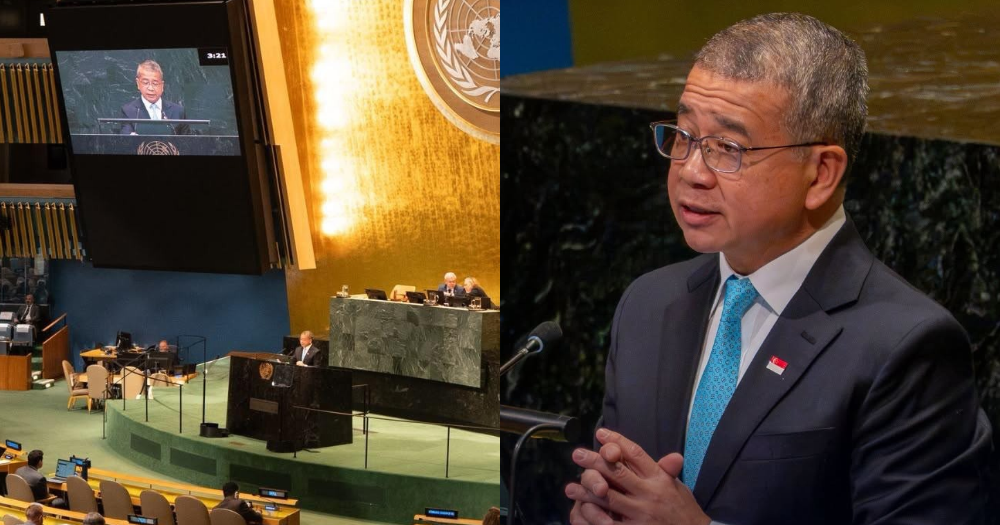
"Singapore will continue to be a staunch supporter of the court, whose work is fundamental to the international legal order," Singapore's Law Minister Edwin Tong reiterated at the UN General Assembly debate on the annual report of the International Court of Justice (ICJ) on Oct. 29.
This is part of Tong's official visit to New York from Oct. 28 to Nov. 4 for International Law Week and the ICJ elections.
The ICJ is the UN's principal judicial organ.
All states sovereign equals
In an increasingly contested world, upholding international law and the UN Charter is critical to ensuring that might does not make right, especially for small states, he said.
Tong noted that the UN membership had grown from 51 to 193 countries since 1946.
As such, the ICJ, which is well-suited to settle disputes between states from all regions and on a wide range of topics they choose to submit to the court, more fully embodies its identity as the "World Court", he added.
Tong said: "All states, big or small, old or young, are treated as sovereign equals before the court."
International law
In that regard, the court must reflect the contemporary membership of the UN, he added.
"Its judges must be eminently qualified and collectively represent the world's principal legal traditions," he said. "The court's task is to interpret and apply international law in a principled and impartial manner."
Tong noted, however, that "the law does not operate in a vacuum".
"Such diversity in the judges' legal traditions, backgrounds, and perspectives sharpens judicial reasoning and strengthens the legitimacy of the court's decisions."
Survival
Tong pointed out that for small states, governance by international law is not a matter of choice, but one of survival.
He reiterated that an effective and strong multilateral rules-based international order is an imperative for all states.
He said: "I call on all member states to support this crucial institution that serves as the bedrock of the international rule of law and is fundamental to the peaceful settlement of disputes."
UN Security Council High-Level Open Debate
On the same day, Tong also delivered a statement on behalf of the Oceans Four – Fiji, Jamaica, Malta and Singapore – at the UN Security Council High-Level Open Debate.
He said: "For small maritime nations, safety and security in the oceans and seas is critical. Our countries actively contributed to the negotiations and conclusion of the United Nations Convention on the Law of the Sea (UNCLOS).
"We remain committed to upholding it as the legal framework within which all activities in the oceans and seas must be carried out."
Emerging technologies carry promise, challenges
Noting that emerging technologies such as Artificial Intelligence (AI) and autonomous ships carry both great promise and challenges for maritime security, Tong emphasised a few points.
Firstly, he said innovation, safety, and security should advance hand-in-hand.
"The international community must work together to harness new technologies to strengthen maritime safety and security, whilst at the same time upholding and respecting navigational rights and freedoms in accordance with UNCLOS," he said.
Tong added that while AI can enhance maritime domain awareness by improving navigational, communications, and early warning systems for all states, these benefits must be underpinned by robust safeguards promoting accountability, transparency, and human oversight.
"We therefore welcome the adoption of the IMO's non-mandatory Maritime Autonomous Surface Ships (MASS) Code and support continued efforts towards the development of a mandatory framework, ensuring the safe integration of autonomous and remotely operated commercial ships into global shipping," he said.
He added: "We also support broader international efforts to advance responsible AI governance, including through the Global Dialogue on AI Governance and Global Digital Compact."
Weaponisation of new technologies
The second point Tong made was the importance of collectively guarding against the weaponisation of new technologies.
They can be deployed to disrupt or damage critical underwater infrastructure, including subsea cable networks, he said.
Tong added: "Drones or autonomous vessels can be used to interfere with the safe passage of ships."
"Recent attacks against civilian vessels have further highlighted the risks to maritime safety and the protection of seafarers."
He warned that cyber-attacks pose real-world consequences for maritime security, compromising navigational safety and disrupting port operations.
Such technologies could also be exploited to take control of vessels for unlawful purposes.
Thirdly, Tong said the international community must guard against all actions that threaten international peace and security, and reject unlawful restrictions on transit passage through straits used for international navigation.
He said actions that deny, hamper, impede, impair or suspend the right of transit passage would violate UNCLOS, and that the right is also firmly entrenched in customary international law, which binds all states whether or not they are parties to UNCLOS, in times of peace and war.
“When transit passage is disrupted, consequences reverberate across the global economy,” he said.
Sustain rule of law
On Nov. 3, Tong will also be attending the 2026 elections for ICJ Judges at the UN.
Singapore has nominated Ambassador for International Law Rena Lee for election as an ICJ Judge for the 2027 to 2036 term.
Her candidature reflects Singapore's commitment to contributing to the court's work in the peaceful settlement of disputes between states, the Ministry of Law said.
It added that beyond his engagements at the UN, Tong will meet various counterparts at the UN to discuss international developments and strengthen legal cooperation.
He will also meet U.S. law firms and Singapore lawyers based in New York to deepen professional ties and explore opportunities for collaboration with Singapore's legal sector.
"Singapore advocates for an international order where sovereignty is respected, trade can flow and disputes can be resolved peacefully," Tong said.
He said: "We must all play our part to sustain the rule of law, strengthen its application, and contribute to the institutions that uphold international law."