



Abroad


Who are the Houthis, why are they striking Saudi Arabia & how the Mecca Pact might come into play, explained
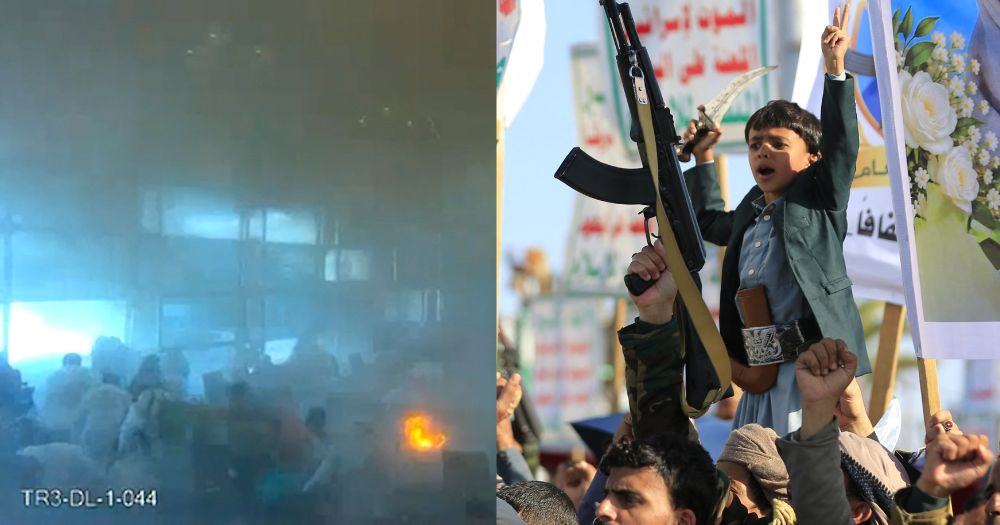
At least 13 people were killed over the weekend by Houthi missile attacks on Ridyadh airport.
October 13, 2026, 12:57 PM
Image via AFP


Saudi Arabia’s King Khalid International Airport in Ridyadh was recently struck in a series of missile attacks, with the Yemeni Houthi militia claiming responsibility.
CNN reports at least 20 deaths and hundreds of injuries.
Saudi Arabia finds itself facing military challenges along two critical waterways.
In the east, the U.S. war with Iran has restricted the Strait of Hormuz, while in the south, recent advances by the Houthi militia have threatened to similarly restrict access through the critical Bab al-Mandeb, which connects the Indian Ocean to the Red Sea and the Suez Canal.
This has a significant knock-on impact on the world, as the transport of energy supplies faces further difficulties.
Who are the Houthis?
The Houthis is the colloquial name of a group of fighters from northern Yemen, also known as Ansar Allah, according to a report written by the Council on Foreign Relations.
They have been fighting a rebellion against Yemen's government since around 2004, and in 2014, they took control of Yemen's capital, Sana'a.
They have continued fighting against government forces, slowly but successfully taking more and more land from government-controlled areas.
At present, they control at least one-third of Yemen's territory, roughly concentrated in the northwest of the country, along its Red Sea coast and the Wall Street Journal estimates they have around 350,000 fighters.
That region is the most densely populated part of the country, resulting in the Houthis governing over two-thirds of Yemen's roughly 34 million population.
How is it connected to Iran?
The Houthis and Iran are both Shia Muslims, but of different branches, and distinct from the Sunni Saudi Arabia.
The alliance between Iran and the Houthis appears to be geopolitically and ideologically related, although the Houthis have occasionally been called proxies of Iran; the Council on Foreign Relations says they are more accurately described as an 'informal partner'.
The CFR notes that, in contrast to other Iranian proxies such as Hezbollah, the Houthis' origin does not involve Iran, and they have, on occasion, taken action independently of Iran.
However, geopolitically speaking, the Houthis and Iran are very closely aligned and are hostile not just to the internationally recognised government of Yemen, but also to the United States and Israel.
Iran is known to have provided the Houthis with a significant amount of weaponry, including ballistic missiles, cruise missiles, and modern drones such as the Shahed, as reported by the WSJ.
The Houthis have, in turn, used those weapons against their neighbours, such as Saudi Arabia.
In earlier conflicts, they used them to attack Saudi oil facilities, such as refineries and storage.
In more recent years, it has also used these weapons to attack shipping passing through the Bab al-Mandeb Strait.
The war with Saudi
While the Houthis' most notable international opponent is Israel, its longest cross-border conflict is with Saudi Arabia.
When the Houthis began to rebel against Yemen's government, allegedly with Iranian backing, the Saudi government was concerned that it would soon face hostile powers at two of its most critical waterways: Iran and the Strait of Hormuz in its east, and a Houthi-controlled Bab al-Mandeb in the south.
The Strait of Hormuz is a critical waterway for the Middle East Gulf states to ship out their supplies of oil and gas.
But in recent years, concerns about Iranian hostility and potential disruption of that strait have led to Saudi Arabia building a pipeline from east to west, allowing it to send out shipments of oil and gas from the Red Sea: either north through the Suez Canal to Europe or south through the Bab al-Mandeb into the Indian Ocean and Asia.
In 2015, concerned about a potential Houthi control of the Bab al-Mandeb, Saudi Arabia began a military campaign to fight the Houthis, largely consisting of airstrikes.
The military campaign was of limited efficacy and ultimately failed to meaningfully disrupt Saudi Arabia's concerns about Houthi control of Yemen.
But it was also a very violent campaign, resulting in a large number of civilian deaths that sparked a multi-year protest campaign against the Yemen war in the West, and Yemen, with many activist groups demanding that the United States stop supplying Saudi Arabia with weaponry.
While this protest campaign failed to change the minds of U.S. President Donald Trump's first administration, after Joe Biden won the presidency in 2020, one of his first actions was to pause U.S. weapons sales to Saudi Arabia, effectively ending its military campaign.
Strait talking
However, after the Hamas attacks of Oct. 7, 2023, the Houthis showed that the Saudi concerns about their ability to restrict shipping through the Bab al-Mandeb were real.
In retaliation for Israeli attacks against Hamas and Gaza, the Houthis said that they would attack selected ships passing through the Bab al-Mandeb, particularly those aligned with Israel and its ally, the U.S.
This led many ships to avoid the Bab al-Mandeb entirely and therefore also avoid the Suez Canal, and instead choose to add weeks to their travel time by circumnavigating the continent of Africa, adding a significant amount of shipping cost to goods carried by those ships.
In the past few months, this situation has, if anything, worsened.
In recent months, the Houthis have managed to take a significant amount of territory from the Yemeni government, including more of the country's Red Sea coast and the island of Perim, also known as Mayyun, which sits at the heart of the Bab al-Mandeb.
This allows the Houthis even more control over the Strait, effectively controlling its narrowest point.
The Bab al-Mandeb is about 29 km wide at its narrowest point, compared with roughly 16–19 km for the Singapore Strait.
The Mecca Pact
The most recent attacks over the weekend targeted an international airport in Riyadh, but perhaps the more significant attacks are the alleged attacks on the holy city of Mecca, which the Houthis deny.
After a recent September attack, Saudi Arabia said attacking Mecca was a “red line” according to CNN, and unlike previous accusations from 2019 and before, the Saudis had an additional resource: the Mecca Pact.
The Mecca Pact, otherwise known as the Mecca Defence Alliance, was first signed in August 2026 between Saudi Arabia, Turkey, and Pakistan, and was invoked barely two months later in October, in response to the alleged targeting of Mecca.
Al Jazeera reports that the pact is a mutual defence agreement, that an attack on one is an attack on all, and that the two other parties to the pact have agreed to a limited deployment of troops and military forces to Saudi Arabia, in keeping with the agreement.
This means that an additional two countries are being drawn into an ever-expanding military scenario in the Middle East, with no clear sign as to when that engagement will, if it even can, end.