News


Ho Ching on Air India investment: Running airline business never easy, no free lunch
Temasek has shown support for SIA's investment in Air India.
September 03, 2026, 07:16 PM
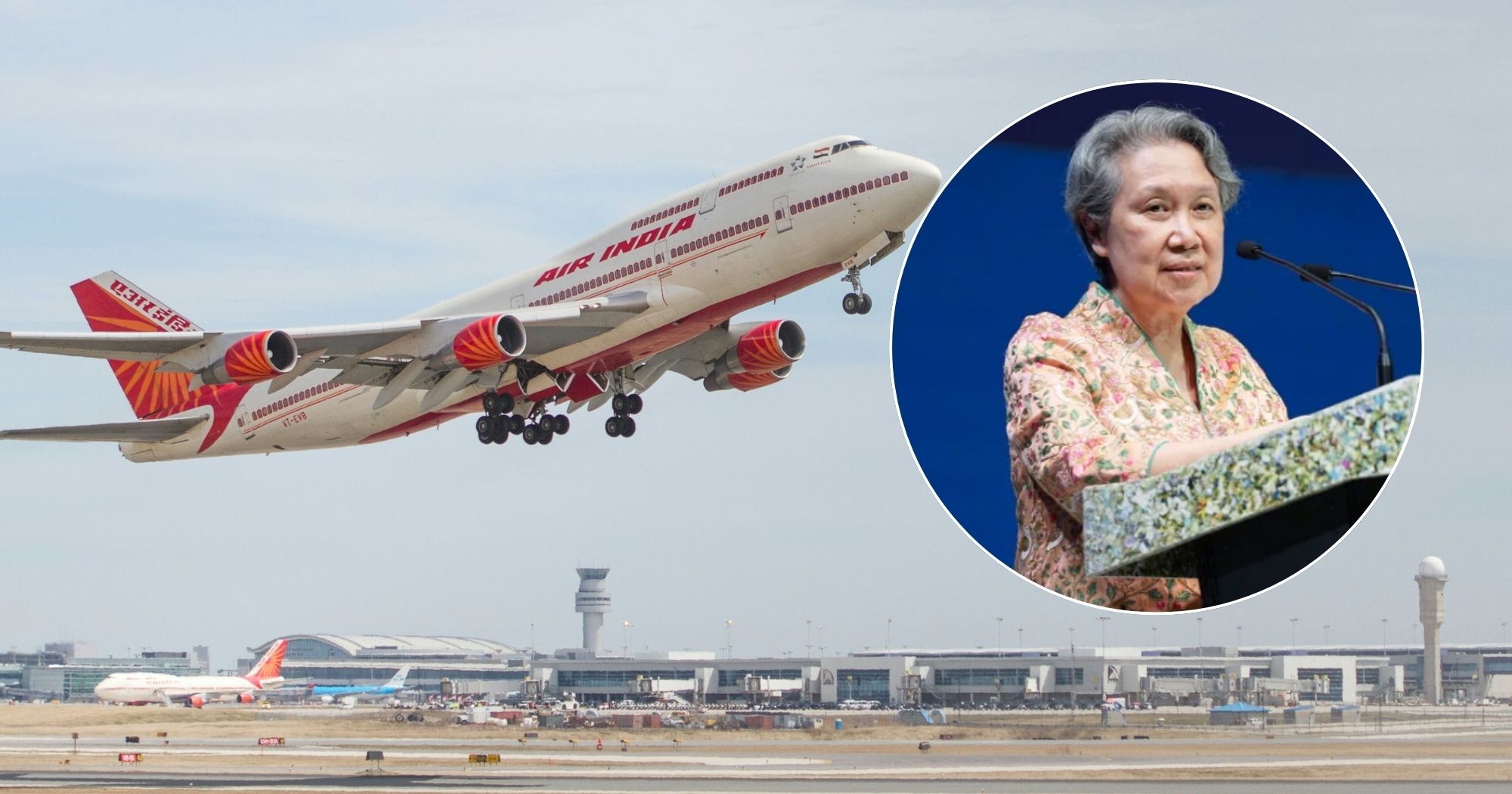
Photo from John McArthur/Unsplash and Temasek


Running an airline is never an easy business as it is heavily regulated and not purely market-driven, chairman of Temasek Trust Ho Ching wrote on social media on Sep. 2.
She took to her Facebook account to comment on Singapore Airlines (SIA) and Air India ties in the wake of reports that Air India registered a record loss of more than US$2 billion (S$2.5 billion), which weighed down on SIA's profits.
Singapore's national carrier posted nearly S$1 billion in losses less than two years after it acquired a 25.1 per cent stake in Air India.
Temasek, the majority shareholder of SIA, has in turn stated on Aug. 29 its support for the long-term strategy of Singapore's national carrier, particularly where its Air India investment is concerned.
How SIA acquired stake in Air India
In 2013, SIA and Tata Sons entered a joint venture agreement and established Tata SIA Airlines Limited.
They operated under Vistara, a full-service airline known for its newer facilities and higher quality.
SIA, as a foreign entity in India, took the maximum allowed 49 per cent stake.
Tata held 51 per cent.
Vistara commenced flight operations as a premium, full-service carrier in January 2015.
In January 2022, Tata Sons completed its acquisition of the state-owned Air India from the Indian government.
Tata effectively owned Air India and Vistara — two separate full-service airlines.
In November 2022, SIA and Tata agreed to merge Vistara into Air India to avoid duplication.
SIA, with its 49 per cent stake in Vistara, was guaranteed a 25.1 per cent stake in the enlarged Air India Group by also committing an initial cash investment of S$360 million.
The India government officially cleared Singapore Airlines' foreign direct investment into the consolidated Air India group in August 2024.
Vistara merged into Air India in November 2024.
Airlines, like banks, need to compete with foreign entities
Ho, weighing in on the matter, wrote that businesses must be able to compete without expecting government intervention to give it a boost.
She gave the example of how Singapore banks must compete domestically and overseas, sometimes even at the encouragement of the Singapore government opening up the playing field to foreign entities and inadvertently exposing local businesses to market forces.
She added:
But unlike most other national airlines, SIA is clear minded and clear headed.
There are no handouts from Singov - and SIA must established its own position and strengths to weather the challenges of the airline industry.
No free lunch
This is in stark contrast to other governments that would "put obstacles in the path of foreign airlines while protecting its own, sometimes with endless subsidies", Ho also wrote.
The Singapore government's approach to SIA would then appear counterintuitive, but it is to promote competitiveness.
She acknowledged that the government has sometimes even “gone out of its way” to encourage foreign airlines to establish hubs in Singapore.
Singapore, she noted, is one of the few countries where the national carrier does not account for 70 to 80 per cent of the domestic market.
She wrote that local airlines, like banks, must "constantly innovate and offer better products and services" to maintain or grow their market share in Singapore.
It must do so in the face of the competition offered by international operators.
"No free lunch," she concluded.
Privatise or nationalise Air India?
In her post, Ho also outlined Air India's history and its origins as Tata Air Services in 1932, saying it had established itself as a "premium service airline" long before SIA came into existence.
Her recounting of Air India's history provided a casual observation of the India government's intervention in its aviation industry and its own commercial airline business, as it vacillated between privatising and nationalising the carrier.
This was to highlight how far SIA has come to catch up and surpass Air India over the years by competing globally on its merits as a commercial entity.
Air India subsequently held SIA up as the standard to meet, Ho noted.
Becoming Air India
Air India lost its focus when too many stakeholders tried to navigate its path.
Tracing its roots, Ho noted Tata Air had transitioned into Air India and became a public limited company in 1948, and the India government subsequently became a majority stakeholder in the airline, which occurred in 1953, "to give it more financial heft to develop its international network".
Air India was eventually forced to merge with other India-registered airlines due to the country's laws at the time.
Ho said "constant disagreements" between then-chairman JRD Tata, an Indian industrialist and aviation pioneer, and his government shareholders soon led to his departure as chairman of his "beloved" Air India.
"And Air India service standards and financial stability went downhill since," she wrote.
Teacher emulating student
Attempts by JRD's successor, Ratan Tata, to recover the airline to its former glory failed, Ho noted.
There was a tinge of irony in this.
She explained that when SIA had split from Malaysia-Singapore Airlines (previously known as Malaya-Singapore Airlines), Air India was the "gold standard" that it would try to emulate and surpass.
Ratan, who was "eager and ambitious" for the Tata group to recover Air India, most wanted SIA as his partner, she said, describing SIA as "the student who had turned in an excellent set of results and surpassed its former role model".
Using another airline as a benchmark is not unheard of.
Many airlines "in the Middle East, Africa, Latin America and China would later try to emulate and surpass SIA during their formative or reform years", Ho observed.
Questions raised
Questions have been raised about the purpose and the viability of SIA’s continued investment in Air India, notably by Workers Party Member of Parliament (MP) Kenneth Tiong, who wrote a social media post on the subject on Aug. 26.
In it, he said that he would be asking a question in parliament on the subject, and that he would oppose any use of Temasek’s funds to “prop up” Air India, and that if SIA wanted to continue with Air India, it should do so “on its own two feet”.
Long-term strategy
In its statement on Aug. 29, Temasek said it views SIA's business decision on Air India from a long-term perspective and is supportive of it.
"We recognise that the large-scale transformation of Air India involves complex, multi-year operational and integration challenges," joint head of portfolio development Juliet Teo wrote.
She added that efforts of this scale take time and are not expected to be linear, particularly in the aviation sector, where outcomes are shaped by industry developments.