News


Woman loses suit against Prudential after S$100,000 brain aneurysm surgery claim denied, says she plans to appeal
Following the judgment, Cai said she will "most likely" appeal, and intends to seek help from the legal community.
September 04, 2026, 01:48 PM
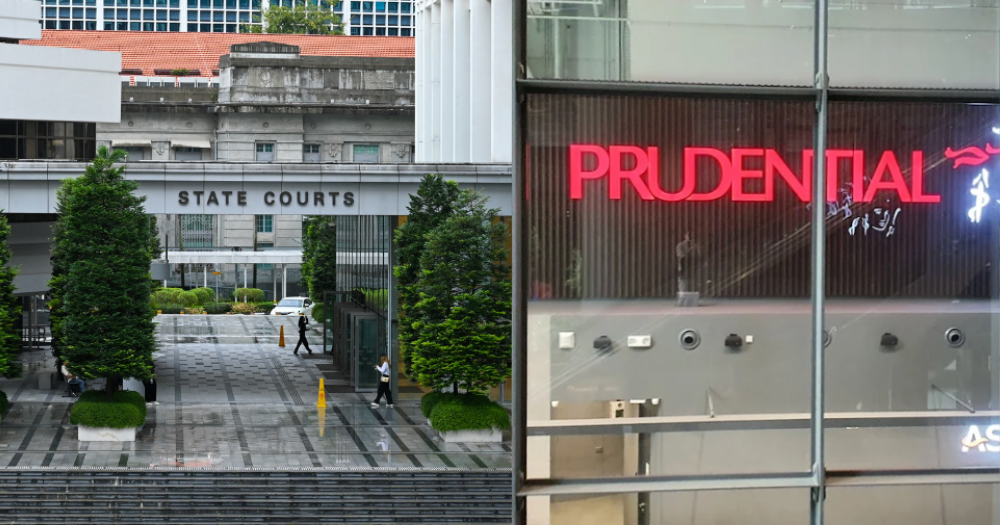
Photo from AFP and Prudential/Google Maps
A woman who sued Prudential after she had her S$100,000 brain surgery claim denied has lost her suit.
District Judge Teo Guan Kee ruled that it was unfair to say that Prudential had "buried" its clause regarding exclusions to brain aneurysm surgery.
In response to Mothership's queries, the woman, Cai Yanhong, said she plans to appeal the verdict.
The stroke
In 2023, Cai suffered a stroke from a ruptured brain aneurysm.
She collapsed on the bus and was conveyed to the National University Hospital (NUH) by ambulance, where she underwent an emergency operation performed by the head of neurosurgery.
The surgery was an endovascular repair, a minimally-invasive procedure. Cai subsequently recovered.
But when she tried to make a claim under her early critical illness policy from Prudential — the Prulife Multiplier, which she purchased in 2016 — her claim was denied.
This is because according to the policy contract, endovascular repair is not covered by insurance.
Brain aneurysm surgery is only covered if it is done in the form of a surgical craniotomy, an open-skull procedure.
The suit
In March this year, Cai commenced her lawsuit for the full claim amount of S$108,500, plus waiver of premiums, against the insurer.
The woman, who was self-represented, argued that she was not given a choice of what surgery would be performed, being "unconscious, in the ICU, fighting for [her] life".
She also pointed out that the surgery Prudential covered was riskier, more invasive, and had higher mortality rates than the minimally-invasive one.
Furthermore, Cai argued that the exclusions to the medical conditions, apart from exclusions for pre-existing conditions, were not explained to her during the sales process.
While she did see the policy summary, as a layperson then without the condition, she "would not understand the terminology" of the exclusion, she said.
In its defence, Prudential countered that the contract had "made it very clear" that the surgery Cai underwent was not covered in the policy.
An email sent to Cai about the policy at the time of purchase set out the definitions of critical illnesses that would entitle her to payment.
This included the definition of brain aneurysm surgery, which was defined only as surgical craniotomy, and not endovascular repair.
Said a lawyer for the insurer:
"In essence, Ms Cai’s case is that the terms of the contract between the parties ought to somehow be what she likes them to be, as opposed to what had been expressly agreed in writing between the parties.
This position is without any legal or factual basis whatsoever."
The judgment
In a written judgment published Sep. 3, the judge dismissed Cai's claim.
To Cai's argument that she was not fairly informed of the terms of the policy, particularly the exclusion of endovascular repair, the judge said he was unable to accept this.
He also disagreed that there was any "secret or hidden redefining of the term 'brain aneurysm surgery'".
Cai had been provided with a copy of the product summary, and she also initialled it, acknowledging receipt of all pages of the product summary, the judge said.
Through this, she confirmed that the contents of the summary "had been explained to her satisfaction".
Upon receipt of the policy documents, Cai had also been told that she had a 14-day period to review the documents and ask for the policy to be cancelled, if she was dissatisfied with it.
But Cai did not cancel the policy.
"The effect of [Cai's] argument is that policyholders should not be bound by a term of their insurance policy, if they independently form a belief that it is not necessary for them to read all the provisions of their policy," he said.
"I am not aware of any authority which supports such a principle."
The response
Following the judgment, Cai said she will "most likely" appeal, and intends to seek help from the legal community.
"I know my way around contracts, but I do lack professional medical knowledge. If I can't make out the exclusions, most people outside the medical profession probably won't," she said.
"It doesn't matter how closely you look at the contracts. You don't know what you don't know."
In response to Mothership's comments, a Prudential spokesperson said that they are thankful for the favourable conclusion of the case.
"Ms Cai’s claim was assessed in accordance with the policy she purchased 10 years ago, and it was determined that the surgical procedure she underwent was not covered under the terms of that policy... The court has affirmed that the claim was assessed in line with the policy contract," the spokesperson said.
They added that they will look into waiving any court-ordered costs payable to Prudential "as a gesture of goodwill".
The spokesperson also said that the case underscores the importance of greater awareness of critical illness insurance.
Prudential will continue to strengthen its financial literacy efforts to help the public make more informed financial decisions, they said.