Abroad

Trump's own appointed Fed Chair raised interest rates despite Trump's objections, what next?
Warsh's up?
September 18, 2026, 10:49 AM
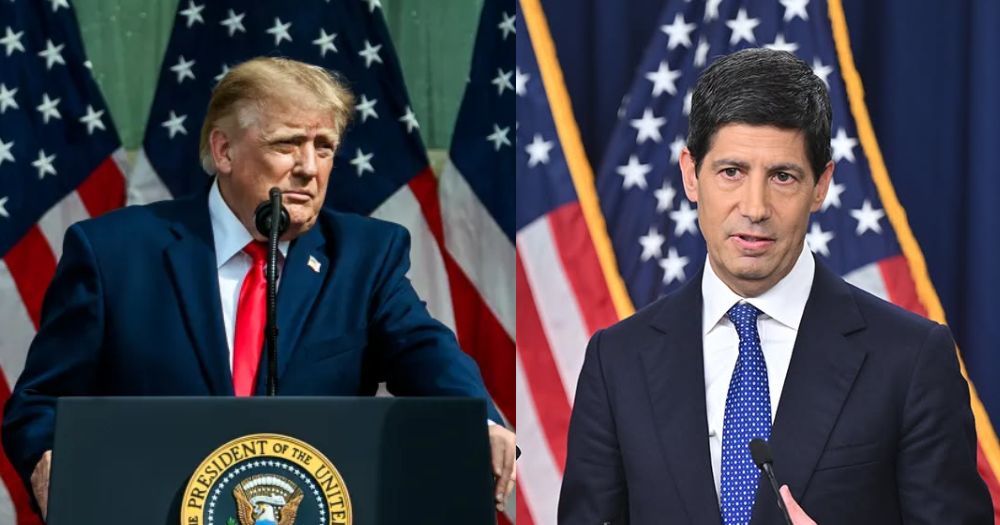
Image via White House Gallery & Board of Governors of the Federal Reserve System/Facebook

 On Sep. 16, the United States Federal Reserve voted unanimously to raise its benchmark interest rate by 0.25 per cent.
The decision comes against the wishes of U.S. President Donald Trump, who criticised the move and demanded on social media that the interest rates be lowered “and fast”.
The conflict between Donald Trump and the Chair of the Federal Reserve would be unsurprising if it were a year ago.
But the current chair, Kevin Warsh, is Trump's own nominee from earlier this year.
What does the rate increase mean? How was it decided upon, and what is the political background behind Walsh's decision?
Raising rates
In a statement released by the Federal Open Market Committee, the 12-member group that effectively decides what interest rates are set at, the primary reason for the increase was in order to support a “timely return” to the committee's 2 per cent inflation goal.
Interest rates are considered a critical indicator of how U.S. economic performance, and hence the health of the global economy.
This could be seen in how the U.S. stock market reacted immediately to the news, falling initially, before recovering as trades assessed the news, as the Wall Street Journal reported.
Higher interest rates, make borrowing more expensive, benefiting lenders and making things more expensive for people and businesses borrowing money.
CNBC reported that the Fed also signaled that it was not yet done, and that it was likely to raise rates one more time before the end of the year, where as the WSJ suggested that traders had been expecting two more raises, hence the recovery was an indication of relief.
The BBC quoted Fed Chair Kevin Warsh as saying that inflation had been too high for too long and that raising rates was a “sober” and “responsible” decision.
The U.S. Bureau of Labour Statistics puts the current inflation rate at 3.4 per cent, and it has not been below the 2 per cent target since 2021.
Fighting inflation, but also growth
Higher interest rates mean that the cost of major items of household spending will go up, such as mortgage rates for home buyers.
U.S. consumers are increasingly using debt to purchase items such as vehicles or even home goods, and increasing interest rates will make such spending more expensive.
But at the same time, years of high inflation have exacerbated a cost-of-living crisis in the U.S., and the present moment is a timely reminder of why the Fed, and other central banks like it, are given so much power to rein it in.
However, just as crucial is the impact higher interest rates will have on business.
Higher interest rates make it more expensive for businesses to borrow money, effectively slowing economic growth as companies find it harder to expand and customers find it harder to make purchases.
How did Trump react?
Trump was apoplectic.
He took to Truth Social to declare that interest rates should be 1 per cent or less, and that the US had the best credit in the world.
Resorting to all caps, he demanded: “LOWER THE INTEREST RATES FOR THE UNITED STATES OF AMERICA, AND FAST!”
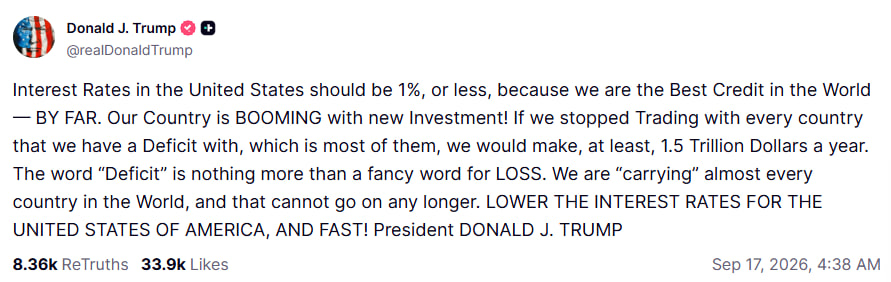 Image via Truth Social
But when he spoke to the press later, he absolved Warsh from blame, saying that the 12-member board he was part of was “very hostile” and “very political”, and that Warsh “might as well vote with the board, because it's not going to matter.”
Is this chair taken?
Warsh is Trump’s own pick for Fed chair, after feuding for the entirety of 2025 with Jerome Powell, Warsh’s predecessor.
Powell, also pursuing lower inflation, resisted Trump’s urging to either lower interest rates or quit his position early in order to enable Trump to nominate a Fed chair who would.
But the Fed Chair is not the only person who determines interest rates.
That is done by the FOMC, made up of Warsh as the chair, but also the board of governors of the Federal Reserve System, and the heads of the various regional reserve banks.
Powell, as the former chair, remains on the board, also against the wishes of Trump.
There are a few moments of irony regarding the ongoing bad blood between Trump and Powell: Trump famously threatened to fire Powell earlier in 2026, an action he’s not allowed to take.
One irony is that Powell spent most of the first year of Trump’s second term not raising interest rates, unlike Warsh, who has raised them within six months of taking office.
The other irony is that Trump literally only has himself to blame for Powell’s appointment; he nominated him in 2017 during his first term.
A hawk in dove's clothing
Although the BBC suggested that some had feared Warsh would simply rubber-stamp Trump’s demands in his role, it was noted at the time of his nomination that Warsh was a “relatively safe choice”, a former financier with central bank experience.
The Guardian, at the time of Warsh's nomination, quoted an expert as saying that Warsh was "one of the better outcomes".
Warsh was also known for having strong views on monetary policy, even being classified as a "hawk", someone more willing to use interest rates to fight inflation, although the closer he got to being appointed, the less he emphasised those views, as reported by Morningstar magazine.
When asked by the press about what message the move had for the president, Warsh simply chuckled and said: “I’ve got nothing for you on a discussion with the president.”