News


MS Explains: S'pore political officeholders are getting a pay raise. How much exactly?
Lots of math.
September 09, 2026, 08:46 PM
Photos via Canva, MDDI/YouTube.


After a 15-year freeze, the salaries of Singapore's political officeholders will be adjusted after the government accepted the recommendations of an independent review committee.
The benchmark salary of a minister at entry-level grade MR4 will increase from S$1.1 million to S$1.8 million.
The news caught international media attention, and all sorts of numbers have been thrown out — S$1 million increase, 64 per cent rise.
But how much are Singapore's political officeholders actually getting paid now?
Why raise salaries?
Before anything, the context.
Prime Minister Lawrence Wong emphasised the reason for the increase: good government depends on good leadership, and good leadership requires good talent.
There are many impediments when it comes to convincing individuals to switch to political life. A pay cut might not be the main reason — but it's still an opportunity cost that should not be ignored.
In his speech, PM Wong mentioned potential pipelines of talent for public office. Such an individual might be a senior civil servant, or the CEO of a major listed company in Singapore (or on track to be one).
"At those levels, remuneration can run into several million dollars a year — well even above the revised MR4 benchmark," PM Wong said.
The government is not, and will not, try to match that. But adjusted salaries could help make sure that the financial hurdle is not "unnecessarily high".
So, what's the pay package?
To understand a minister's salary, we first have to understand how their pay structures work.
In short, the pay is based on a few key components: the framework, the ratios, the salary range, and the pay composition.
The framework
First, the framework.
It was established by the 2012 review committee, which was also when salaries were last adjusted. In fact, at the time, salary benchmarks were cut.
The salary point of an entry-level grade MR4 minister takes reference from the median income of the top 1,000 Singapore citizen earners.
This was chosen as the 2012 committee found that these earners represented the calibre of individuals needed in government.
A 40 per cent discount was then applied to this median figure to reflect the spirit of public service.
40 per cent is more art than science. As the 2012 committee wrote, "There is no scientific method for striking a balance between paying competitive salaries and taking a discount to signify the political service ethos. It is a judgment call."
So, the 2026 committee found that the median income of the top 1,000 was S$3.1 million. After applying the 40 per cent discount, you get around S$1.8 million.
So that S$1.8 million is now the benchmark salary for an entry-level grade minister.
The ratios
Now, the MR4 salary — that S$1.8 million figure — is important. Remember it, because it's the reference point for the salaries of all other political appointment holders.
How, you may ask. Well, all other salaries of political appointment holders, from the PM to the Deputy PM and President, are calculated based on ratios, pegged to the MR4.
For example, the PM's ratio compared to MR4 is two. This means the PM will earn twice the MR4 minister benchmark salary.
Here's the full table of ratios following the 2026 review.
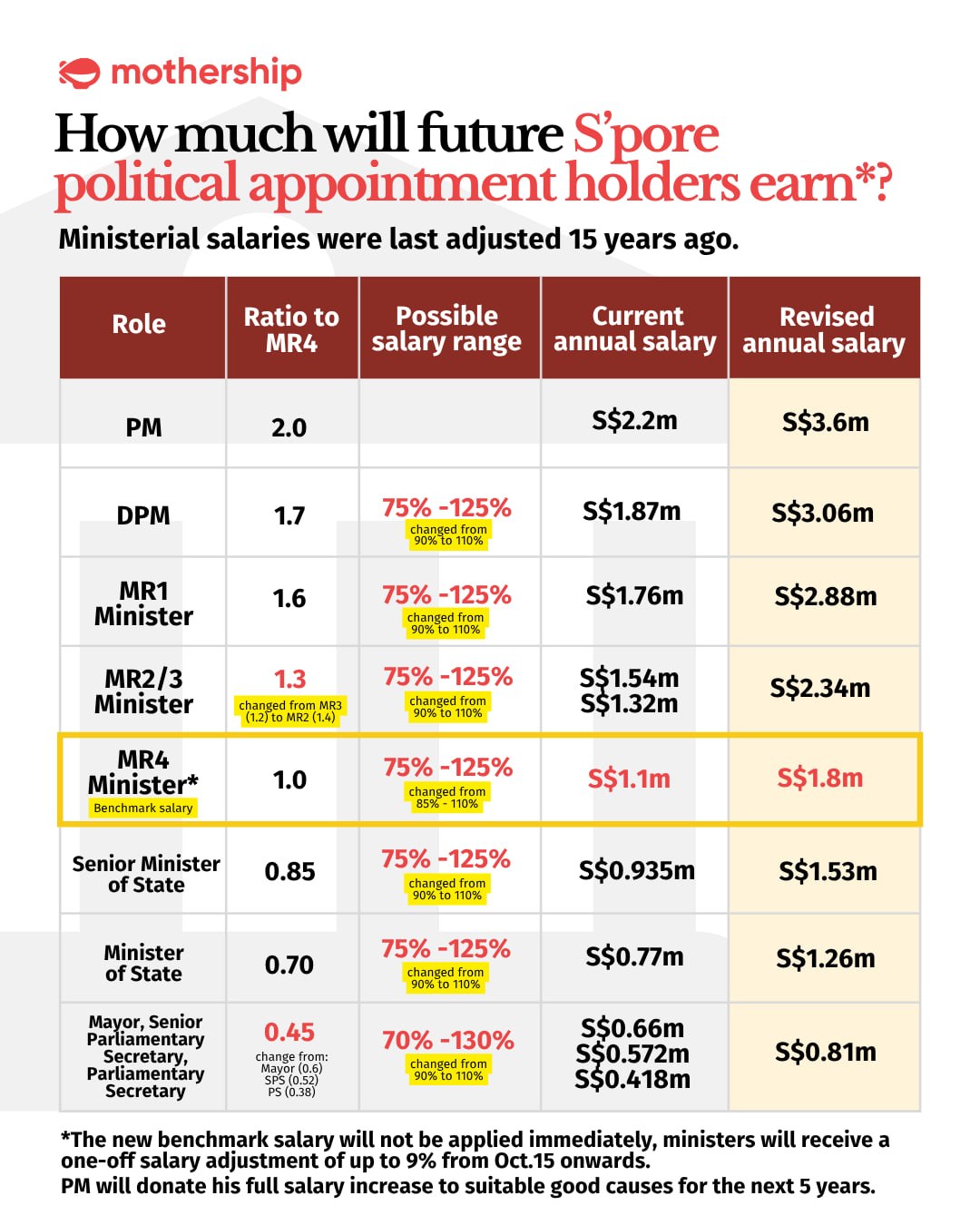 The total annual salary norm assumes one month of AVC, three months of individual performance bonus, and three months from the National Bonus. This is additional to the 13-month fixed pay.
For the sake of simplicity, the table doesn't include the President, Speaker of Parliament, Deputy Speaker of Parliament, Members of Parliament, Nominated Members of Parliament, and Non-Constituency Members of Parliament.
But the salaries of all these appointments are also pegged, indirectly, to the MR4 benchmark salary.
For example, the President's salary is pegged to 70 per cent of the PM's, the Speaker's at 50 per cent of an MR4 minister's, and the Deputy Speaker's at 15 per cent of the Speaker's.
The salary range
Does this mean a newly-appointed MR4 minister will get S$1.8 million? Not quite.
S$1.8 million is the reference salary point, but each ministerial grade also has a salary range, based on this reference point.
This range is meant to give the PM flexibility in deciding how much to pay ministers within the same grade. And where an individual places in this range can be based on factors such as performance, experience, and so on.
Let's say you and a friend are both up to become newly appointed ministers. You have a long and illustrious career behind you, and a pay package to match; your friend, on the other hand, is less experienced, though super promising.
This salary range will give your boss the room to pay you more, based on your experience and career stage, than your younger colleague.
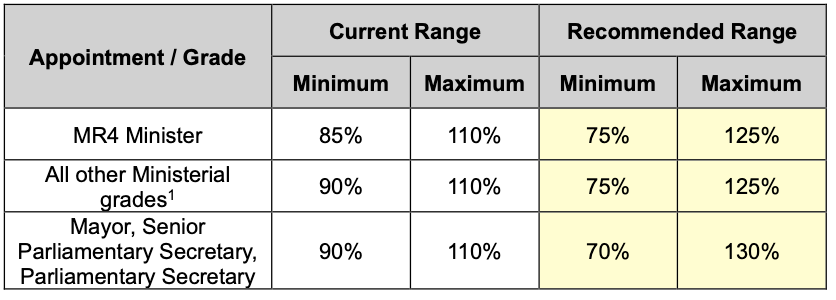
So what does this mean for the pay package? Following the 2026 report, this range is between +/- 25 per cent from the reference salary point, for most ministerial grades.
That means a new MR4 minister can be remunerated anywhere between S$1.35 million to S$2.25 million.
Here are the salary ranges for the various ministerial grades and appointment.
The pay composition
PM Wong has said that 10 out of 16 ministers are currently at the MR4 grade.
He expects most of them to be at the lower end of the MR4 grade salary point — which means S$1.35 million — by the end of this term of government.
Does this mean an average MR4 minister will receive exactly S$1.35 million?
Not quite either.
Ministerial salaries are made up of two components: fixed and variable pay.
Fixed pay comes in at 65 per cent. Variable pay comes in at 35 per cent.
The fixed pay consists of the monthly pay and a 13th-month bonus. In other words, 13 months of pay annually.
The variable pay component comprises an annual variable component (AVC), individual performance bonus, and the National Bonus.
AVC typically ranges zero to 1.5 months, depending on Singapore's economic performance.
Individual performance bonus is decided by the PM, and ranges from zero to six months.
The National Bonus depends on whether the four key indicators meet their target levels, and ranges from zero to six months.
For PM Wong, because nobody grades his individual performance, his pay packet does not include an individual performance bonus component.
Instead, his National Bonus is double that of a minister, ranging from zero to 12 months.
In short, here's the formula for a minister/appointment holder:
Total salary = Fixed pay (13 months' salary) + AVC (0 to 1.5 months) + performance bonus (0 to 6 months) + National Bonus (0 to 6 months)
One more thing
We are almost ready to make a calculated guess as to how much ministers will get paid, following the adjustments.
But first, there is one more detail to take note of.
The new benchmark salaries will kick in immediately for the President, PM, Speaker, Deputy Speaker, and MPs. (It's worth mentioning that PM Wong has committed to donating his entire increment to suitable good causes for the next five years.)
But for other existing officeholders — current ministers included — salaries will not immediately shift to the new benchmarks.
Instead, they will instead receive a one-off adjustment of up to 9 per cent by Oct. 15, 2026, subject to performance.
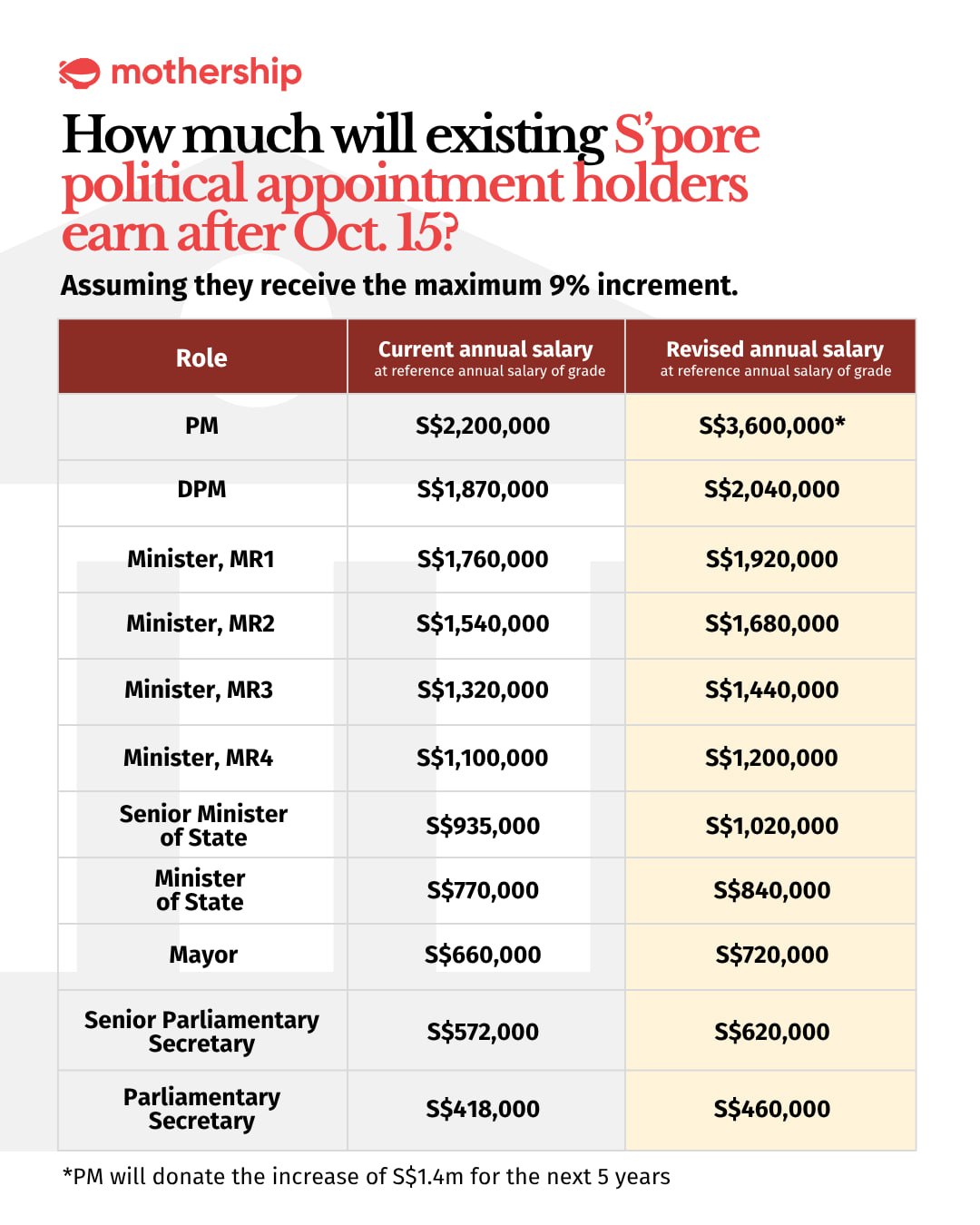
So, how much are the ministers getting paid?
It is impossible to know the specific adjusted salary without knowing the specific pre-adjustment figure, which is not public information.
So, we'll have to make use of the example given by PM Wong.
Let's assume you are an MR4 minister earning S$1.1 million at the moment. You've done well, and PM Wong gives you the full 9 per cent increment.
You get about S$1.2 million. That's about 33 per cent shy of the benchmark salary of S$1.8 million.
Let's break this figure down.
In a good year
For starters, your 65 per cent fixed pay will be S$780,000. That's about S$60,000 a month (remember, it's inclusive of a 13th-month bonus).
You performed well, so PM Wong decided that you are deserving of a three-month performance bonus.
At the same time, Singapore fared well and hit the National Bonus indicator targets, but did not exceed them. This grants you an additional three-month bonus.
Together with an AVC of one month, your bonus comes in at seven months.
So, you get an additional S$420,000. This is how you'll earn the full S$1.2 million. Inclusive of bonuses, this comes up to 20 months of pay.
In an exceedingly good year
Let's say both you and Singapore do exceedingly well. You get the maximum six months of performance bonus and six months of National Bonus.
Together with a maximum 1.5-month AVC, your bonuses will come in at 13.5 months.
With the fixed pay component, your take home in an exceedingly good year will go beyond S$1.2 million, reaching S$1.59 million.
In a bad year
But take the converse. Let's say both you and Singapore underperform, for whatever reason. Your bonuses will clock in at zero months.
That leaves you with just your fixed pay of 13 months, and your pay that year will be S$780,000.
So taking everything together, if we consider bonuses and assume that you're getting S$1.2 million after the 9 per cent adjustment, you stand to make between S$780,000 and S$1.59 million in a year.
Of course, this is just for entry-level ministers.
For a more senior figure — say DPM Gan — let's assume his original remuneration was S$1.87 million (the previous salary reference point for DPMs).
With the full 9 per cent applied, his adjusted remuneration will be around S$2,040,000 in a good year.
In an exceedingly good year, his remuneration may reach S$2,703,000, after including 13.5 months worth of bonuses.
In a bad year with no bonuses, S$1,326,000.
However, because the salaries of each minister are assigned within a range, it is impossible to know the exact remuneration of each individual minister without making assumptions, unless the particular figures are explicitly disclosed. Which they're not, for now.
Clean wages
Even in a bad year, an MR4 minister stands to earn more than most political leaders around the world. The U.S. president earns US$400,000 (S$505,636); the UK prime minister, £172,153 (S$294,787).
But one running argument in support of the high wages is that these high wages are also clean wages, which is one the core principles of the current ministerial salary framework.
That means the ministerial salaries do not contain hidden perks. No pensions, no housing, no flashy vehicles, no tax exemptions.
Only the President, Prime Minister and Speaker of Parliament are accorded the use of an official car, which is taxable.
Ministerial salaries are also CPF-eligible and taxable.
Compare this with the U.S. and UK examples mentioned earlier. The British prime minister gets access to extensive property, including various country houses across the UK. The U.S. president gets a US$246,000 per year pension from the time they leave office until their death.
(Donald Trump also famously flies around in a luxury private jet gifted by the royal family of Qatar. But that's another story.)
In PM Wong's words:
"The full remuneration is transparent. There are no hidden salary components or perks outside the published framework. This is what we mean by a clean wage.
In return, Singaporeans rightly expect a great deal from their political leaders. High standards of integrity and conduct. Competence. Responsibility for the decisions we make. And ultimately, accountability to voters at the ballot box."
Debate on Thursday
While the government’s decision on the salary adjustments does not need to pass a vote in parliament, parliament is nonetheless set to debate the government’s position on the ministerial salary review on Thursday (Sep. 10).
The debate will be on PM Wong's and Chan's ministerial statements.
The Workers' Party has raised objections to the ministerial salary framework in the past.
Its manifesto also calls for the abolishing of the office of the mayor.
In 2012, when debating ministerial salaries, the Workers’ Party proposed an alternate framework to peg a minister’s salary to that of a senior management grade in the civil service instead.
Back then, chief among their criticisms of the 2012 framework was that the proposal to peg a minister’s salary to the top 1,000 income earners has “created a flawed formula”.
These income earners make up a small percentage of the workforce and are unrepresentative of the general population, the WP said in a 2012 statement.
They also proposed for any review or change of the salary structure for political office to be subjected to parliamentary approval.
Earlier this year during his Budget 2026 speech, WP chief Pritam Singh questioned if some of the National Bonus indicators, such as GDP and income growth, were still relevant in the age of AI.
"If GDP growth will no longer reliably create good jobs for Singaporeans, should it remain in the ministerial bonus formula at all?" he asked.
In his speech on Sep. 8, Chan Chun Sing said that the government will be tightening the targets for the National Bonus and studying indicators to reflect the quality of life as experienced by Singaporeans.