Parliament


Govt accepts recommendation to raise ministerial salaries, 1-off adjustment of up to 9% from Oct. 15
Ministerial salaries were last adjusted 15 years ago.
September 08, 2026, 01:22 PM
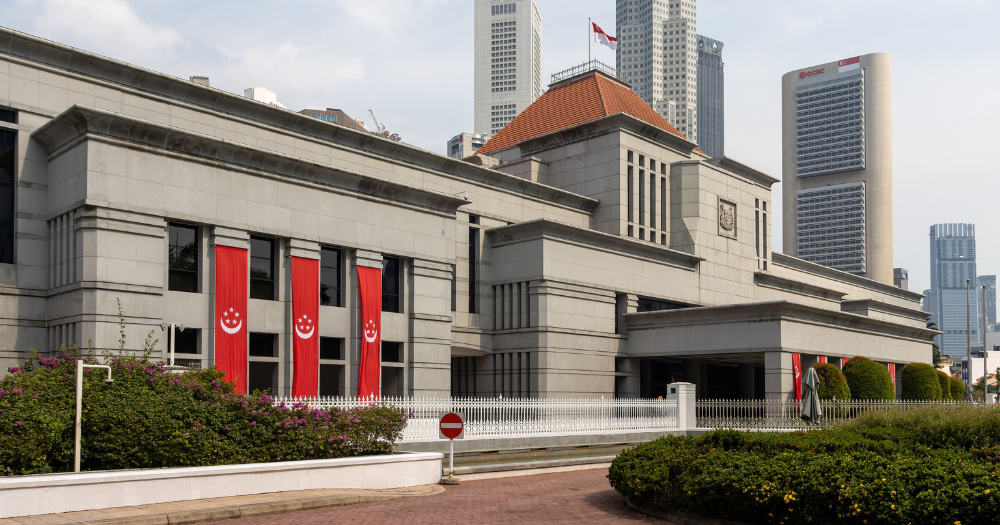
Photo via Wikimedia Commons.


The government has accepted the recommendations of an independent review committee to raise ministerial salaries in line with benchmarks, and will update the MR4 reference annual salary to $1.8 million.
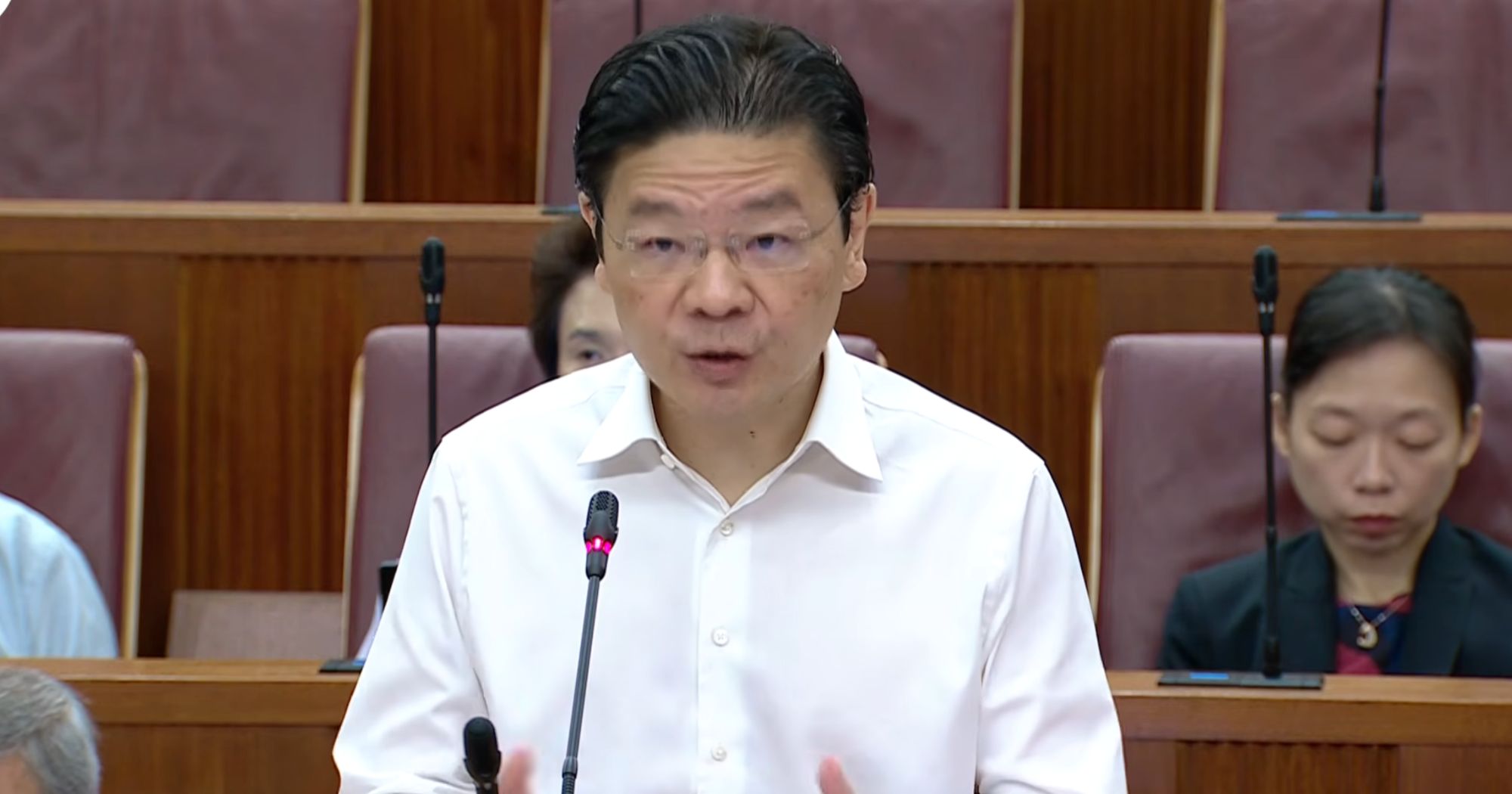
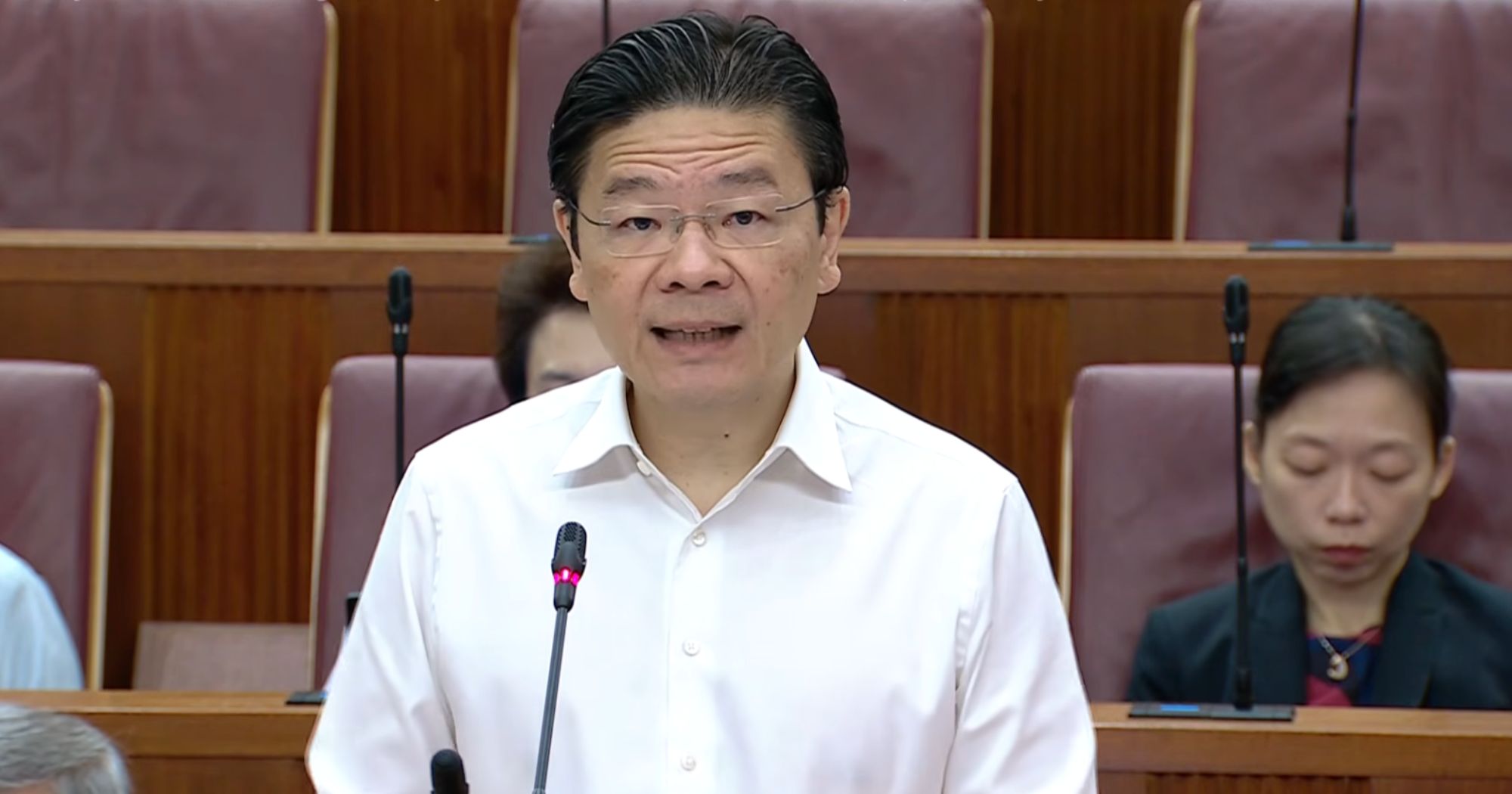
Prime Minister Lawrence Wong mentioned earlier in parliament that the proposed adjustments will not be implemented immediately in one step.
This increase represents a 3.6 per cent annual growth rate since 2011, when ministerial salaries were last adjusted.
Existing political appointment holders (PAHs) will receive a one-off adjustment of up to 9 per cent from Oct. 15, 2026, subject to performance.
The decision to accept the committee's recommendations was announced in Parliament by PM Wong on Sep. 8, with Coordinating Minister for Public Services Chan Chun Sing furnishing the specific details.
In January, Chan confirmed that a committee to review ministerial salaries had been convened.
The committee had submitted its report in April, but the government decided then to defer consideration of its recommendations owing to the uncertainty arising from the Middle East conflict.
Ministerial salaries were last adjusted 15 years ago, when new benchmarks were introduced and cuts were made.
Salary norm increases
Under the current ministerial salary framework, the salary of PAHs — including that of the President, Speaker of Parliament, Deputy Prime Minister (DPM), Senior Ministers of State (SMS), Ministers of State (MOS) and Mayors — are pegged by ratio to the salary of an entry-level minister (grade MR4).
The salaries of Members of Parliament (MPs) and Non-Constituency Members of Parliament (NCMPs) are also linked to the MR4 salary.
The MR4 salary benchmark is set at the median income of the top 1,000 Singaporean citizen earners, with a 40 per cent discount applied to reflect the spirit of public service.
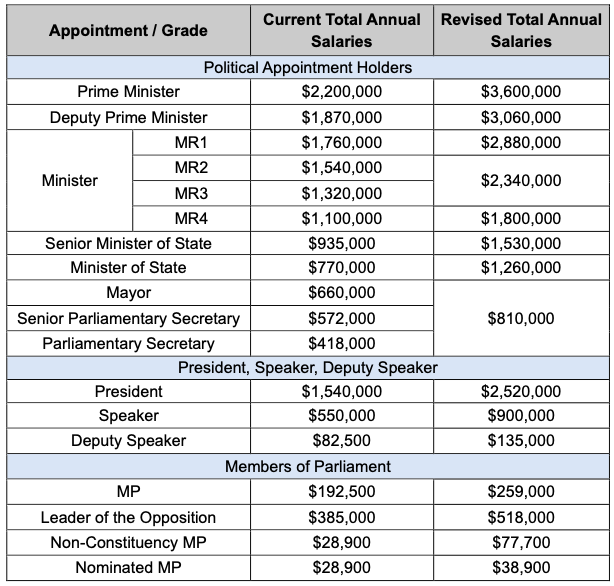
With the MR4 benchmark salary going up from S$1.1 million to S$1.8 million, the salaries of the rest of the PAHs will shift accordingly based on the determined ratios.
There are currently four ministerial grades, MR1 to 4, with MR1 being the most senior.
10 out of 16 ministers are currently at MR4.
Following the review exercise, the MR2 and MR3 grades will be merged into a single grade, pegged at 1.3 times the MR4 salary.
The pay for mayors, senior parliamentary secretaries (SPS) and parliamentary secretaries (PS) will also be merged and set at 0.45 times the MR4 salary.
Here are the ministerial and PAH grades and their corresponding salaries.
 Screenshot via 2026 Review of Political Salaries For Political Appointment Holders and Members of Parliament.
The PM's salary is set at twice the benchmark.
PM Wong said in parliament that he will donate the full increase of his salary to "suitable good causes" for the next five years.
He will review this position afresh after five years, taking into account the circumstances at the time.
One-off adjustment of up to 9 per cent
Speaking on the salary adjustments, PM Wong said that the government does not intend to "move immediately" to the proposed salary levels "in one step".
Instead, a one-off adjustment of up to 9 per cent will be made for PAHs.
This means that a MR4 minister earning S$1.1 million (as per the previous benchmark) will get an increment of around S$100,000.
The full 9 per cent will not be automatically applied to all PAHs, and the level of adjustment will depend on individual circumstances, such as individual performance and when their salary was last adjusted.
This one-off adjustment will take effect from Oct. 15, 2026.
Beyond this one-off adjustment, subsequent adjustments will be based on individual performance and responsibilities.
National Bonus
Under the ministerial salary framework, only 65 per cent of a minister's salary is fixed.
The rest of the 35 per cent are variable components determined by an annual variable component, individual performance and the National Bonus framework.
The National Bonus was introduced during the 2011 review exercise to replace the GDP bonus.
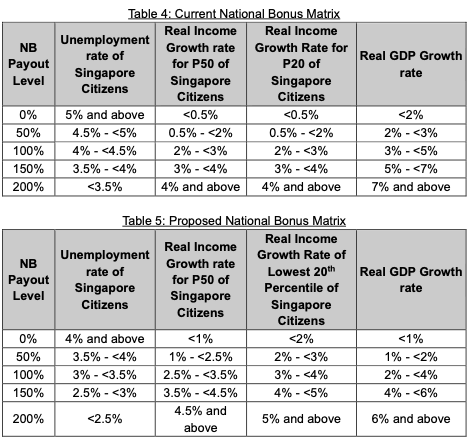
It comprises four indicators:
- Real median income growth rate of Singapore Citizens (SCs)
- Real growth rate of lowest 20th percentile income of SCs
- Unemployment rate of SCs
- Real GDP growth rate
If the goals of the indicators are met, then eligible ministers and PAHs may receive a bonus of between zero to six months.
The goals of the indicators will be revised and tightened, based on the committee's recommendations.
 Screenshot via 2026 Review of Political Salaries For Political Appointment Holders and Members of Parliament.
The government has also accepted the committee’s recommendation to study, develop and incorporate indicators measuring quality of life and social progress felt by Singaporeans in the National Bonus.
Salary ranges
Additionally, the pay of each ministerial grade may fall within a range, which gives the PM the flexibility to adjust the salary of a PAH according to their background and career stage.
This pay range will be widened to 75 per cent to 125 per cent, from the current 90 per cent to 110 per cent, for ministers, DPM, SMS and MOS.
The wider salary range allows the PM to appoint new PAHs at a lower salary within the grade, while more experienced individuals can be paid more within the same grade.
With this range, it means that an MR4 minister may earn anywhere between S$1.35 million to S$2.25 million, with the PM having the discretion to decide the amount.
PM Wong said that by the end of this term of government, most MR4 ministers will be earning about $1.35 million.
The salary range for Mayors, SPS and PS will be widened to 70 per cent to 130 per cent, from 90 per cent to 110 per cent.
MPs, NCMPs
The government has also accepted the committee's recommendation to update the monthly allowances for MPs from S$13,750 to S$18,500.
The government will also be undertaking a study to delink the salary of MPs and Mayors from the MR4 benchmark, based on the committee's recommendation, Chan said in his speech.
The committee noted that the considerations for these community-related roles may differ from those of full-time PAHs.
NCMPs will also see an increase in their allowances from 15 per cent of an MP's annual allowance to 30 per cent.
This translates to S$5,500 per month.
The increased MP and NCMP allowances will take effect from Oct. 15, 2026.
President, Speaker and Deputy Speaker
The salary of the President, being pegged to that of the Prime Minister's, will similarly increase.
The salary of the Speaker of Parliament will continue to be pegged at 50 per cent of the MR4 salary.
This translates to about S$900,000 annually.
The salary of Deputy Speakers will continue to be pegged at 15 per cent of the Speaker's salary.
The salary adjustments will be fully applied to the President, Speaker and Deputy Speakers.
Not just a matter of pay: PM Wong
In his speech, PM Wong acknowledged that political salaries are a "difficult and emotive issue", but one which cannot be avoided simply because it is "politically difficult".
"This is not just a matter of pay. It is about whether Singapore will continue to have the quality of political leadership we need to take our country forward and to serve Singaporeans well in the years ahead," PM Wong added.
According to Chan, the salary adjustments will cost about S$5 million more annually, if the maximum one-off adjustment of 9 per cent is applied to all PAHs.
For the MPs' allowances, it will cost S$6.6 million annually.
Parliament will debate the government's response to report on ministerial salaries during this week's sitting.
Background
The current ministerial salary review committee is chaired by Gan Seow Kee, who is Chairman of Singapore LNG Corporation.
Gan is also an alternate member on the Council of Presidential Advisers.
Alongside him are seven other members from the private sector, labour movement and social sector.
Their recommendations are laid out in an April 2026 report titled, "2026 Review of Political Salaries For Political Appointment Holders and Members of Parliament".
Ministerial salaries were last adjusted in 2011.
The 2017 review recommended adjusting salaries to match the updated benchmarks, but the government of the day decided then to maintain salary levels.
A review was deferred in 2023 due to geopolitical uncertainties and downside economic risks.