News


S'pore cannot wish away its geography nor opt out of geopolitics: Chan Chun Sing at RSIS 30th Anniversary Distinguished Lecture
“Our task is to see it clearly, understand it deeply, and help Singapore navigate it wisely, ahead of time.”
September 22, 2026, 07:49 PM
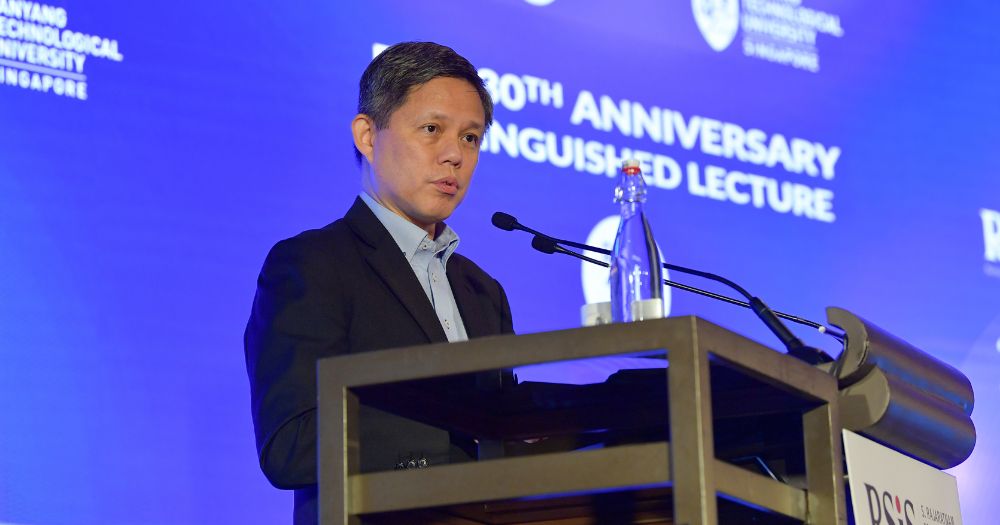
Image via MINDEF


"In Singapore, we can never wish away our geography, nor can we opt out of geopolitics."
Chan Chun Sing remarked on Sep. 22, while delivering a speech marking the 30th anniversary of the Rajaratnam School of International Studies (RSIS).
During the speech, he reminded the audience of the shifting nature of geopolitics and the need for a corresponding evolving reaction to it, as well as the constant need to better understand the world “more deeply than others would expect a small state to.”
“More importantly, to use that understanding to stay relevant, to stay connected, and to stay ahead.”
Our own eyes
Chan began by retelling the story of SR Nathan and RSIS's predecessor, the Institute of Defence and Strategic Studies (IDSS).
The then Defence Minister Tony Tan tasked the future president SR Nathan to build the institute, and Chan recalled Nathan as being a man of “extraordinary instinct.”
Nathan understood before others that Singapore could not afford to be surprised, and that “we needed our own eyes, our own analysis, and, most importantly, our own voice,” and that same spirit was needed now more urgently than ever.
Chan said that the 30 years encapsulating RSIS's foundation was not just a milestone, but an entire strategic era.
In the intervening 30 years, the world had changed significantly, with U.S. primacy giving way to sustained great power competition, cyberspace erasing the protection of physical distance.
Relationships with Singapore's closest neighbours, Malaysia and Indonesia, are being reshaped by forces that are “shifting fast within their respective societies.”
Singapore could neither “wish away our geography” nor “opt out of geopolitics”, and needed to “understand the world more deeply than others would expect a small state to do”, using that to “stay relevant, stay connected, and stay ahead.”
Not more of the same
RSIS’s task on its 30th anniversary was to not “just do more of the same”; it needed to constantly reinvent itself ahead of the times to stay relevant.
He stressed the importance of RSIS’s mission, stressing the importance of the “deep connections and understandings of the personalities, institutions, and deep forces shaping the world” that the school had assiduously built up.
Chan said that the shifts the world was going through were not just structural but also personal.
Decisions that shaped our region were being made by specific leaders with specific worldviews, insecurities, and ambitions.
Using China as an example, he said: “Understanding geopolitics today means understanding the Chinese conception of national rejuvenation and what that means for how China exercises power in the region and beyond.”
Personalities and institutional pressures
But there was a similar need to understand the personalities, institutional pressures, and domestic politics that affected other countries, such as the United States, Malaysia, and Indonesia, to give a few examples.
This kind of deep, granular human understanding could not be assembled overnight, but required “persistent research, language skills, long-cultivated relationships, and genuine intellectual immersion in other societies", Chan said.
But RSIS’s role went beyond understanding the great powers but also understanding Singapore’s closest neighbours, Malaysia and Indonesia.
Neither relationship could be managed on autopilot and required the same depth of understanding of history, political culture, and deep forces shaping the societies from within.
Chan said he shared Nathan's vision for RSIS that it should be the go-to place for everyone within the region and beyond who wanted to understand the deep dynamics of Southeast Asia.
Technological grey zones
But beyond geopolitics, technology was also in the process of redrawing the boundaries of what is possible in security and warfare.
Chan gave the example of AI, autonomous systems, and drones that have changed how conflicts are being fought and how power is projected.
The availability of such technologies, not just at the state level but also for non-state actors, gives them capabilities that once required enormous resources.
Conflicts no longer begin when shots are fired, but long before, in the information environment and cyberspace.
"This is why we say that today we are never living in peace nor war in the conventional sense, but always somewhere in between, always in a grey zone where we must conduct operations every day to protect ourselves from conflict, even as contestation continues."
Capabilities and intentions
Chan said that, in the end, it was about sound judgement about the capabilities and intentions of others.
Capabilities were easier to assess, but intentions were hard, and where RSIS “earns its keep.”
Comparing the situation to chess, which he said was a game of perfect information, but ultimately came down to the intentions and imagination behind the moves.
“It is not the information itself, but what we do with it.”
It was the ability to distinguish signal from noise and the wisdom to know when to act and when to hold back.
Chan said that the hardest questions were deciding when to make a move and when to hold back.
Both, he said, required strategic patience and strategic understanding, and not acting in haste required confidence in one's own capabilities.
“Poor understanding of the other side, and poor understanding of ourselves, increases the risk of miscalculation” He said, and miscalculation would have unwanted consequences.
Intensified imperative
RSIS's imperative has not diminished over the past 30 years, but instead has intensified.
Chan said that Nathan had built the IDSS because he believed Singapore deserved its own strategic voice, a belief that was now more important than ever as the world continued to evolve.
“Our task is to see it clearly, understand it deeply, and help Singapore navigate it wisely, ahead of time.”