Environment


Non-venomous wild snake caught by Mandai staff outside reptile enclosure at S'pore Zoo
It was later released back into the wild.
August 27, 2026, 11:46 AM
Top images via azulesoctopus/Instagram


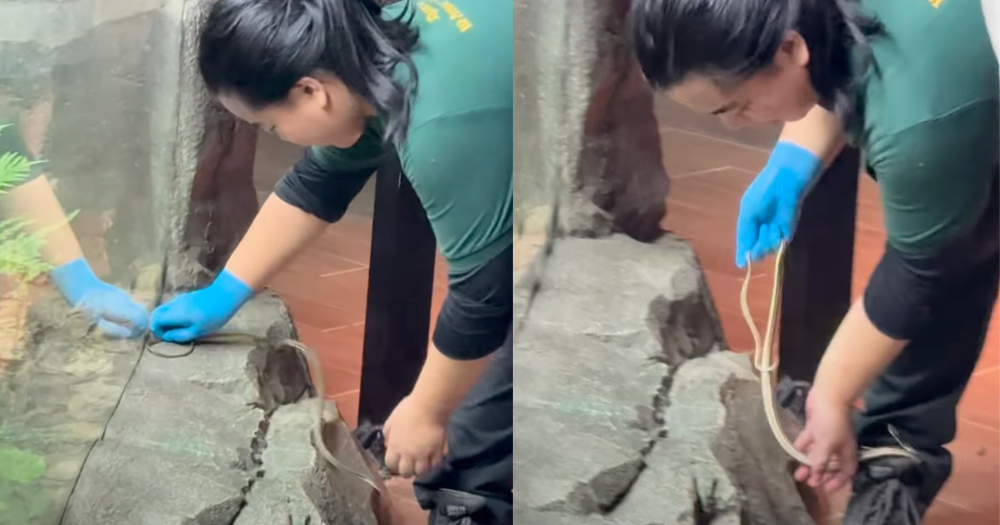
A snake was caught by a Mandai Wildlife Reserve staff in a reptile exhibit at the Singapore Zoo on Aug. 23, as seen in a video circulating online.
The Instagram user who posted the video wrote, "POV: when you're about to step in the reptile exhibition but you heard a visitor told a staff there's a snake outside. My heart skipped a beat."
In response to Mothership's response, a spokesperson from Mandai Wildlife Group shared that it was a wild, non-venomous snake known as a painted bronzeback — a species native to Singapore.
It was not part of the animal population in the Group's care.
The capture
"Guests spotted the snake and alerted our staff, who responded promptly," the spokesperson added.
In the video of the capture, a long, slender snake can be seen slithering along the edge of a glass animal enclosure.
Two staff members were at the scene. One, wearing blue protective gloves, appeared to have a hold of part of the snake's body, while the other employee stood beside her.
Several people, appearing to be visitors, watched from nearby.
Once they had caught the snake, both staff members walked away calmly.
The Mandai Wildlife Group spokesperson said that snakes are generally harmless if left undisturbed, and will typically move away on their own when given room.
In this case, the snake was small and moving fast, so it was at risk of injury in a crowded indoor area, they said.
"Our trained staff safely captured the snake while keeping guests at a safe distance. It was later released back into the wild."
'Let wildlife be'
The spokesperson explained that all the wildlife parks at the Mandai Wildlife Reserve are home not only to the animals under their care, but also to a diverse range of native wildlife that naturally inhabit the surrounding landscape.
Mandai Wildlife Group has protocols in place for wildlife sightings across its parks, the spokesperson assured.
"For everyone’s safety and the well-being of the animal, the best course of action is to let wildlife be and allow it to retreat in its own time," they said.
However, where an animal seems unable to retreat on its own, including situations where it is trapped or in distress, the staff are trained to step in and assist.