News


Wheelchair users & disability group raise concerns about LTA trial for strollers to use priority bays
"The new policy will result in wheelchair-users being left behind at bus stops, waiting for extended periods of time."
August 03, 2026, 06:01 PM
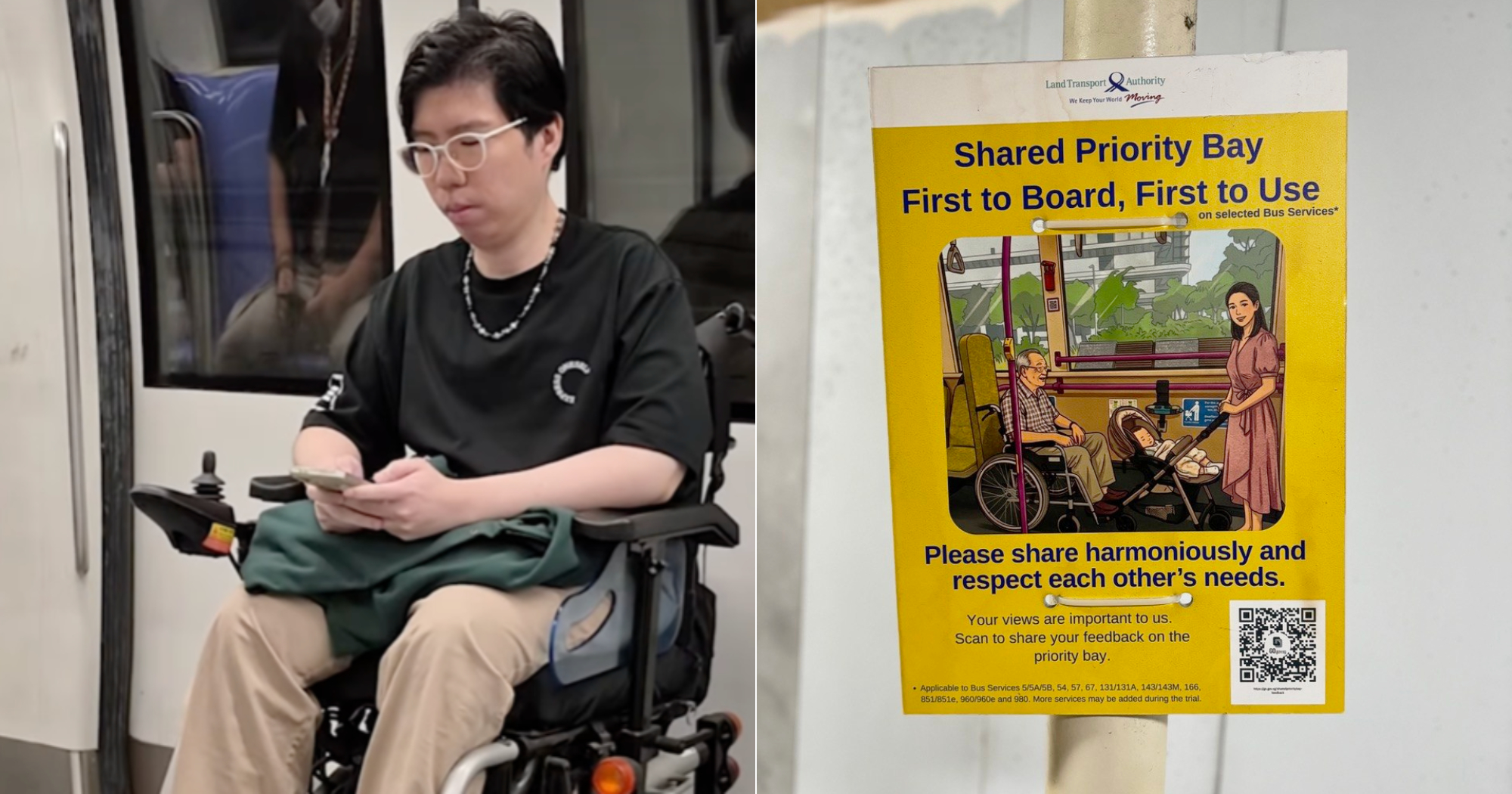
Top images via skyshenmusic/Instagram & Mothership


Wheelchair users and disability advocates have raised concerns over the "First to Board, First to Use" bus trial by the Land Transport Authority (LTA).
The trial runs from April to October 2026.
It allows 10 bus services to open their priority bays as shared spaces for wheelchair users, mobility aid users and parents travelling with children in strollers.
Disabled People's Association: "A wheelchair doesn't fold"
The Disabled People's Association (DPA) weighed in on the trial in an Instagram post on Jul. 26, drawing a stark distinction between strollers and wheelchairs.
DPA wrote: "A wheelchair doesn't fold. A stroller usually does. For wheelchair users, that bay isn't a preference — it's often the only way to travel accessibly and affordably."
It added: "Better bus designs can serve wheelchair users and parents with strollers. Removing an access need shouldn't be the trade-off."
The DPA also noted that wheelchair accessible vehicles were "scarcer, slower to book and far more expensive", hence for many wheelchair users, “the bay is not a seat preference, it is the only accessible and affordable way to get around”.
While extending empathy to parents with strollers, the association called for bus designs to incorporate flexible spaces for strollers, rather than removing existing accessibility features to solve what it described as a "comfort problem".
The DPA also pointed out that many wheelchair users only found out about the trial through social media, and urged authorities to consult affected groups before implementing the policies.
Singer-songwriter Sky Shen speaks up
Local singer-songwriter Sky Shen also shared his concerns on Instagram.
He is a motorised wheelchair user with muscular dystrophy.
He said: "Public transport is a huge part of daily living, and is essential for many of us for getting around."
While acknowledging LTA's efforts to improve commuter quality of life, Shen said the trial would have real consequences for wheelchair users.
He said:
"The new policy will result in wheelchair-users being left behind at bus stops, waiting for extended periods of time, and significantly impacts our ability to participate in normal life — all for 'increased convenience' for passengers with strollers, who could have made space so that both parties could take the bus at the same time."
He added: "This conversation is a sensitive and important one, and one that we must engage in if we want to build a more inclusive home for all."
LTA responds
In response to Mothership's queries, LTA said the trial came about after feedback from parents who struggled to fold a stroller while minding their children alone.
"The six-month 'First to Board, First to Use' trial was introduced to understand how such an approach could work to meet the needs of different commuter groups, including both wheelchair users and families with young children," LTA said.
LTA added that it has been working with various social service agencies, including SG Enable, Handicaps Welfare Association (HWA), and SPD, as well as the public transport operators, to enhance accessibility on public transport.
It plans to gather feedback, including from the DPA, to better understand their concerns and experiences and "to find a balanced way to move forward together".
LTA also said it has heard the concerns raised by wheelchair users about wheelchair bay usage, as well as the challenges that families with young children who use strollers face, so the trial's purpose is to recognise how different needs can be balanced in a way that is fair and practical.
"Based on our observations from the trial so far, we have not encountered conflicts between wheelchair users and families with strollers on the trial services," LTA said.
LTA said it will "consider all views received before deciding on the way forward".