Abroad


Temasek states its long-term support for SIA's Air India investment
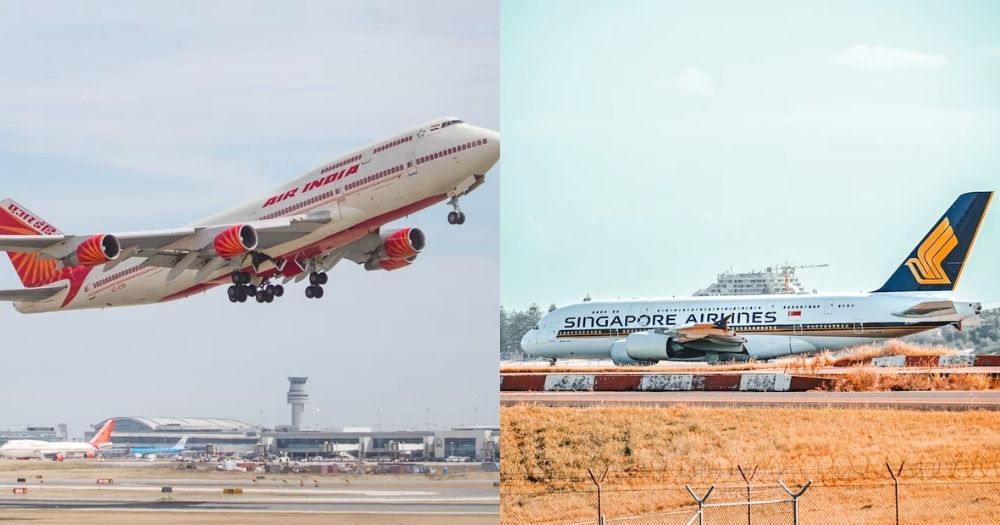
SIA holds a minority 25.1 per cent stake in Air India.
August 31, 2026, 04:29 PM
Image via Unsplash


Temasek, the majority shareholder of Singapore Airlines (SIA), has stated its support for the airline’s long-term strategy, particularly where its Air India investment is concerned.
The Singaporean investment company issued a statement to the Business Times (BT) detailing its support after it was revealed that Air India, which SIA holds a minority 25.1 per cent stake in, reported a loss of S$3.2 billion.
Fresh equity
As a result of this loss, the Air India Group is seeking nearly S$1.9 billion of fresh equity from SIA and Tata Sons, Air India's majority shareholder; of which SIA is expected to contribute about half a billion dollars, as reported by BT.
Questions have been raised about the purpose and the viability of SIA’s continued investment in Air India, notably by Workers Party MP Kenneth Tiong, who wrote a social media post on the subject, published on Aug. 26.
In it, he said that he would be asking a question in parliament on the subject, and that he would oppose any use of Temasek’s funds to “prop up” Air India, and that if SIA wanted to continue with Air India, it should do so “on its own two feet.”
Money Pit
BT published an editorial on Aug. 27 asking whether SIA should cut its losses and walk away from its Air India investment.
The article compared Air India to a “money pit”, saying that SIA’s minority stake bought “influence but no control”, and that SIA’s shareholders were “entitled to ask” what benefits the investment had wrought, other than a seat on the airline’s board and a share of the extensive losses.
Temasek responded to the BT article, with its joint head of portfolio development and head of ecosystem development, Juliet Teo, issuing a statement saying Temasek supported SIA's long-term strategy.
The investment company said that SIA had “Demonstrated discipline and resilience through industry cycles and consistently positioned itself for long-term growth”, citing examples such as SIA's “Strong Recovery” After the COVID-19 pandemic.
The statement was written by Temasek's joint head of portfolio development and head of ecosystem development, Juliet Teo.
Second hub
Teo said that SIA had articulated its objective to invest in a second hub so as to secure long-term growth beyond Singapore.
India was the world's third-largest air transport market and was well-positioned to serve as such a second hub.
SIA, as a long-term participant in the Indian market, had been operating in it through its Vistara investment in 2013, and Temasek said SIA's investment in Air India allowed it to “deepen its participation in India's aviation growth.”
Temasek viewed SIA's business decision from a long-term perspective and is supportive of it.
The transformation of Air India would involve a complex multi-year operational and integration challenge, and that the effort would take time and was not expected to be linear.
Teo highlighted the various challenges, such as industry developments like aircraft innovation and fleet renewal cycles, as well as air space disruptions, geopolitical developments, and fuel price volatility.
Volatility and geopolitical developments
Reuters wrote about some of those challenges, including Indian airlines being barred from Pakistani airspace due to ongoing tensions, as well as airspace and energy price disruptions caused by the war in Iran, as well as a fatal air crash in 2025.
Reuters reported that Temasek did not address whether it would support any “capital contribution” from SIA to Air India.
It also said that SIA said its board would “carefully consider any request for additional capital from Air India.”