Features


'Evidence I've been in this world': S'porean astronomer, 28, gets asteroid named after her for contributions to science
From a little red dot, into infinity and beyond.
August 09, 2026, 11:49 AM
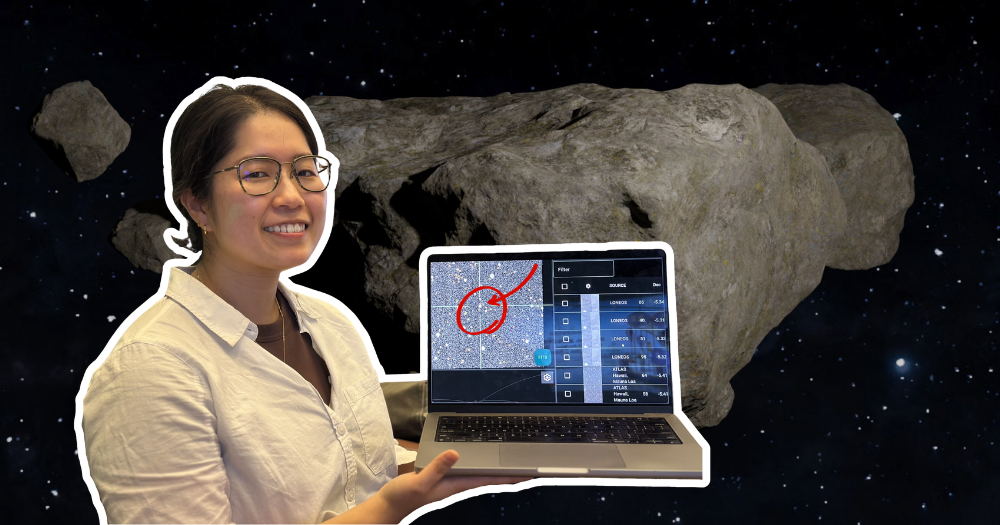
Images via Constance Tan/Mothership & Canva


Orbiting somewhere between Mars and Jupiter at this moment is an asteroid named (26227) Tan.
But what you may not know is that it was named after a Singaporean — 28-year-old astronomer Nicole Tan.
A degree and an asteroid
The news of the naming, Tan said, came as a complete surprise.
You can't pay for an asteroid to be named after you, nor is it something that happens because of a particular accomplishment.
"The process is kind of opaque to everyone," she explained. "[But] it's not like something a billionaire gets once they put money into it."
Asteroids are named by a committee of the International Astronomical Union (IAU). Traditionally, the astronomer who first discovers an asteroid gets first dibs on naming rights, though they are not allowed to name it after themselves.
Some name them after loved ones, while others nominate individuals who have made significant social or academic contributions.
In Tan's case, an accumulation of years of research contributions to the field of astronomy was what got her on the list.
But it was still a shock when one of her ex-collaborators, who happened to be a member of the IAU, called to break the news to her.
"Since there's no criteria for it... it's kind of out of my hands, it's not something I've ever tried to target," she said. "It was very exciting... it felt like a proud moment."
Tan quipped that it's an honour she shares with other asteroids, some with more whimsical names like "potato" or "cavefish" (based, presumably, on their shape).
"You can't really get such a big head about it," she said with a chuckle. "It keeps you humble."
A curious child
Tan was speaking to me while on a six-hour transit in Changi Airport between Poland, where the naming ceremony had taken place, and New Zealand, where she'd submitted her thesis at the University of Canterbury just days before.
It's clearly a busy time in her life, especially since she'd just completed her doctoral degree in Astronomy in June.
But where did it all begin?
As a child, Tan recalled "getting really into universe documentaries" on the Discovery Channel when her family briefly lived in China.
She had always been a curious child, she said, and astronomy and cosmology stood out to her as interesting subjects.
But she did not realise she could build a career out of it until an astronomy class during her undergraduate years, where she was pursuing a different degree.
"I thought, 'Oh, wow, this is really cool.' It's very interdisciplinary, you pull in math and physics and chemistry, all these different aspects in order to solve really big problems," she enthused.
Later, an opportunity arose to pursue a PhD on trans-Neptunian objects (TNOs).
She took it, and the rest was history.
Moments of awe
On the asteroid's information page, a long string of numbers indicates that it has been documented countless times over the span of 75 years, at observatories all around the globe.
It also lists Tan's achievements, including her thesis on trans-Neptunian objects, and that she was a recipient of a college medal in her undergraduate years in the U.S.
But when I asked her about the most memorable moments over the course of her nearly six-year-long degree, her answers were less about achievement than moments of awe.
At one point, she was part of a team recording ground-based observations during a NASA mission to hit an asteroid off course.
"In the doomsday scenario, where the asteroid is coming towards us... the idea is that we find the asteroid early enough so we can nudge it a little bit, so it veers off course," she explained.
So during her research in New Zealand, her team observed the "artificial collision" of an asteroid that was near Earth.
Over the next few months, she got to see the asteroid move towards the point of impact — and then, upon making contact, how it broke apart afterwards.
Tan later got to capture that moment in a gif she stitched together:
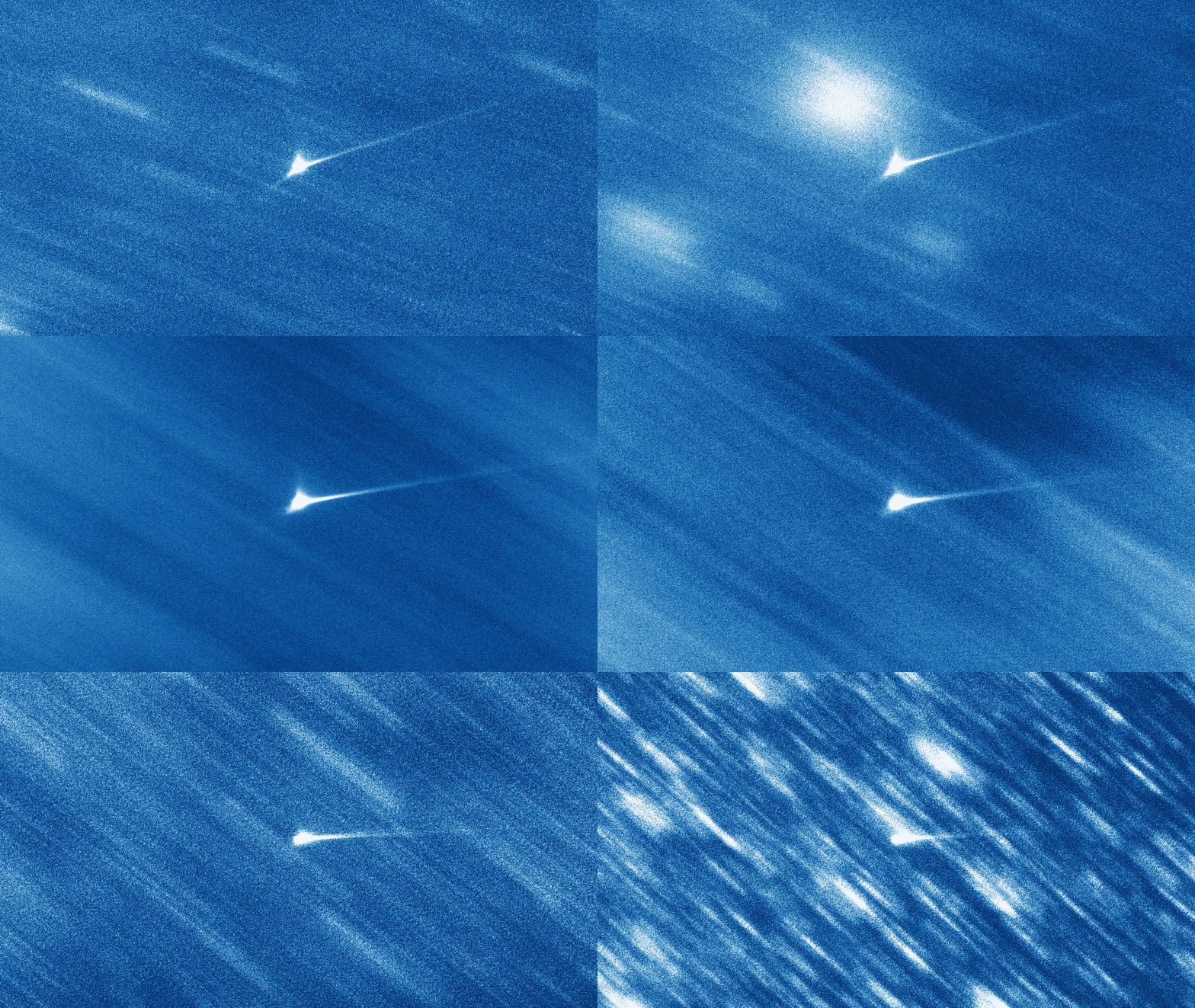 Gif via space.com, courtesy of Nicole Tan
A Singaporean connection
For Tan, the significance of the achievement was in having her research tied to her nationality for the first time.
"My whole astronomy research career has been done completely out of Singapore, so all my research and my institutions have no ties to Singapore, which makes me kind of sad," she explained.
"But the fact that my citation says that I'm a Singaporean makes me pretty excited, because it's the one tangible thing linking me to home."
She now joins the likes of another well-known Tan, Chinese philanthropist Tan Kah Kee (himself a prominent Singapore figure), who had an asteroid named after him in 1990.
While she's spent the last decade abroad, Tan said she hopes to transfer the skills she has picked up from astronomy — computer science, coding and effective communication — into a viable career in Singapore.
Here, the "traditional" career options for astronomers — mostly in academia and research, or institutions and observatories — are limited.
But she's considering her options. "I miss home," she confessed.
Where is it now
Asked about her asteroid, Tan enthusiastically whipped out a telescopic image on her laptop and animatedly gestured to a small bright dot in the centre.
It's faint, but stands out against the many other spots on the screen.
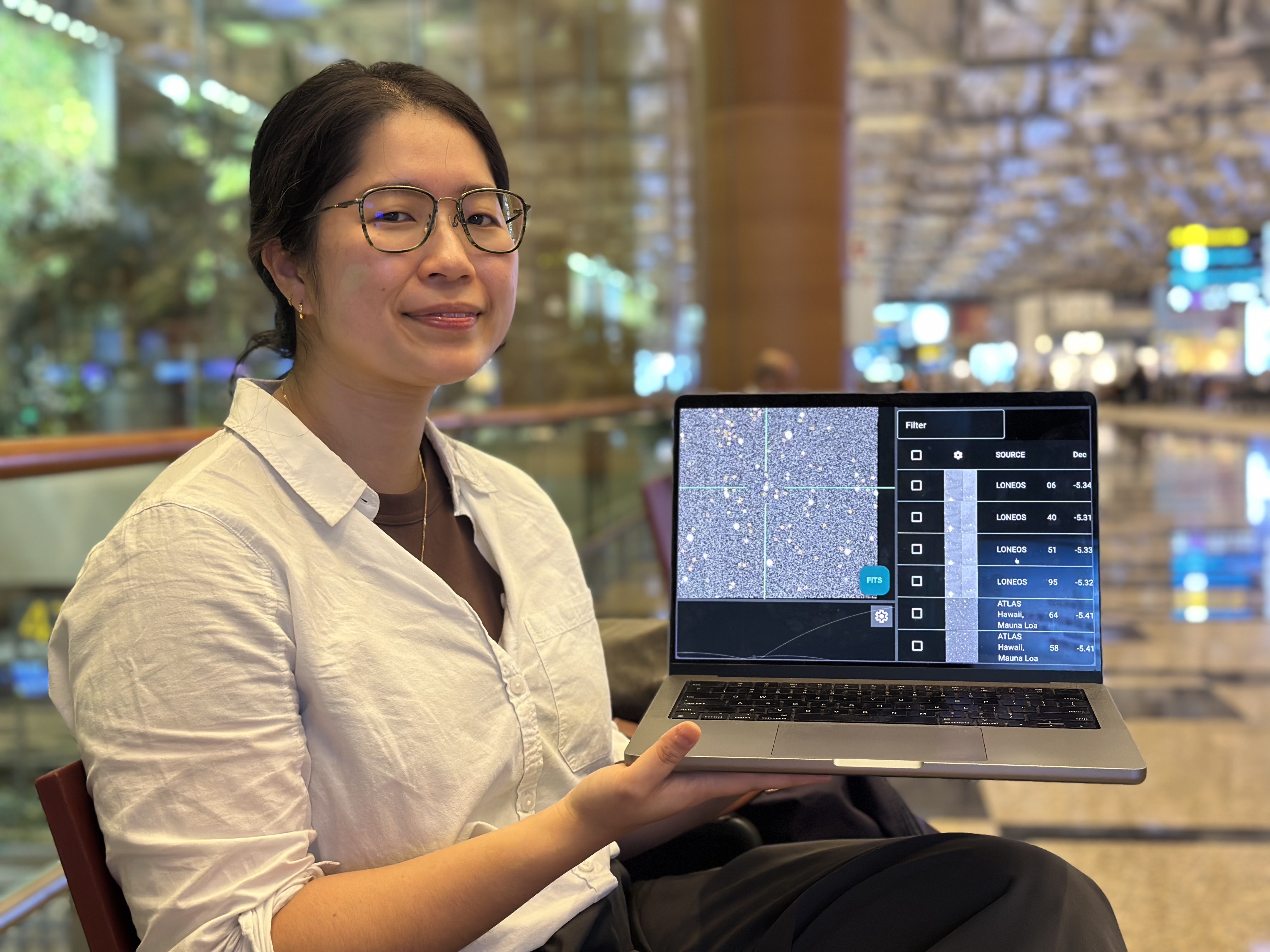 Image by Constance Tan/Mothership
When I asked her to explain what we were looking at, the previously reserved young woman disappeared.
"It's a main belt asteroid just between Mars and Jupiter," she began explaining, adding that it sits inclined instead of in line with the solar system.
"Right now it's orbiting the sun, just going about its life, I guess, like me."
It's a strange kind of parallel. In her work, she captures ephemeral moments in time, a little like a stop-motion camera; but the impact is far more permanent.
I asked how her younger self would feel about her achievement. "Pretty excited," she guessed.
"I always wanted to, as a child, have some sort of, I guess – make a mark.
Not in a grandiose sense, but more in a sense of 'yeah, there's some evidence I've been in this world'."