


News


POV: I paid S$21.50 to watch a S’pore AI sci-fi movie on National Day. It was quite bad.
Review.
August 10, 2026, 12:56 PM
Photos from Rafael See Toh/ Mothership


“Trace Project”, an AI-generated sci-fi feature film, premiered on Aug. 9, 2026.
It was the 64-minute movie's only scheduled public screening in Singapore.
In the lead-up to its release, it received backlash online, with some referring to it as “AI slop” and criticising it as an “insult” to the local film industry.
The movie is about Lin Jiajun, an ordinary young man from Singapore, who overcomes social stigma, his humble background, and his father's disapproval to become the nation's first astronaut picked for a historic Mars exploration programme.
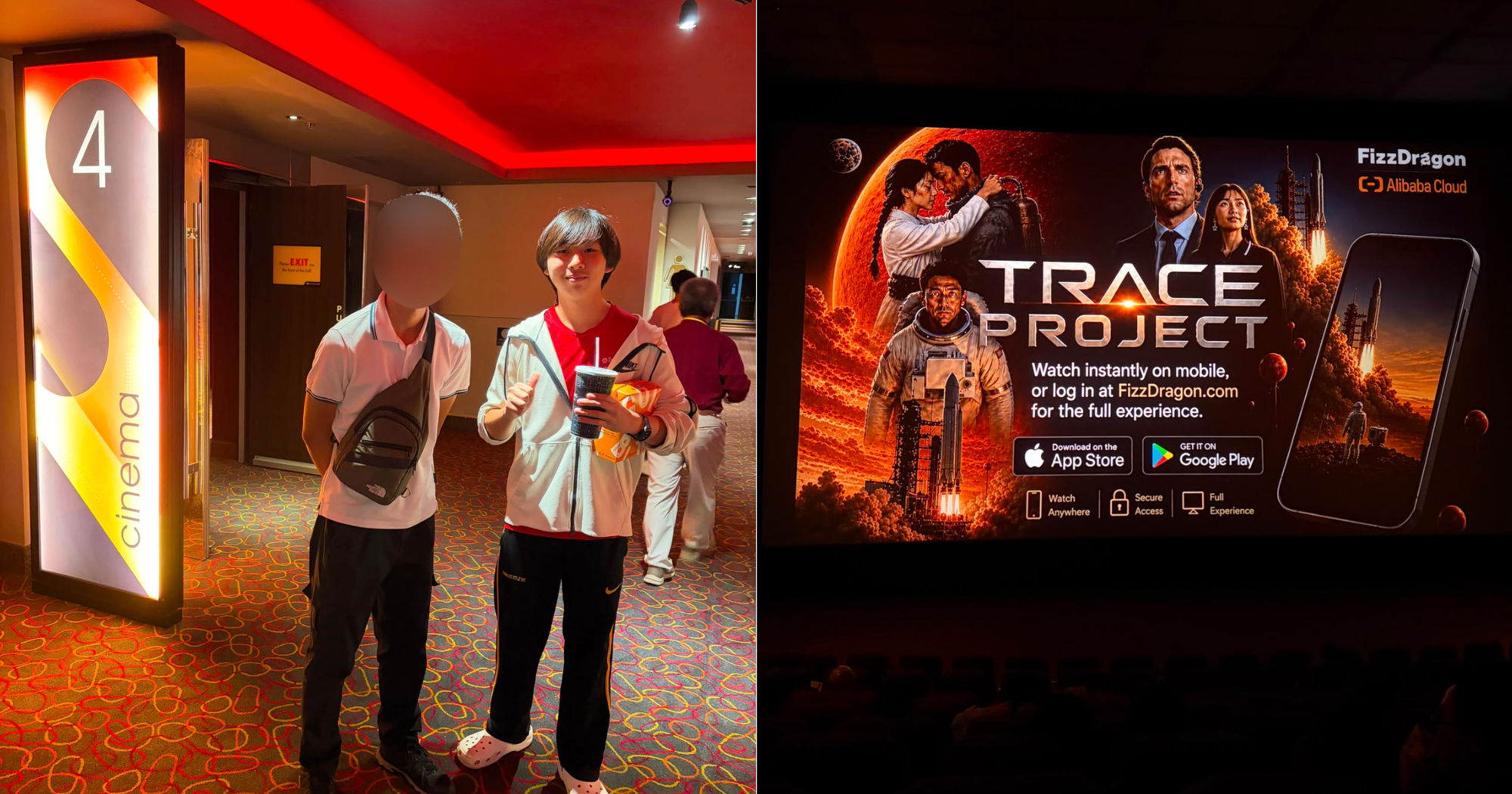
I went to watch the AI-generated movie
While others spent the National Day weekend celebrating the festivities or travelling overseas, I decided to watch “Trace Project” in theatres out of curiosity.
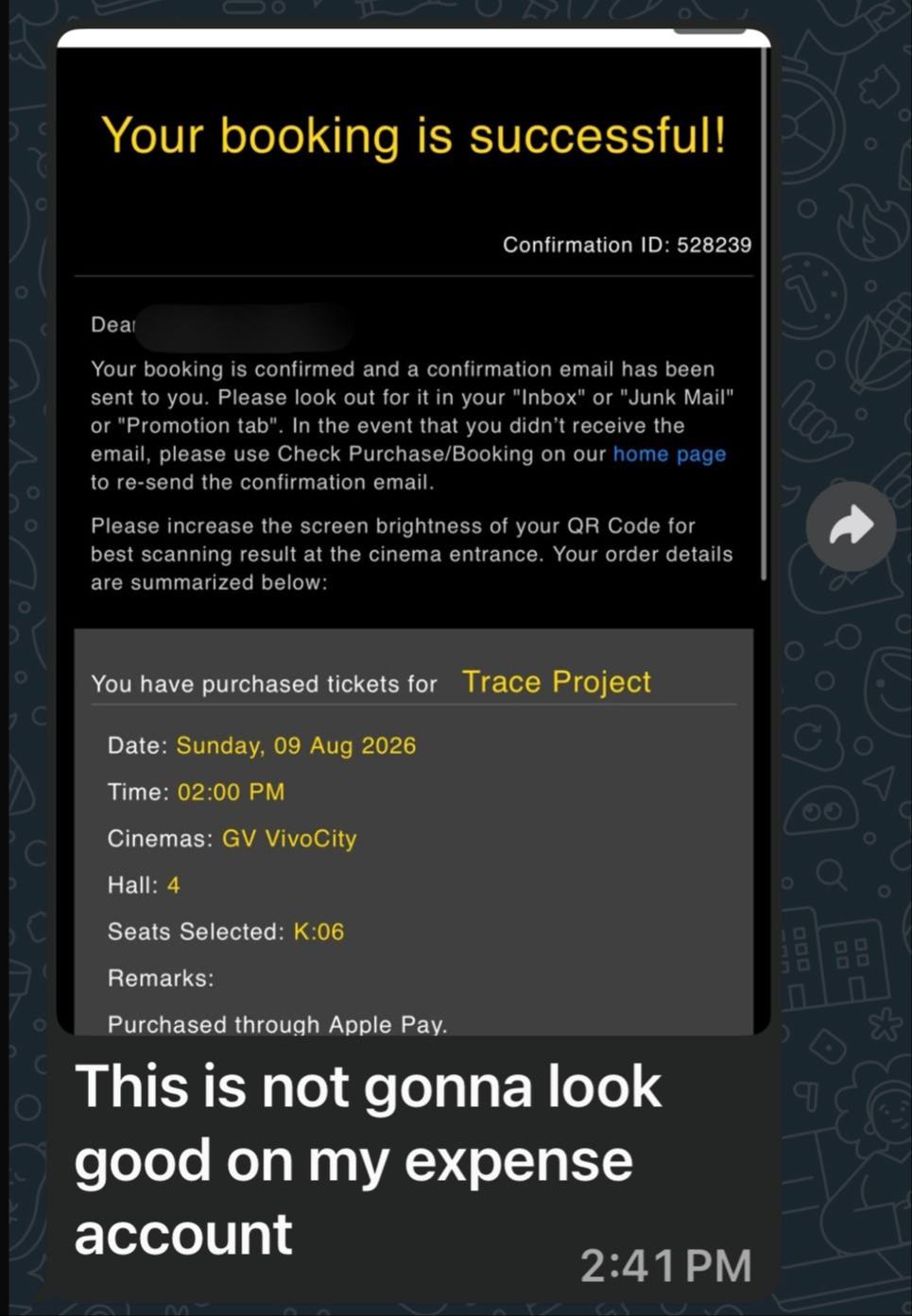
I paid a total of S$21.50 for the movie tickets, S$19 for the actual tickets and S$2.50 for online booking convenience fees.
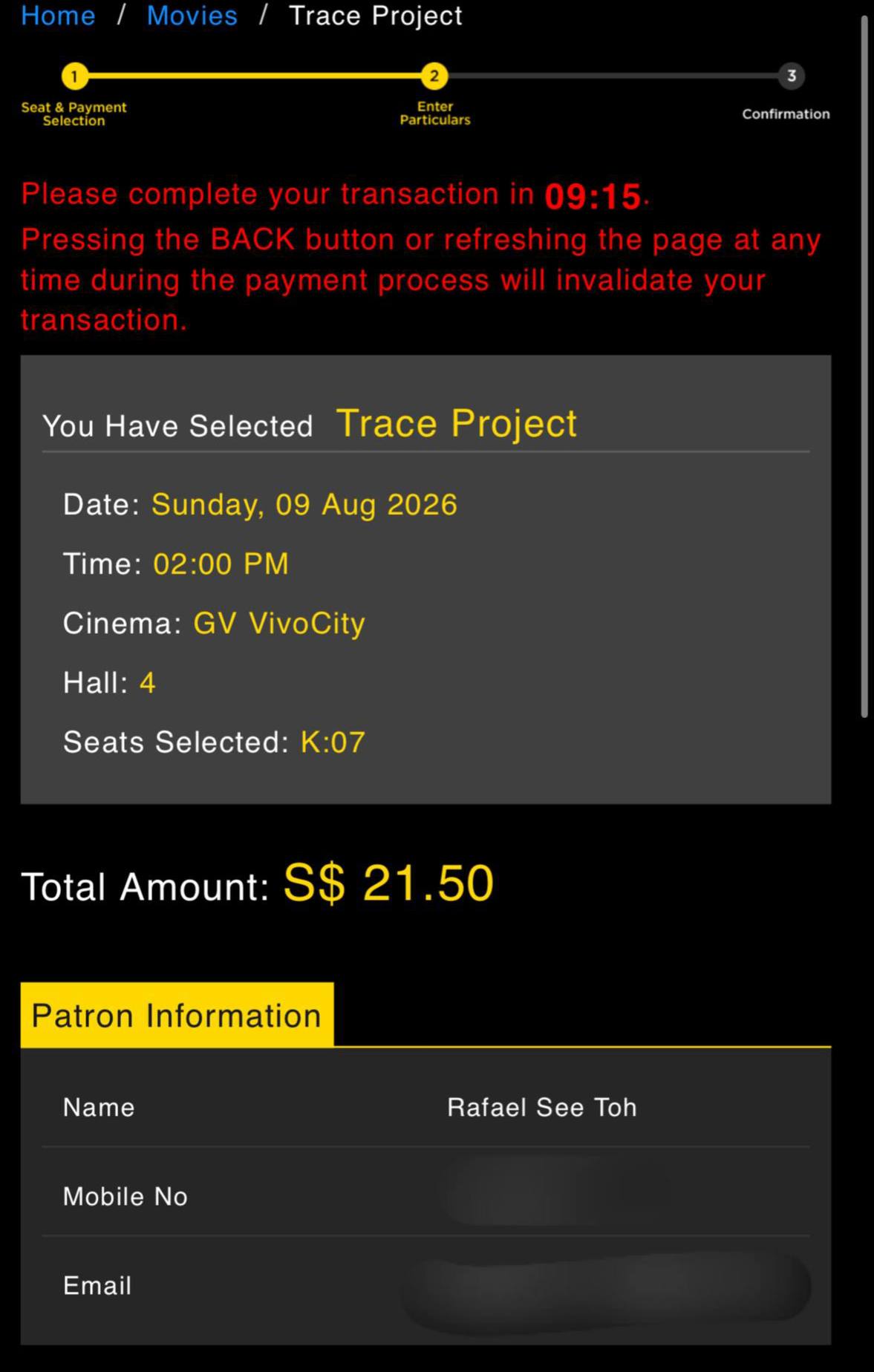 Screenshot from Golden Village
Begged friends
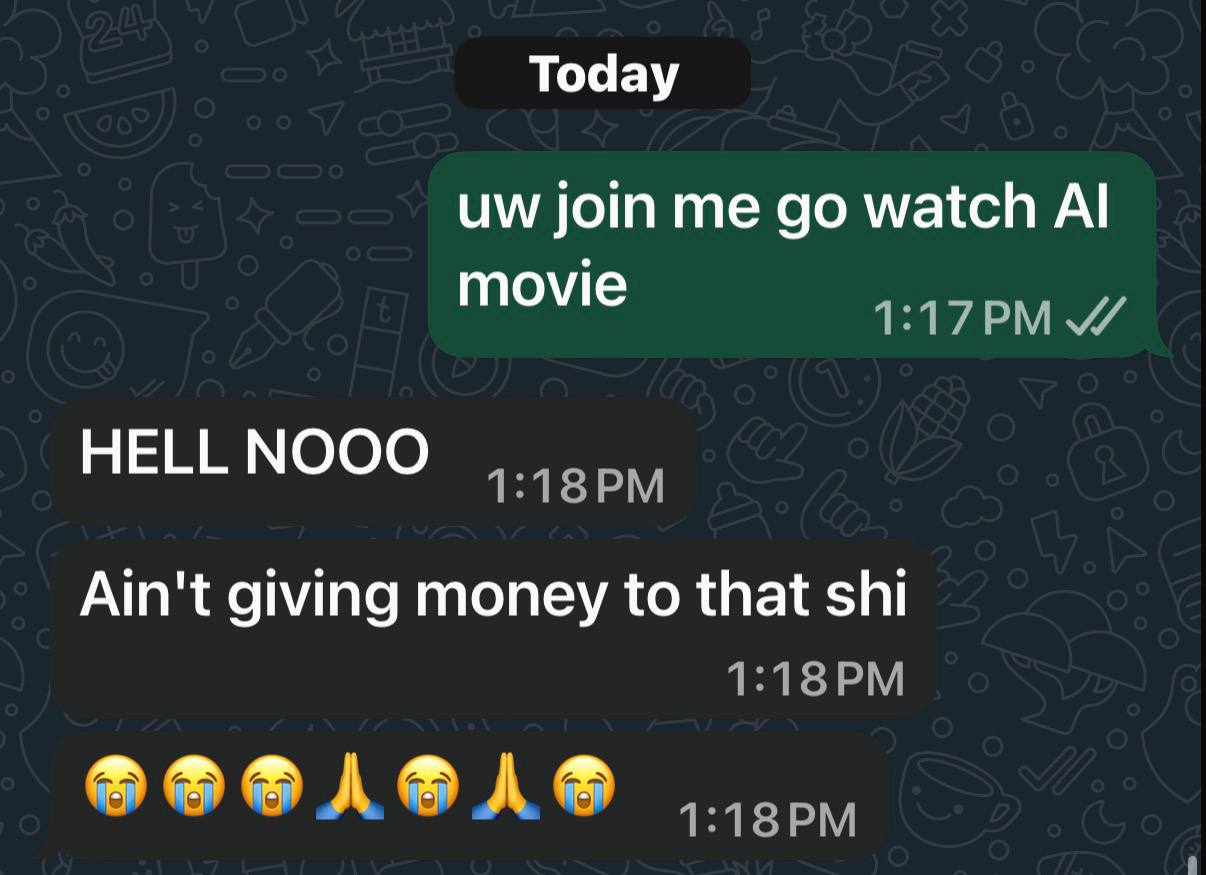
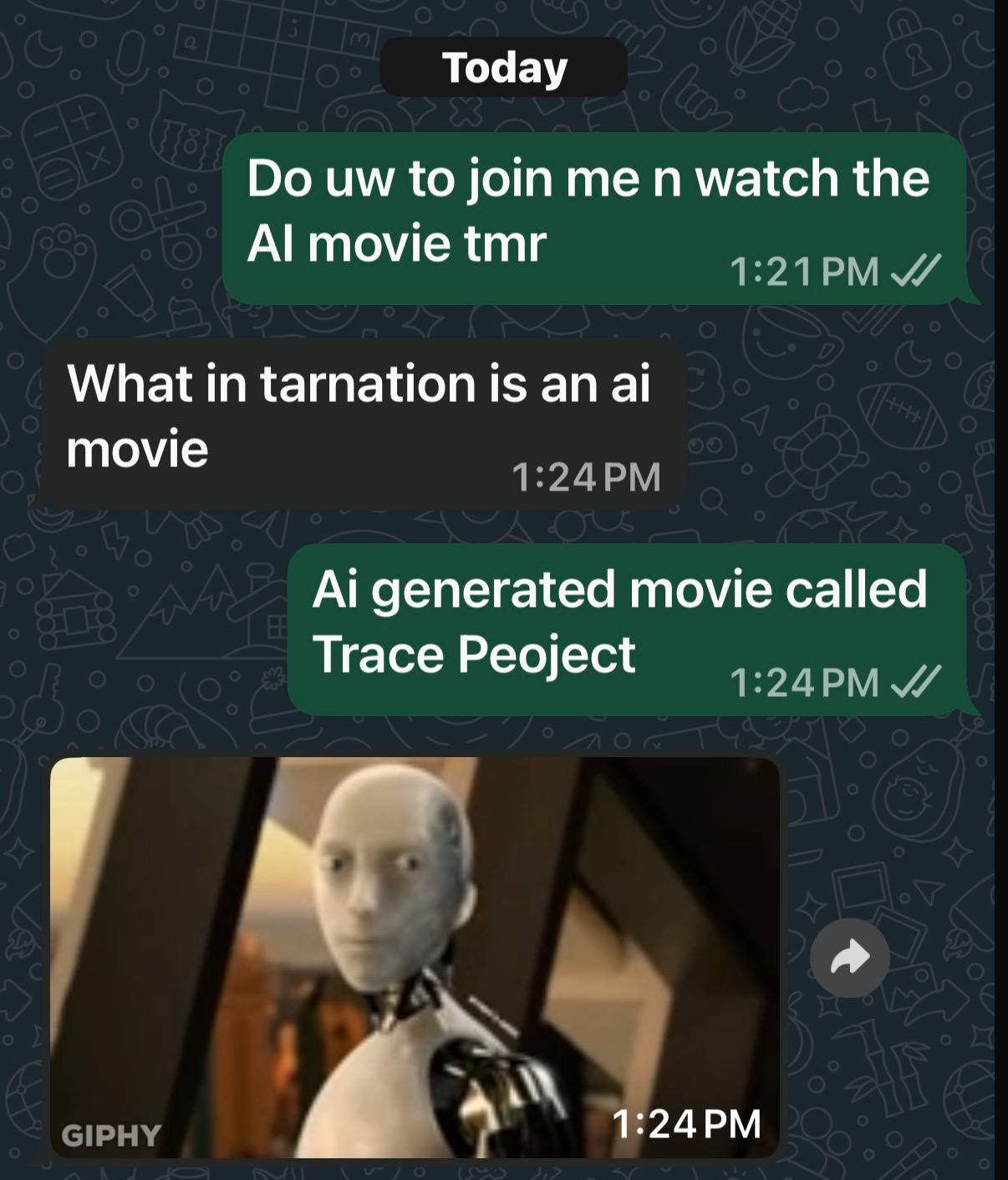
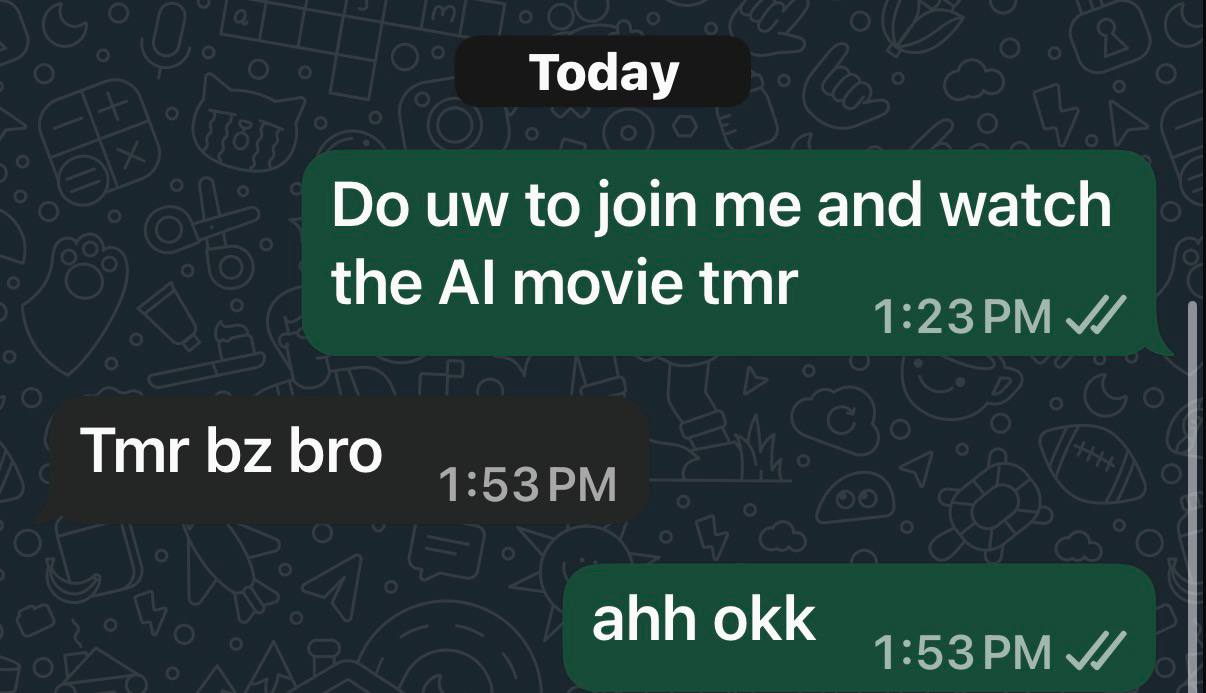
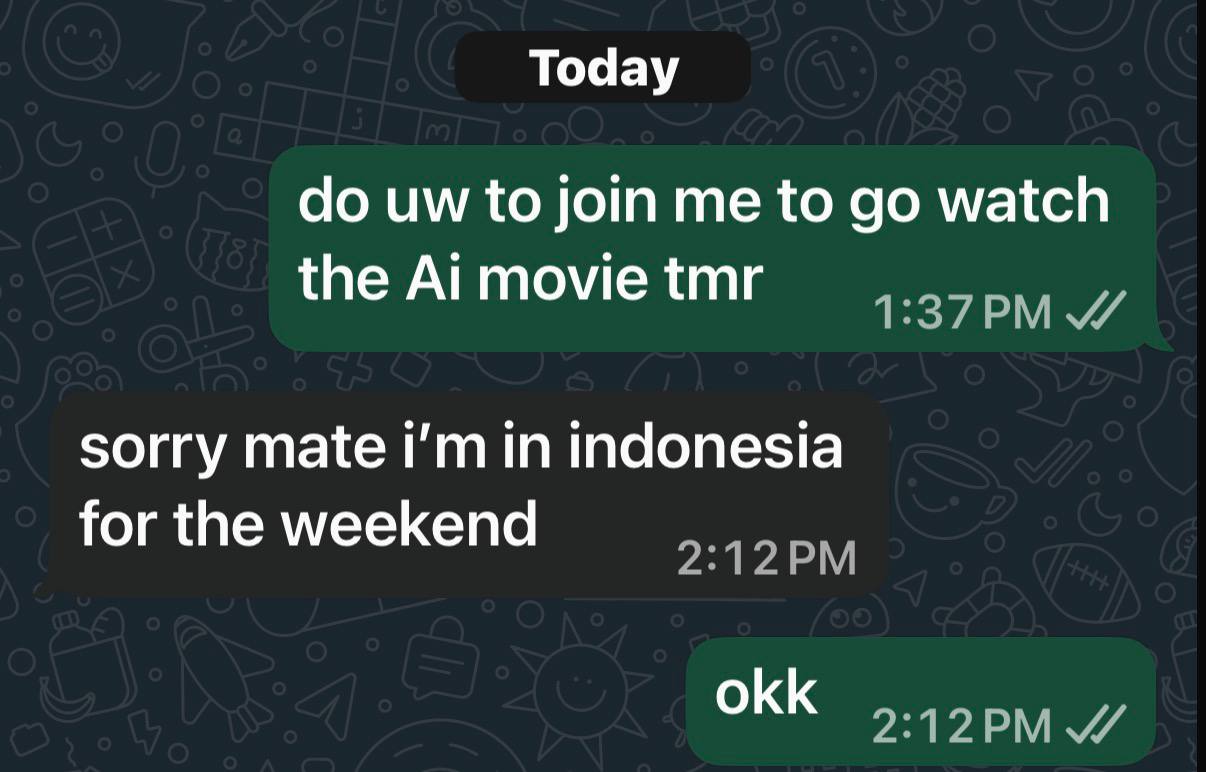
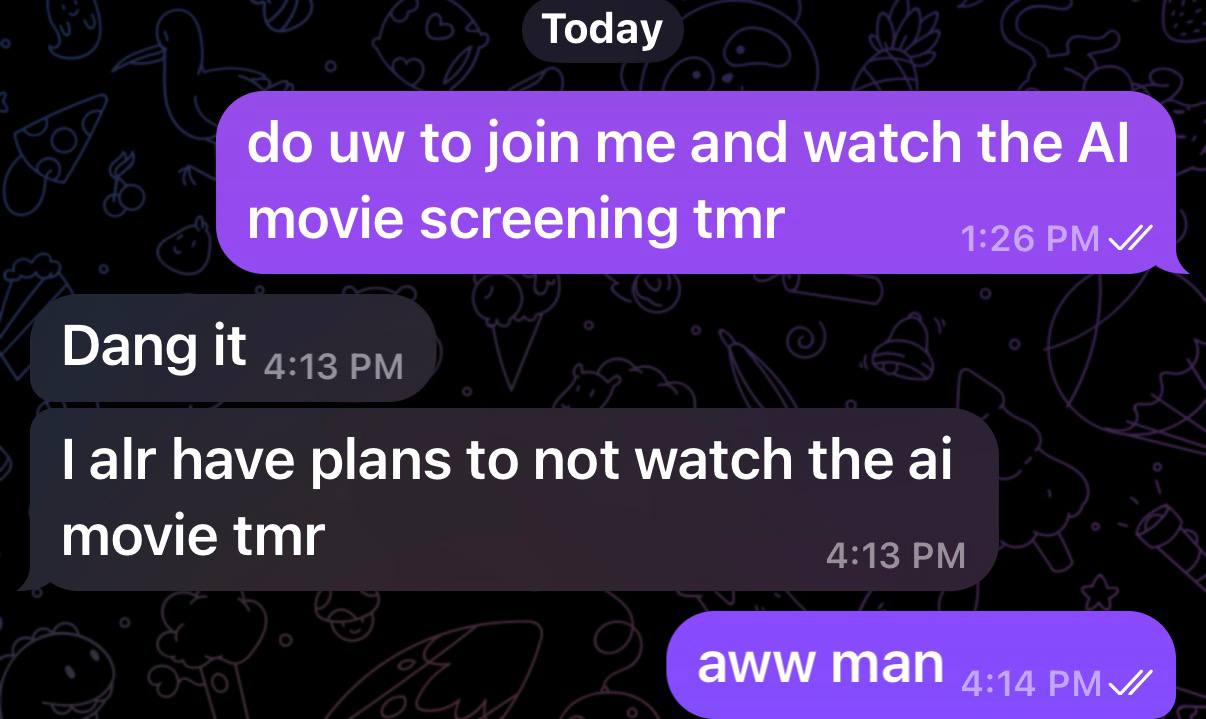
Since it was a public holiday, I also decided to ask a few of my friends, who were aware of the movie's release, if they were willing to watch "Trace Project" with me.
These were their responses:
 Screenshot from Rafael See Toh/ Mothership
 Screenshot from Rafael See Toh/ Mothership
 Screenshot from Rafael See Toh/ Mothership
 Screenshot from Rafael See Toh/ Mothership
 Screenshot from Rafael See Toh/ Mothership
While most of my friends responded with resounding rejection, only one of my friends, Matthew, was interested in watching “Trace Project”.
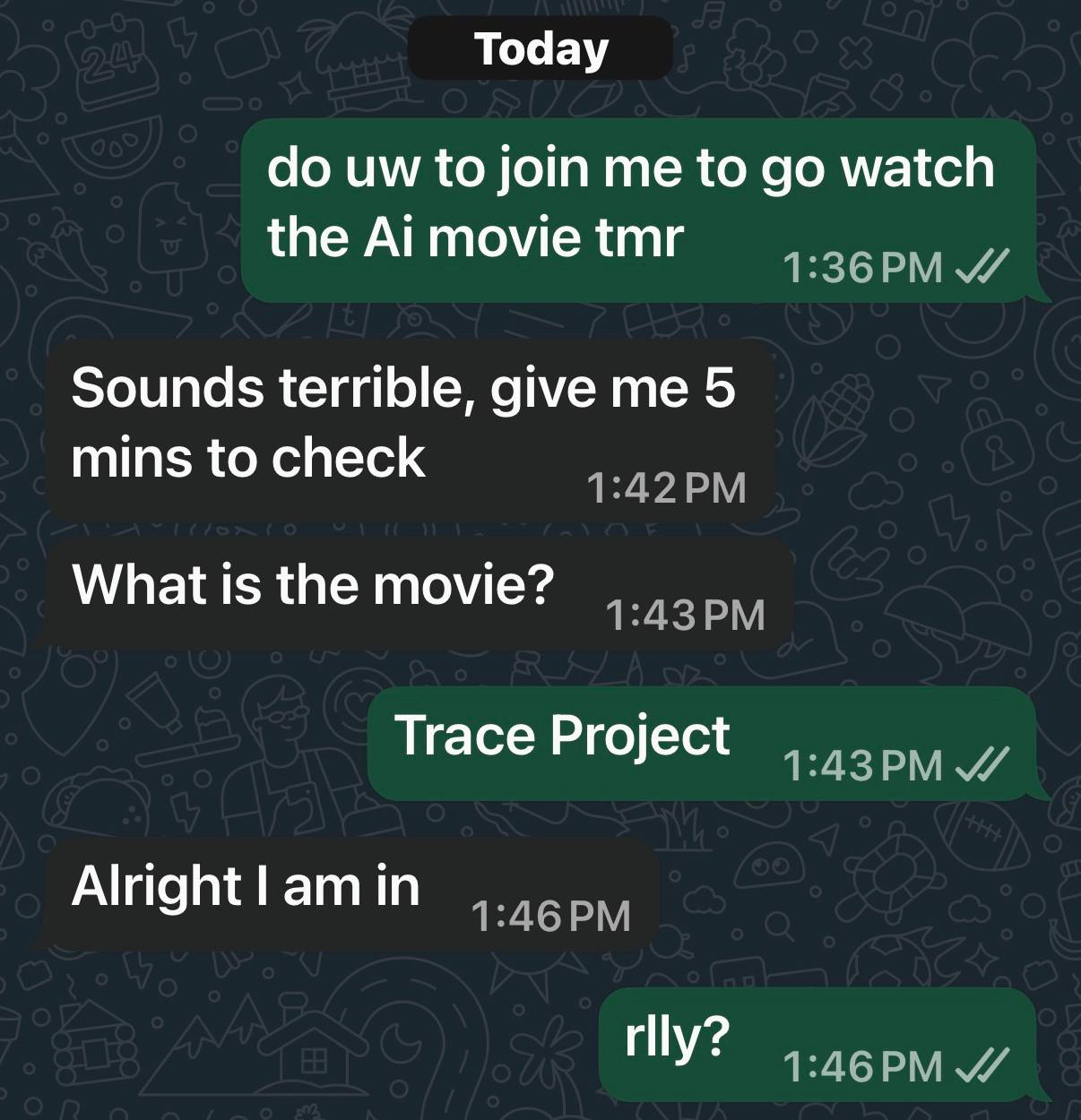 Screenshot from Rafael See Toh/ Mothership
After much discussion, he also paid S$21.50 to secure a ticket to the movie.
 Screenshot from Rafael See Toh/ Mothership
Attendance
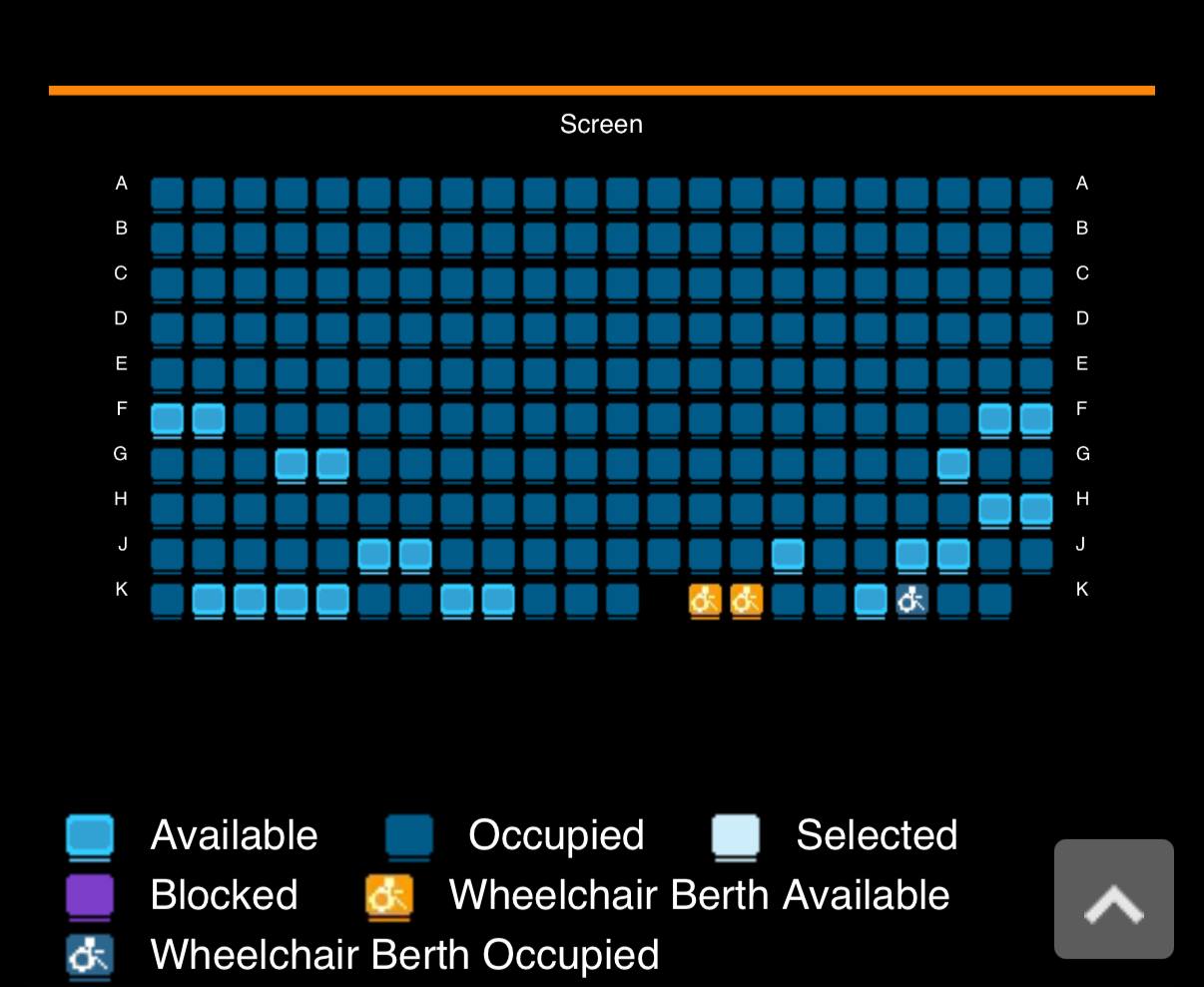
Checks by Mothership revealed that more than 80 per cent of seats for the movie were occupied.
 Screenshot from Golden Village
This puzzled me, given the negative sentiments online.
Why would people pay to watch it?
Were they all like me?
Invited guests
Upon arrival on the day of screening, we observed the team at FizzDragon, the production company behind “Trace Project”, handing out tickets to invited audiences.
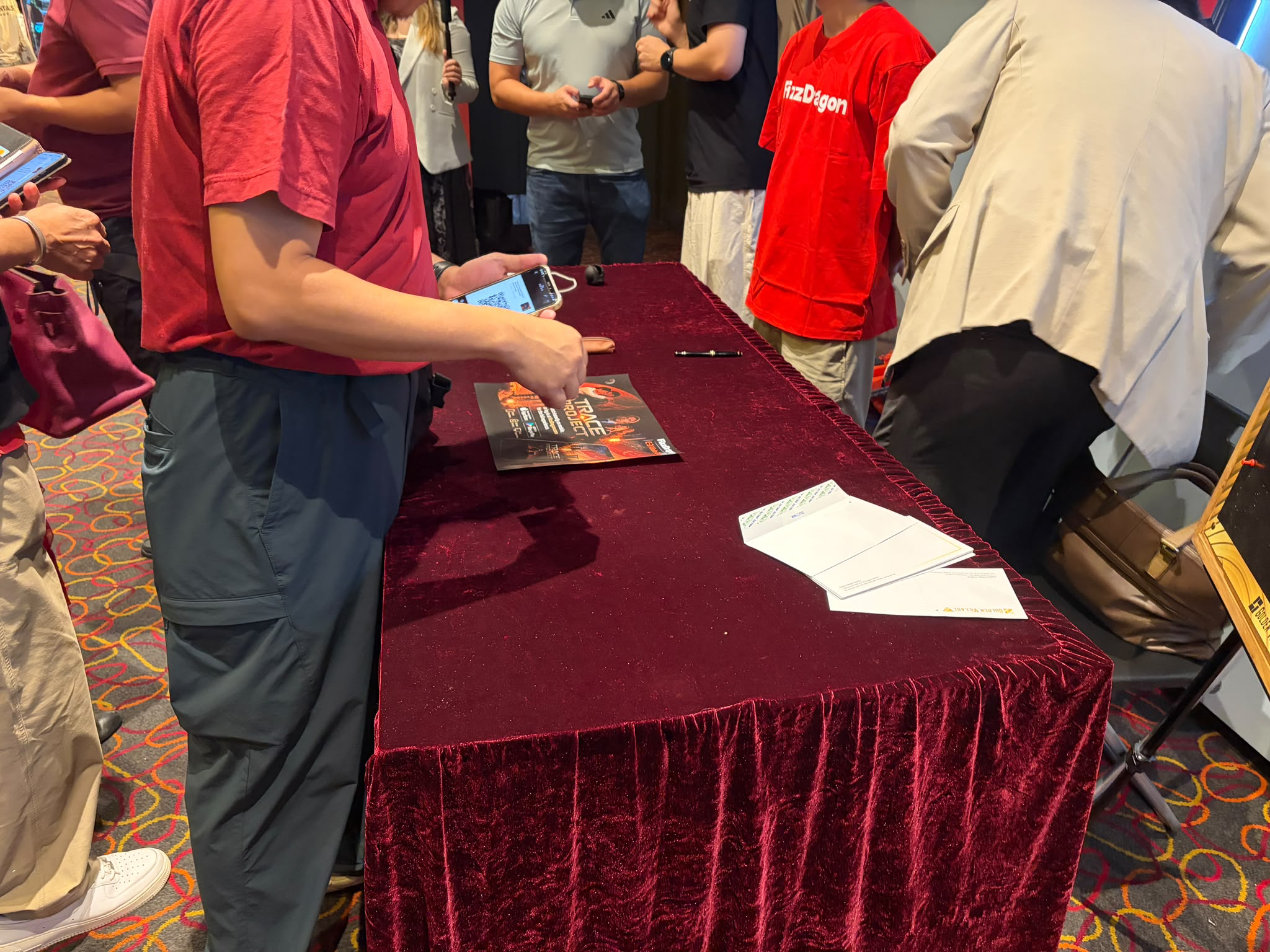 Photo from Rafael See Toh/ Mothership
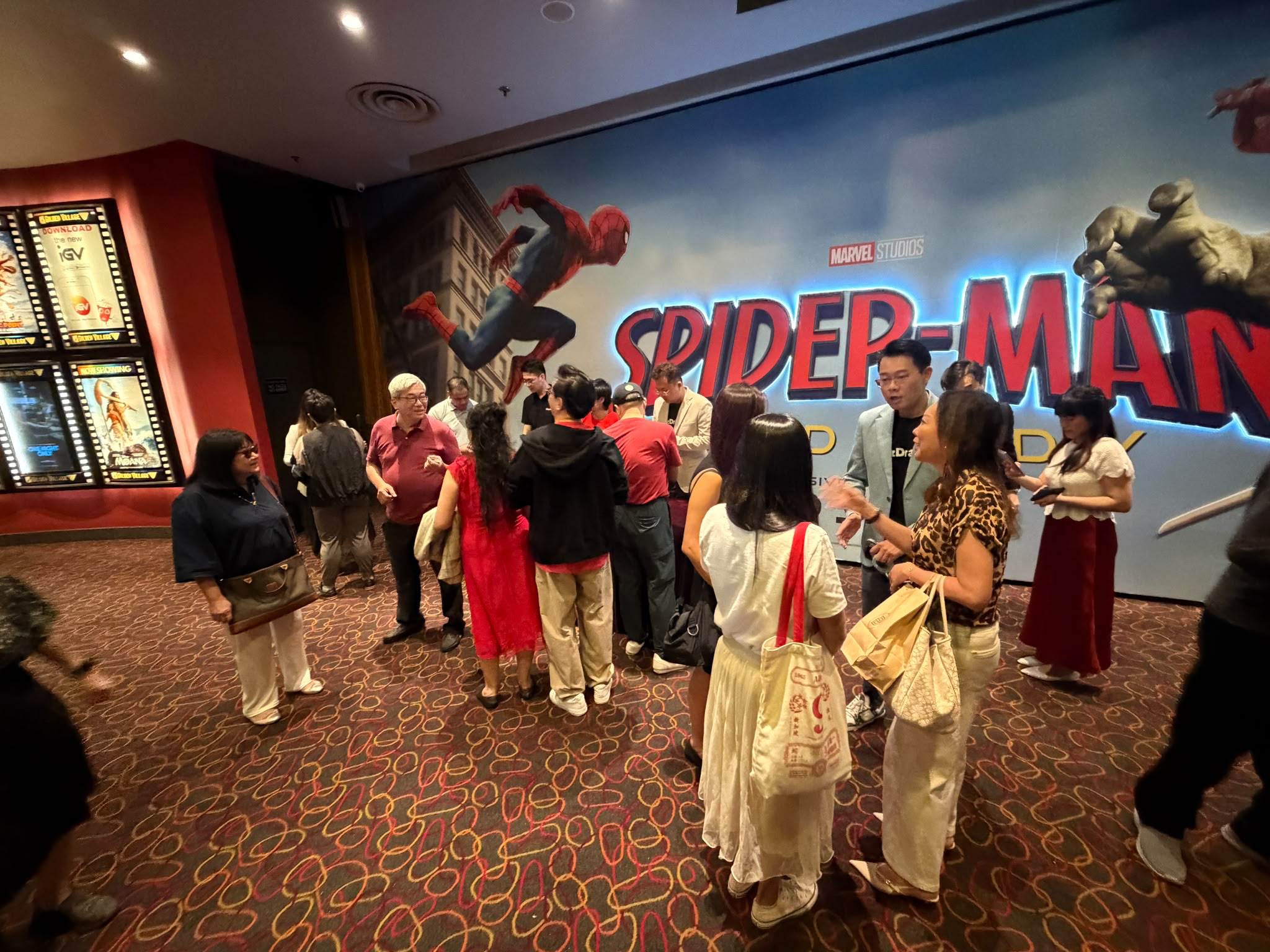 Photo from Rafael See Toh/ Mothership
Those audiences comprised content creators, contributors to the movie and their friends and family.
When I spoke to Pax Chen, the founder and CEO of FizzDragon, she claimed that “around 50 per cent bought the tickets" and "another 50 per cent" were invited.
We also observed a significant number of middle-aged individuals entering the cinema hall.
After purchasing some snacks, we decided to head in.
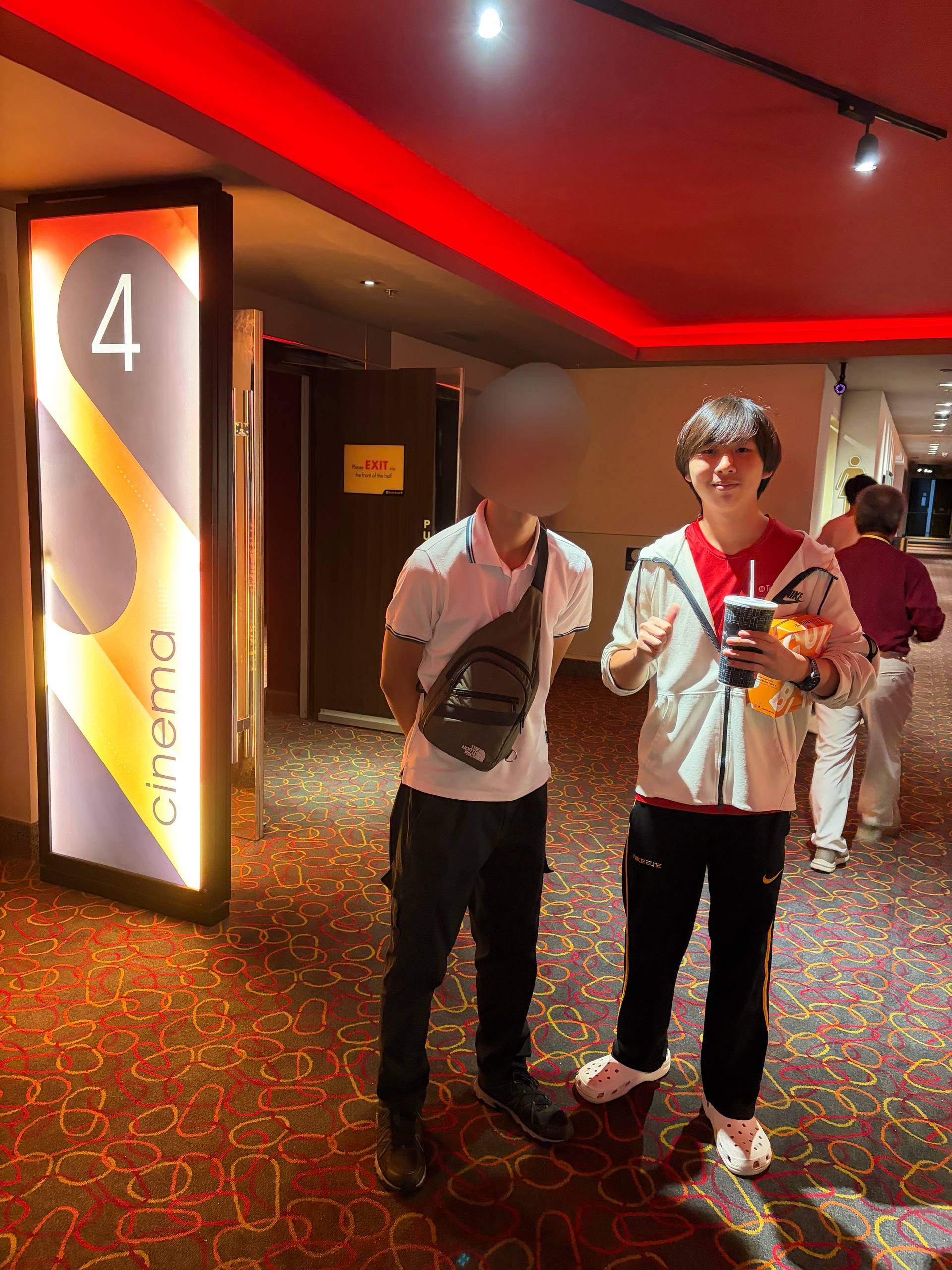 Photo from Rafael See Toh/ Mothership
Addressed the crowd
Before the movie screened, the FizzDragon team greeted the crowd and expressed their gratitude to the audience.
Former People's Action Party (PAP) Member of Parliament Teo Ho Pin also made an appearance and addressed the crowd.
He shared about Singapore’s aspirations “to be a smart nation and a city of dreams”, and he hoped this movie could be a way to “inspire our people to be creative and dream” to achieve this.
The movie commenced soon after.
Review
“Trace Project” felt lacklustre and was genuinely underwhelming.
While the plot of the movie aimed to be inspiring, the movie’s AI-generated visuals and directorial approach severely undermined the story.
The pacing of the movie felt quick, with too many disruptive jump cuts and inadequate exposition.
The movie lacked any notable narrative structure, leaving a lot of plot holes to fill.
This was detrimental in establishing its protagonist, Lin Jia Jun.
Noticeable errors and visual defects due to the AI models used were also present throughout the movie.
At some points, Lin would bear the Singapore flag on his sleeves when he was on Mars.
The flag would frequently show mistakes.
Such examples include the flag featuring six to eight stars instead of five, and it would occasionally morph into a foreign flag.
 Photo from FizzDragon/ YouTube
The portrayal of the characters also felt unnatural.
On some occasions, the voice “actors” would mispronounce words such as “kilometre” and “acknowledged”.
The AI model used felt outdated too.
Sentiments
I was not alone in these sentiments either.
One of those moviegoers whom I spoke to, a 15-year-old who chose to remain anonymous, told me he paid to watch “Trace Project” as he was curious.
When asked about his views on the movie, he said it was “horrible as there were so many mistakes”.
“I am never watching anything AI-generated ever again,” he added.
Matthew, who sat beside me during the screening, expressed disappointment with the movie's creativity when I asked him about the movie.
He criticised the movie’s pace and the depictions of the characters.
“They act so unnatural, so non-human-like that it's distracting all the way through. From start to finish, you are constantly told, this is AI-generated, this is AI-generated,” he said.
Matthew also said he regretted watching the movie.
He felt he could have done something else, he said: “Instead, I decided, hey, why not torture ourselves for today?”
Reviews online also revealed similar reactions.
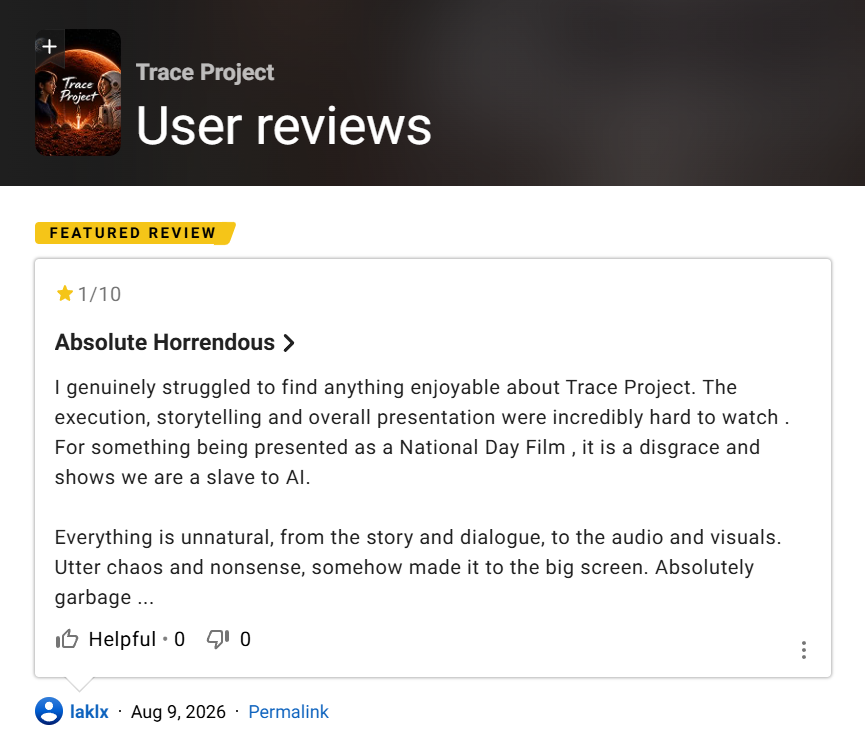 Screenshot from IMDB
Unintentionally funny
However, some felt that its lacklustre quality made it “comedic”.
Brian, a 25-year-old who also paid to watch “Trace Project”, told me that if audiences were to “approach this more as a comedy than an actual drama”, it made the movie “quite entertaining”.
“The movie has a lot of plot holes and unresolved storylines. But if you just forget about all that and just think about what goofy lines the characters are saying, you'll have quite a good time,” he said.
Proof of concept
After the screening concluded, FizzDragon held a question-and-answer session.
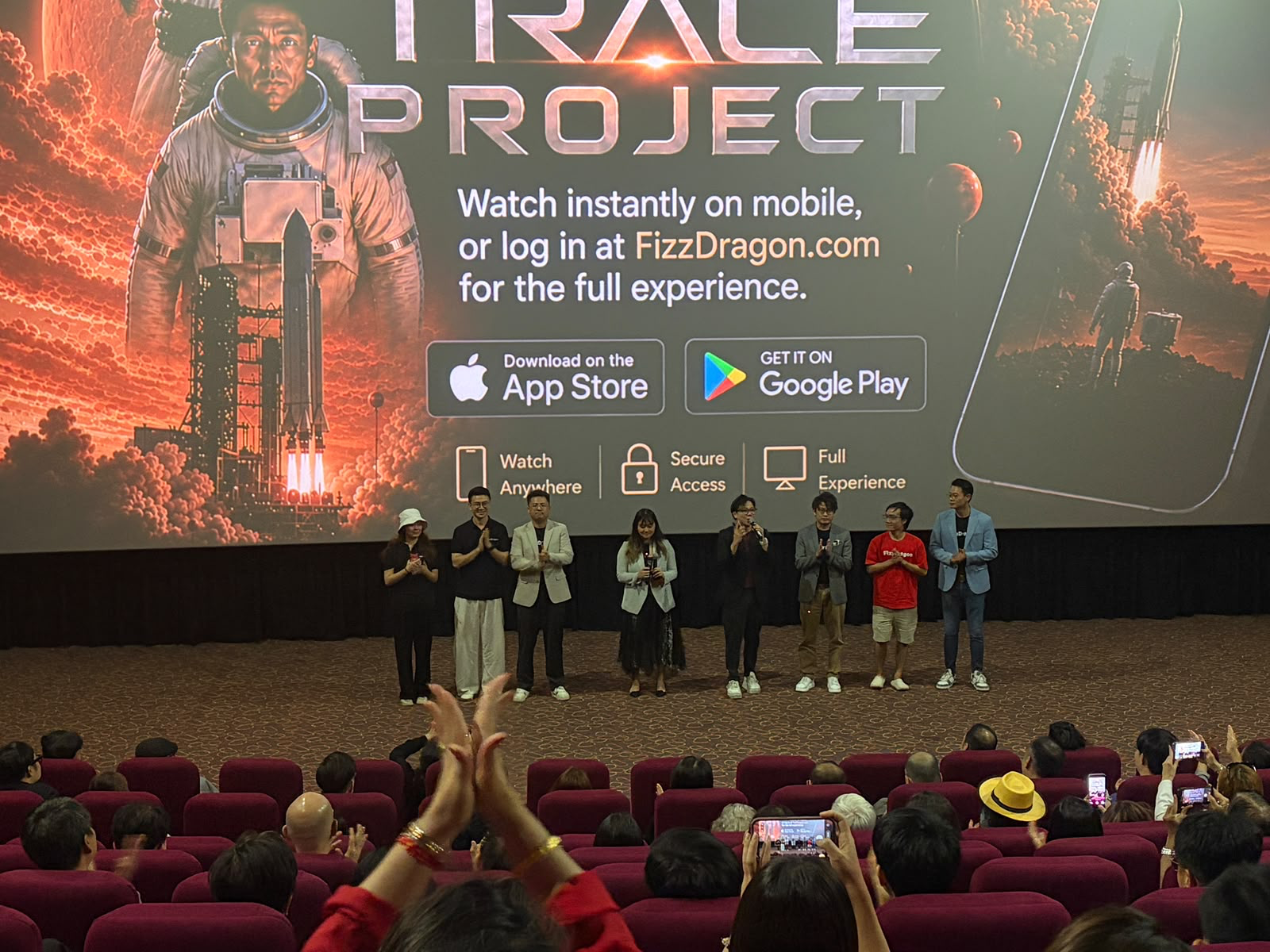 Photo from Rafael See Toh/ Mothership
While moviegoers asked questions, such as the production timelines and the cost and profit made from producing the movie, others also queried the team on the visual defects and errors in the movie.
FizzDragon claimed that while most of the visuals were AI-generated, the script was mainly human-written.
They also acknowledged the mistakes and said the movie took about two to three months to produce.
The team also admitted that they “rushed” it so that the movie could be premiered on National Day.
“We see a lot of things need to be improved,” Chen said.
However, FizzDragon assured that it would make adequate rectifications for the movie.
Some of the movie's audiences also viewed the premiere as a proof of concept rather than a final product.
Juan, a film producer in his 50s who attended the movie via an invite, said this movie is a “work in progress”.
“While it is quite lauded that AI can take us so far. I think generally certain storytelling nuances and context still fall a bit short, but I'm also very aware that perhaps the team also understands that,” he said.
“I think the spirit behind the company and the creators is actually good because I think they know that everything is a work in progress and they are willing to continue to improve what they have,” Juan added.
Juan also said he supported FizzDragon, claiming its moves were “rather progressive”.
When asked if the movie was indeed a proof of concept, Chen assured it was a “finalised project” that “can be improved along the way”.
“This is the magic of AIGC (AI-generated content). You can always improve along the way,” she added.
Art
Ultimately, the backlash to this movie was warranted to a certain extent.
As someone who has been involved in the production of short films and videos, I did initially share similar sentiments.
While FizzDragon pushed the use of generative AI as a way of minimising production costs, I feel that the art of creating a film should be based on human ingenuity and passion.
Matthew felt the same.
“Art is not labour in the same way that construction, automation, and manufacturing are laborious. People make art because they love it. The labour of love is why artists create, every detail, every design, made with intention.” he said.
“I can't help but flinch throughout the film. I really despise AI-generated imagery,” he added.
What is good?
While the negative aspects mainly revolved around the use of AI for the movie, the only good part was its storyline of showcasing a lofty Singaporean ambition.
However, as FizzDragon said, the script was mainly produced by humans.
If a production team were to make a full-fledged feature film with adequate pacing and exposition combined with creative cinematography while using the plot of “Trace Project”, I believe the movie would have potentially performed well.
However, this kind of creativity requires human ingenuity and does not necessarily rely on trained data.
After all, cinematic flourishes such as the transitions in Park Chan-Wook films, the step-printing effects in movies directed by Wong Kar-wai, or the Singaporean-tailored narratives in Jack Neo’s films were all made through human ingenuity.
There is a chance that AI-generated movies will feel generic and soulless without those flourishes.
Until then, the best part of “Trace Project” was that it made me feel something so strongly.
Which is human.
Singapore Film Society response
In response to Mothership's queries, Kenneth Tan, chairman of Singapore Film Society, said: "SFS did not recommend that this film be screened on that date or on any date. We did not recommend or suggest anything in relation to it."
When asked if there were guidelines for cinemas and film organisations to consider before giving new movies a theatrical screening, Tan responded: "From my own experience in the industry, cinemas generally take into consideration the anticipated levels of appeal or attractiveness to, and therefore, attendance by, the target audience for each film."
"Another natural consideration would be, the number of other films also available for programming or screening during any particular period or range of dates," he added.