Abroad


5.9-magnitude aftershock hits eastern Indonesia as deaths from initial earthquake climbs to 54
Most of the displaced spent the night outdoors, wary of aftershocks.
August 17, 2026, 11:22 AM
Top photo from BNPB/Facebook


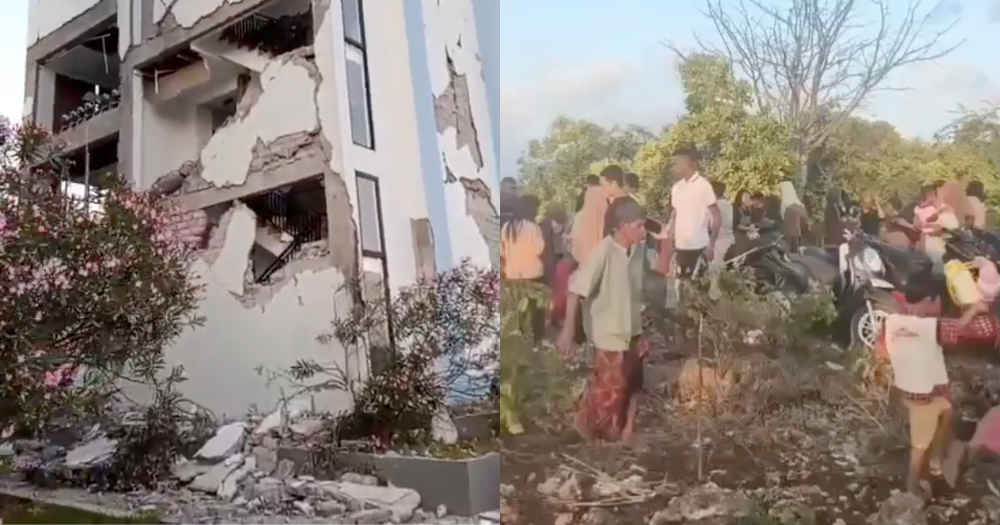
A magnitude 5.9 aftershock hit Indonesia's Flores island on Aug. 17, two days after a magnitude 7.7 earthquake rattled six regencies.
According to an infographic posted to Facebook by Indonesia's National Agency for Disaster Countermeasures (BNPB), there have been at least 54 deaths, 199 injured, and 9,963 people displaced by the quake.
In terms of property damage, 2,403 homes were damaged, of which 1,543 were severely damaged, 328 moderately damaged and 532 slightly damaged.
According to the South China Morning Post (SCMP), the German Research Centre for Geosciences said the depth of the aftershock was 10 km.
Those affected by the quake slept outdoors, wary of aftershocks, SCMP reported.
Most landslides cleared & roads reopened
SCMP reported that rescuers focused efforts on three regencies that remained unreachable: Manggarai, East Manggarai and Nagekeo.
Head of the search-and-rescue office in Maumere, the capital of Sikka regency on Flores, Fathur Rahman said: "We have cleared most landslides and reopened roads to previously isolated villages, although communication disruptions and power outages continue to hamper search efforts".
The Trans-Flores Highway, an approximately 700km road, had sections blocked by landslides.
At least 995 aftershocks have been recorded by authorities, with 46 felt by residents, said the National Disaster Management Agency’s chief for disaster prevention, Abdul Muhari.
Intense aftershocks shook homes
Residents at Labuan Bajo, the entryway to Komodo National Park, slept outdoors as aftershocks shook homes.
SCMP reported that a farmer, Anastasia Imad, said: "The shaking was terrifying, so intense that my house nearly collapsed."
“We feared the aftershocks would bring it down on us while we slept.”
Relief workers distributed food, water and medicine while emergency shelters were set up for those who were displaced.
Restoring electricity and communications, as well as delivering aid to remote villages isolated by landslides, were among the biggest challenges, said authorities.
Prior disasters
Indonesia sits on the Pacific Ring of Fire, a horseshoe-shaped region where roughly 90 per cent of all earthquakes recorded occur due to seismic activity.
Flores itself has experienced some of Indonesia's deadliest natural disasters, including a 7.7-magnitude earthquake and tsunami in 1992 that killed 2,500 people, reported The Bangkok Post.
In 2018, a magnitude 7.5 earthquake triggered a tsunami on the island of Sulawesi, killing more than 4,340 people.
The Boxing Day earthquake of 2004, which struck off the coast of Sumatra, measured a magnitude of 9.1; it triggered a tsunami that killed around 230,000 people in a dozen countries.