News


Over S$1.9 million beauty prepayment losses reported in 1st half of 2026, nearly 18 times more than year before: CASE
Most complaints were about beauty businesses failing to honour contractual obligations, such as after sudden closures.
August 14, 2026, 06:41 PM
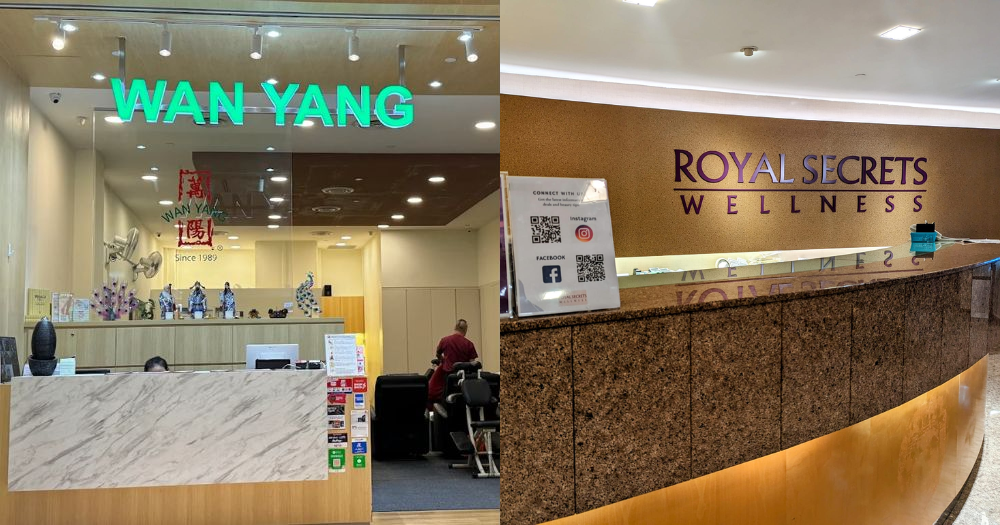
Photos from Google Maps and Royal Secrets Wellness' Facebook


Consumer complaints against the beauty industry rose to 1,124 over the first half of 2026, the most reported among Singapore industries to the Consumers Association of Singapore (CASE).
Over S$1.9 million losses from prepayment packages were recorded from these complaints.
This is close to 18 times the S$108,000 in losses recorded from 558 beauty-related complaints in the first half of 2025.
Abrupt beauty business closures
"The increases in complaints and prepayment losses were largely driven by the abrupt closure of several beauty and wellness businesses," CASE explained.
Following such sudden closures, consumers were not able to utilise their prepaid packages. The association highlighted recent examples that made headlines.
The Wan Yang chain of massage and foot reflexology parlours, which abruptly closed all outlets in November 2025, led to over S$137,000 in losses for unutilised prepaid packages.
The February 2026 closure of Royal Secrets Wellness beauty salon and spa resulted in prepayment losses exceeding S$1 million. One person reported a loss of about S$50,000.
Nearly four in 10 complaints CASE received against the beauty industry were related to businesses failing to honour these types of contractual obligations.
About 15.3 per cent of complaints involved alleged unethical sales tactics, while a further 13.8 per cent concerned delayed, refused, or withheld refunds.
Risks of making upfront payments
CASE President Melvin Yong called the sharp rise in beauty-related prepayment losses "deeply concerning".
"Behind the reported losses are consumers who paid in advance for services they may never receive. This underscores the risks of making large upfront payments for beauty packages, especially when businesses close suddenly."
CASE will continue to call for stronger safeguards to better protect consumers' prepayments.
In the meantime, Yong advised consumers to avoid making large advance payments where possible, and consider paying per use or in smaller instalments.
Electrical and electronics
After beauty, the four most complained-about industries for this period are, in descending order, electrical and electronics, motorcars, travel, and renovation contractors.
The number of complaints against the electrical and electronics industry dipped slightly from 571 in the first half of 2025, to 530 in the same period in 2026.
Most of them (about 38.9 per cent) involved products that were defective or did not conform to contract terms.
About 14.7 per cent were related to businesses failing to honour their contractual obligations, and 9.4 per
cent concerned delayed, refused, or withheld refunds.
Motorcars
Motorcars, which received the highest complaints the previous year with 573, fell to third place this time with 488 complaints.
About 45.7 per cent of them were related to purchases and privately owned cars, while another 12.5 per cent involved car-sharing services.
Travel
As for the travel industry, complaints increased by 19.3 per cent from the previous year to 192 in the first half of 2026.
About 36.9 per cent of complaints against the travel industry concerned delays or refusals in processing refunds.
A further 17.3 per cent were about businesses failing to honour confirmed bookings or agreed travel arrangements.
CASE said that the rise in travel and airline-related complaints comes amid recent air travel disruptions caused by geopolitical tensions and changes to flight schedules.
As a result of these conditions, chances of cancellations, itinerary changes, and service disruptions increased.
It is particularly common in cases where consumers make transactions through intermediaries such as online travel agencies.
Renovation contractors
CASE received 402 complaints against the renovation contractor industry in the first half of 2026, a very slight 1.5 per cent decrease from the same period in 2025.
Most consumers reported dissatisfaction with the quality of services rendered such as poor workmanship, and contractors' failure to honour obligations.
Defective or non-conforming goods, and delays in delivery were also key concerns raised.