



News


Terrorist, tutor, trader, & thief: 4 attempted escapees from S'pore law
One remains at large.
August 14, 2026, 04:41 PM
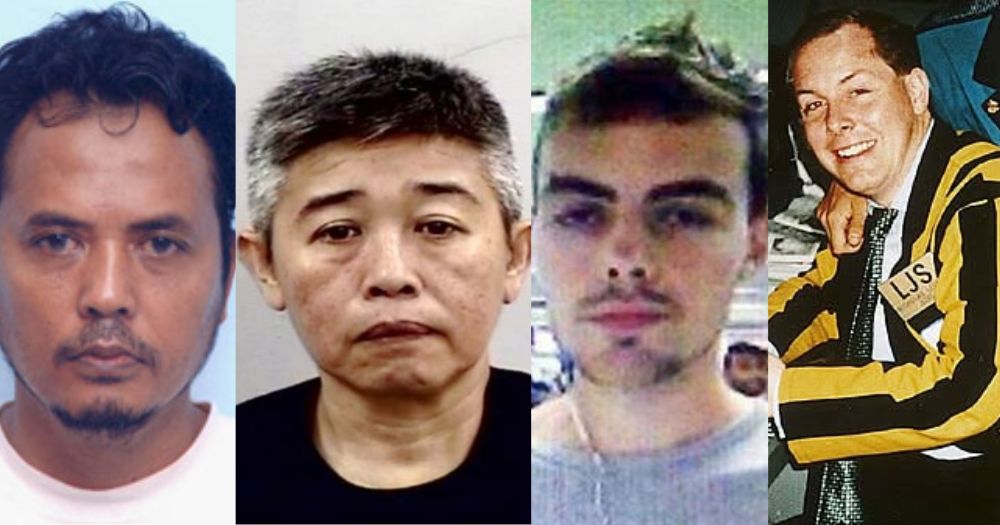
Image via MHA, SPF, & Nick Leeson/Facebook


With the arrest and extradition of former lawyer Lim Tean, there has been much talk about his decision to evade jail by escaping to Johor.
His escape was short-lived, but what about other people who have absconded from Singaporean justice? Here are four other prominent names who have fled, or tried to flee, Singapore to evade the law.
Mas Selamat Kastari
Of all the people who have absconded from Singaporean law, none has made as large an impact as Mas Selamat Kastari.
Mas Selamat was the former head of Jemaah Islamiyah's Singapore branch who famously escaped from the Whitley Road Detention Centre in February 2008.
A suspected terrorist, he had been detained for nearly two years since 2006, when he was deported from Indonesia to Singapore, where he was detained without trial under the Internal Security Act.
He took advantage of a family visit day, when he was allowed to change into civilian clothes.
Asking for privacy, he went into a toilet stall, was allowed to close the door behind him and be totally obscured from sight.
There he let a tap run, while he escaped through a grille-less window, climbed down a drainpipe, and slipped through a weak point in the centre’s fencing.
He evaded police for four days despite an extensive manhunt, and managed to swim across the Strait of Johor undetected.
Once in Johor, he managed to evade police for over a year before he was arrested in a small hamlet located just outside Johor Bahru.
He was eventually found after the Royal Malaysia Police detained three former JI members, who revealed Mas Selamat’s location under interrogation.
Mas Selamat was detained for two years by Malaysia and was eventually transferred to Singaporean custody in 2010, where he remains imprisoned indefinitely.
Pony Poh
Unlike Mas Selamat, over whom a lot of ink has been spilt about his escape and return, more mysterious is the fate of one Pony Poh.
Poh Yuan Nie, also known as Pony Poh, was a principal of a tuition centre who was found guilty of 27 counts of cheating for helping six foreign students cheat during the 2016 GCSE O-Level examinations.
As part of an elaborate scheme, Poh masterminded a scheme where one accomplice would take an examination and transmit the questions to another pair of accomplices who would work out the answers.
The pair would then send the answers to the six students, who would be wearing concealed smartphones and flesh-tone earphones to receive.
But the plan was foiled when an invigilator noticed electronic sounds and voices coming from one of the students.
Poh was found to be the mastermind of the scheme, and in 2020 was sentenced to four years in jail.
During the trial, Poh's lawyer appeared to insinuate that the offences stemmed from one of Poh's accomplices being a spurned lover, who was in a relationship with Poh for seven years but did not realise that Poh was not a man.
But Poh, then 56, failed to appear in court on Nov. 23, 2022, and in December 2022, the Deputy Public Prosecutor applied to the court for a warrant of arrest for Poh to be executed outside of the jurisdiction.
This allowed for an Interpol Red Notice to be made.
As of January 2025, Poh and about 40 other Singaporeans have Interpol Red Notices against them.
Despite this, Poh has evaded arrest for nearly four years.
Nick Leeson
Nick Leeson will be instantly familiar to millennials of a certain age or, weirdly, die-hard Ewan McGregor fans.
Nick Leeson was the British derivatives trader who famously single-handedly brought down one of the United Kingdom’s oldest financial institutions, Barings Bank.
Barings was founded in 1762 and set up Barings Futures (Singapore) (BFS) in 1986, with Leeson arriving in the country in 1992 as BFS's derivatives operations manager and eventually as a trader.
Leeson’s responsibilities eventually came to encompass front office operations, such as trading, but also back office operations, which processed the paperwork for such trades.
According to The Independent, this allowed Leeson to operate a secret and unauthorised trading account that was referred to as the “88888” account, which he used to hide trading losses.
It came to a head in 1995 when Leeson was betting on the Nikkei Index not falling below 19,000 points, when the 1995 Kobe earthquake hit, causing the stock exchange to plunge, causing losses of nearly S$1.4 billion.
Leeson realised that he would not be able to hide his losses, and chose to flee, first to Kuala Lumpur, and then back to England via Frankfurt.
Between 1992 and 1995, Leeson managed to rack up S$2.2 billion, about S$3.5 billion today, in losses in the account, coming close to being discovered on several occasions but managing to keep it hidden.
The bank was not able to absorb such a loss, causing the over 200-year-old bank to go into administration, and a warrant of arrest to be issued for Leeson.
Leeson was detained in Frankfurt when he arrived, initially attempting to fight extradition, but eventually agreed to return and pled guilty to two charges of fraud and forgery.
He was sentenced to six and a half years in prison, during which time his wife would divorce him, and he would be diagnosed with colon cancer.
He was eventually released early on one-third remission in 1999 for good behaviour, and eventually returned to the UK, where he has become a speaker at the after-dinner and keynote speaking circuits.
His actions would inform Singapore's amendments to the Futures Trading Act and take other measures to strengthen its regulatory framework of futures trading.
Perhaps the oddest thing to emerge from this is the 1999 Ewan McGregor film Rogue Trader, where he plays Leeson, which came out the same year he played Obi-Wan Kenobi in Star Wars Episode One.
It's a hard film to recommend; you might be better off watching Rogue Trader instead.
David James Roach
Another absconder that was eventually caught was the Standard Chartered robber.
In 2016, Canadian David James Roach robbed the Holland Village Branch of Standard Chartered Bank, making off with S$30,450 in cash.
He had handed the bank teller a note telling her, "This is a robbery, give me money, don't call the police, I have a weapon."
But in truth, all he had done was tuck his hand into an empty sling bag, and pretended that he had kept his weapon there.
Having robbed the bank at 11 am, by 2.40 pm the same day Roach was on an AirAsia flight to Bangkok.
But he was arrested upon arrival in Bangkok, not for the robbery, but for bringing more than US$20,000 in cash in Singapore currency, a restricted good.
Thai authorities declined to extradite him to Singapore, instead deciding to jail him for 14 months, after which they deported him to Canada.
But his route back to Canada took him through the United Kingdom, where he was further detained by UK police who agreed to return him to Singapore, but on the condition that the Singapore government promised not to cane Roach.
Roach eventually pled guilty to one charge of robbery and another of transferring criminal proceeds out of Singapore, and was sentenced to five years' imprisonment and six strokes of the cane.
He was granted clemency in 2021 by then-president Halimah Yacob regarding his caning sentence, in order to fulfil the assurances given to the UK government that allowed Roach’s return.