Branded

Want to invest in Grab & SpaceX? With less than S$30, you can start building your portfolio with SGX.
Time to blast your money past local borders.

Image via SpaceX


Unless your last name is Musk, you’re probably not hitching a ride on a SpaceX Falcon Heavy anytime soon.
But while SpaceX captures imaginations with rockets and Mars missions, investors may want to think about a more down-to-earth question: how do you build a global portfolio without needing a massive starting budget?
Here’s the good news: the Singapore Exchange (SGX) has given everyday investors a local launchpad called Singapore Depository Receipts (SDRs) to access overseas companies affordably.
Instead of needing a large sum to buy into individual foreign stocks, you can use a smaller budget—say S$1,000—to build exposure across several global names, including companies linked to the digital, consumer and space economies.
Here’s why SDRs are the ultimate financial rocket fuel for the common man on the street.
What exactly is an SDR?
It’s an investment instrument traded right here on the SGX that represents shares of a major company listed overseas (like Thailand, Hong Kong, Indonesia, and the U.S.).
Instead of the hassle of converting into foreign currency, opening a complicated foreign trading account and navigating overseas market rules, you just buy the SDR in Singapore dollars through your usual local broker.
Why SDRs are a flex
SDRs are not new and interest in them is growing exponentially.
Over the course of the past year, the daily traded value of SDRs more than tripled to over S$12 million while assets under management (AUM) more than doubled to over S$270 million, with the most popular names being Alibaba, BYD, and Tencent.
So why have SDRs become so popular?
1. Affordable: No "Crazy Rich Asians" budget required
Overseas stocks often force you to buy huge "board lots" that cost a fortune. SDRs chop those up into bite-sized pieces (known as “fractionalising”), making it the more affordable option if you don’t have that much capital to invest.
Let’s use the example of Chinese lithium-ion battery manufacturer CATL, whose products are used in electric cars and energy storage systems—a company with growth potential in this era of energy transition.
Listed on the Stock Exchange of Hong Kong, CATL shares are priced at HK$680 (S$112) each.
Minimum board lot size is 100 shares, which means you need a minimum investment of over S$11,000.
On the SGX, each CATL SDR represents a fraction of the HK shares (30 SDR = 1 share).
So each CATL SDR trades at S$3.73.
With a minimum board lot of 100 units, the minimum amount you need to start investing in CATL is S$373.
That’s not all.
Let’s say you’re an investor who has set aside S$1,000 for investing.
With the majority of SDRs at minimum investment amounts of under S$300, not only will stocks in leading companies like CATL become accessible, you will also get exposure to a wide array of stocks to build up your portfolio while keeping within your budget.
TL;DR: More cash on hand for your next vacation.
2. Convenient: Because who has time for currency math?
If doing mental currency conversion gives you a headache, you’re going to love this.
SDRs are traded on the SGX during normal Singapore market hours, using the exact same local brokerage account you use for everything else.
No need to stay up at ungodly hours monitoring your stocks.
Buying overseas-listed stocks means having to maintain a multi-currency account to transfer in and exchange foreign currencies either through your bank or directly on a trading app.
This is a massive hassle because most of us earn, save, and invest in SGD.
SDRs make it super simple by removing the chore of juggling multiple currencies like HKD, USD, or THB in different sub-accounts.
To fix this, SGX has launched these SDRs, which allow you to trade popular foreign stocks with all the conversion simplified and done for you.
In other words, you can see everything and trade entirely in SGD.
3. Competitive: Fewer hidden fees
Since everything happens in SGD directly on our local exchange, there are no painful or hidden FX conversion charges to contend with and no stamp duties to cough up.
Brokers also tend to charge lower commissions for trading on the SGX as compared to overseas markets.
And if you hold your SDRs directly in your Central Depository (CDP) account, the custody fee is just $0.
Nobody is charging you a monthly fee for simply letting your investments sit there and look pretty.
Sounds great. What SDRs are available?
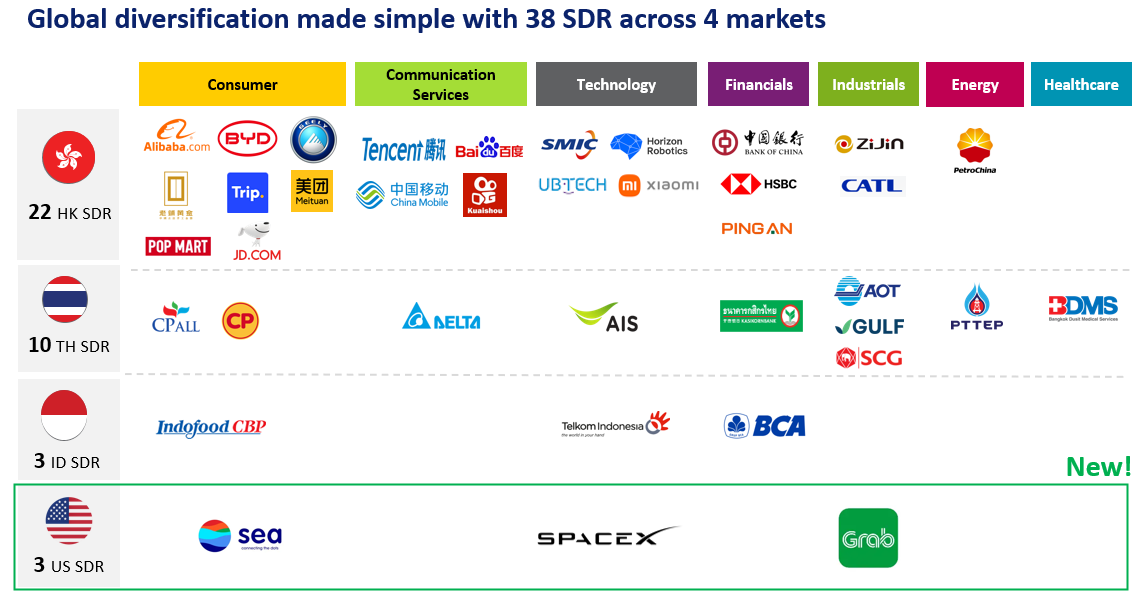
Currently, there are 38 SDRs across four markets (Hong Kong, Thailand, Indonesia and the U.S.).
The SDRs span a wide range of industries such as communication services, technology, energy, and consumer goods, which is perfect for those who want to diversify their portfolio.
Looking to tap on the artificial intelligence (AI) boom? SDRs give you access to companies like chipmaker SMIC and robot manufacturer UBtech, among others.
Or if you see potential in the global EV transition, SDRs help you own a slice of EV manufacturers BYD and Geely.
For those who are looking to invest in regional financial institutions, SDRs allow you to buy into Indonesia’s Bank Central Asia and Thailand’s Kasikornbank.
If you’re interested in U.S. stocks, here’s the good news: From Jul. 22, you will be able to access U.S.-listed companies like SpaceX, Grab and Sea via SDR.
One big advantage of U.S. SDRs is that they will be traded in even smaller board lots of 10 units, making the minimum investments for Grab, SpaceX, and Sea less than S$30.
The Bottom Line: If you have a favourite brand and love its products, why not invest in that brand’s growth too? With SDRs, you can easily become an owner, building your wealth using the brands you love. Your wallet will thank you.
Keen to start investing with SDRs? Check out this list of retail brokers that offer access to trading on the SGX.
Thanks to this sponsored content by SGX, this writer has broadened his understanding of investing.