News


Social media bans not the preferred outcome, but child safety standards have to be met: Josephine Teo
Banning is not the desired outcome, the Minister for Digital Development and Information said.
July 17, 2026, 03:50 PM
Photos via Unsplash, Mothership.


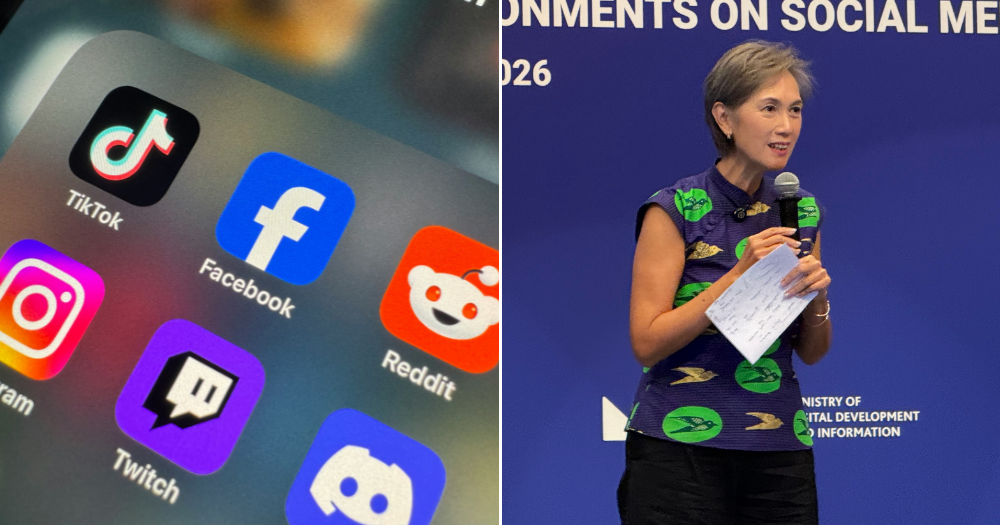
For social media platforms or services that are not willing or are unable to make their products sufficiently child-safe, banning them might be better, despite bans not being the "starting point", Minister for Digital Development and Information Josephine Teo said.
She was sharing her takeaways from the panel discussions at a forum, titled "Fostering Child-Safe Digital Environments on Social Media", on Jul. 17.
Held at National University of Singapore Society's Kent Ridge Guild House, the forum was organised by the Ministry of Digital Development and Information and the Institute of Policy Studies.
It saw researchers, industry stakeholders, policymakers and youths discuss approaches to protect children from some of the dangers of social media, such as online harms and addiction.
Banning possible if platforms unable to meet child-safe standards
Reflecting on her takeaways from the forum, Teo said she observed "strong support" for government intervention.
However, Teo said that the need to think about the "right forms" of such intervention was also surfaced.
"There is a question of whether child safety has to meet certain standards, and if those standards are not met, whether as a society we support the government saying that the access should no longer be made available to a young person. For example, those under 18," the minister said.
"While we are not averse... for us to block access to under-18s, that is not the starting point. That is not the preferred outcome," she observed.
What the government is working towards is to work with social media platforms and providers to create services that have safety features built in "to the extent that our society finds acceptable and desirable".
She characterised this as a "collaborative" while also "determined" approach.
"It's potentially a differentiated landscape where some services, some platforms, have made it possible for child-safe access, and they continue to offer access to those under 18," she explained.
However, Teo noted that there may be some services that have "not been willing or able to do it".
"Then, as a society, we think that it is probably better to block access for under-18s to these kinds of services," Teo said.
Preparedness more important in the long-term: Teo
Teo also commented that in today's world, there is no separation between the online and offline world.
"What then do we do in terms of helping children navigate the online world, and in particular their activities on social media?" Teo asked.
One recurring point raised during the panel discussions was that social media has a developmental role in children's lives.
Ben Chua, who leads youth-based not-for-profit YouthTech SG and was a panellist at the forum, pointed out how "shared internet culture is how [youths] connect, joke, learn and form a generational identity."
While parents may want to protect their children, Teo said that there must also be a "preparedness" mindset.
She explained, "If we want our children to thrive in any environment, protecting them from harm is only part of it. Preparing them to deal with the realities of that environment is equally, if not more important, on a longer-term basis."
"And so, from this perspective, we propose the idea of tiered access," she continued, which she said she observed "strong" support for during the panel discussions.
Policy in Australia and New Zealand
Present at the forum were also officials from Australia's and New Zealand's online safety agencies.
Australia's social media ban for children under 16, which took effect on Dec. 10, 2025, was the first of its kind globally.
Children under 16 cannot set up new accounts, and existing profiles were deactivated, BBC reported.
New Zealand's lawmakers have also mooted a similar social media ban for under-16s, while the UK has imposed similar restrictions.
Sharing during a panel discussion, Sarah Fox, acting executive manager at Australia's eSafety Commissioner, noted that Australia's social media regulation was not a blanket ban, but a "delay" in access to social media.
When asked by a member of the audience about lessons from Australia's experience so far, Fox said that there is no silver bullet and that the "ban" is just "one tool in a broader toolkit".
"Meaningful implementation" in Singapore
Since April 2026, the Infocomm Media Development Authority has required app stores to screen for under-18 users and prevent them from downloading age-inappropriate apps.
Singapore's Online Safety Commission began operations on Jun. 29, 2026, giving victims of online harms a go-to agency to seek recourse.
In January, Sembawang GRC Member of Parliament Vikram Nair asked in Parliament about the possibility of an under-16 social media ban being implemented in Singapore.
Minister of State for Digital Development and Information Rahayu Mahzam responded that the Singapore government was "actively engaging our Australian counterparts and assessing the effectiveness of the measures in Australia".
Rahayu added that while a ban sounds like an "attractive" and "obvious" solution, the Singapore government wants to ensure "meaningful implementation".
She also noted implementation challenges experienced by Australia's regulators, such as the migration of under-16 users to social media platforms outside of the regulatory ambit.