News


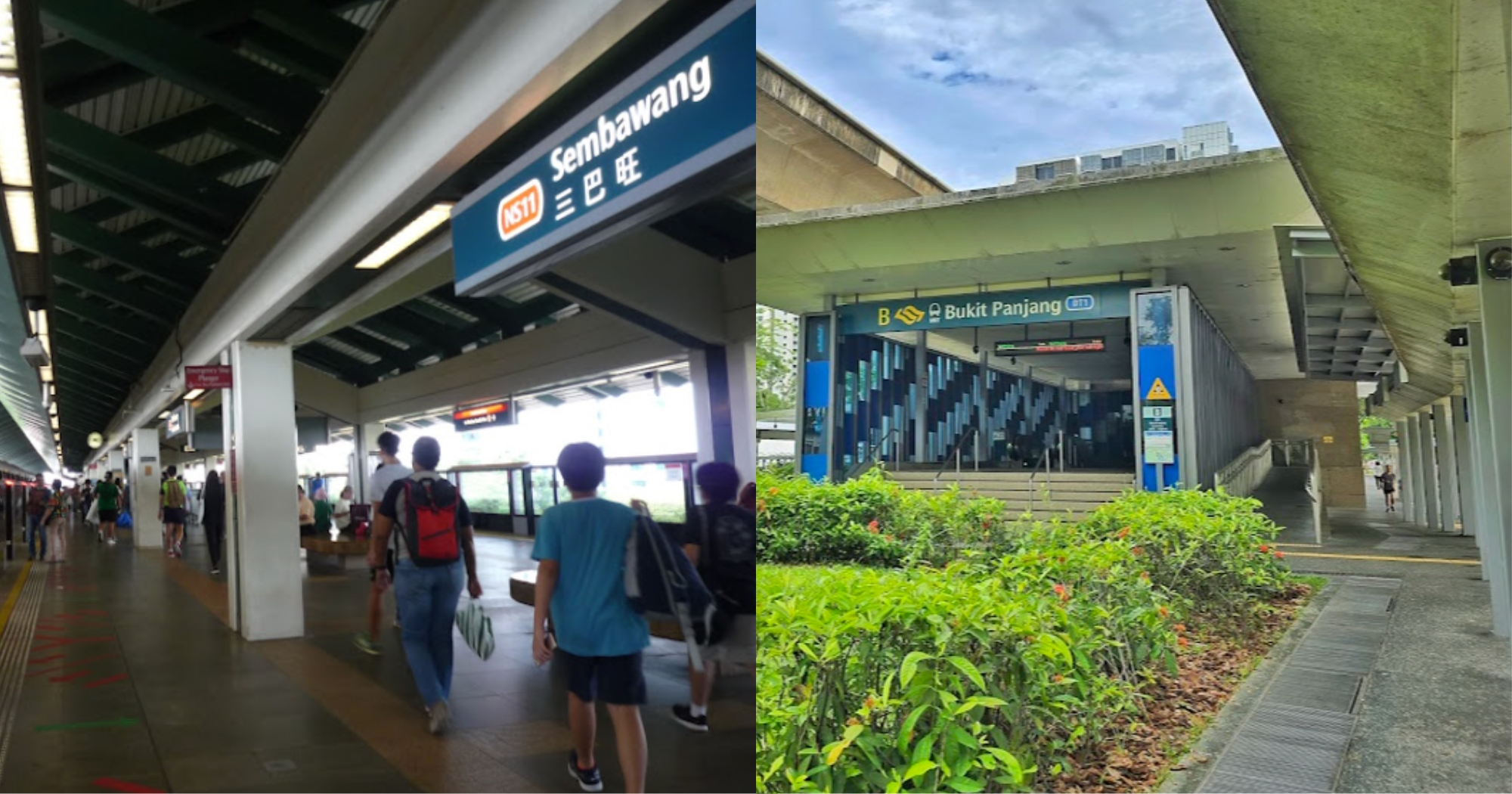
Sembawang, Bukit Panjang, Punggol, Sengkang residents took longest to travel to work in 2025: Survey
The survey noted that Sembawang residents had the highest median travelling time of 50 minutes.
July 05, 2026, 01:48 PM
Images via Google Maps


Sembawang residents took the longest time to commute to work in 2025, according to the General Household Survey 2025.
The survey was released by the Department of Statistics (SingStat) on Jun. 30, 2026.
It noted that residents in Sembawang had the highest median travelling time among Singapore towns at 50 minutes.
This was followed by a median travelling time of 45 minutes for residents who stayed in Bukit Batok, Bukit Panjang, Choa Chu Kang, Jurong West, Punggol, Sengkang, Tengah, Woodlands and Yishun.
The Straits Times reported that according to the General Household Survey 2015, residents who lived in seven of those 10 towns also had the longest median commute of 45 minutes.
Bukit Batok, Jurong West and Tengah were not included in the previous list.
Personal experiences
A Bukit Panjang resident, who wished to remain anonymous, told Mothership that when she commutes via shuttle bus, it takes one-and-a-half to two hours travel time to get to work in the east.
On days that she takes public transport, she takes a bus to Geylang Bahru before taking a train to Tampines East.
She then takes another bus to work, which makes her travel time more than two hours including waiting time.
A Punggol resident, who takes public transport every day, told Mothership that her 50 to 55-minute travel time includes a five minute walk from her house to the bus stop followed by a 10 minute bus to Punggol MRT.
She then takes the train from Punggol to Serangoon MRT before transferring to Caldecott MRT.
She then walks for 10 minutes to her office.
Urban transport researcher Paul Barter, who is based in Singapore, told ST that most workplaces are located in the downtown core, central region and other areas, including Tuas and Pasir Panjang.
With SingStat noting that almost half of employed Singapore residents worked in the central region, Barter said those living farther from these job centres would naturally take longer to travel to work.
Sembawang
Sembawang West Member of Parliament (MP) Poh Li San said she has not received complaints from residents about long travelling times, she told ST.
She added that this is due to NSL's Admiralty station being within walking distance of many estates.
Residents are also able to reach Woodlands station on the Thomson-East Coast Line (TEL) by bus.
Poh also said most of her residents working in the central area can take the NSL or TEL, where they can often get a seat when they board during the morning peak.
She noted that others may work nearer home, including at Woodlands Industrial Park or in Ang Mo Kio.
Bukit Panjang
According to Bukit Panjang MP Liang Eng Hwa, residents who live farther from Bukit Panjang MRT station, including Fajar and Segar, may find commuting within the town just to reach the MRT station inconvenient and time-consuming, especially during peak hours.
Liang added that the Downtown Line’s indirect loop through the city centre from Bugis to Bencoolen stations could lengthen some journeys further.
He added that, however, city-bound bus services including 972 and 972M, use the expressways, offering faster connections, and complementing rail services.
Shorter commute times
The Land Transport Authority told ST that since the S$900 million Bus Connectivity Enhancement Programme was launched in July 2024, about 244,000 commuters, which include those from Sembawang and Bukit Batok, benefitted daily from 35 new or extended services and over 60 improved ones.
According to the survey, residents of Tanglin had the shortest work commutes in 2025, with the median duration being 25 minutes.
Those who lived in Bukit Merah, Bukit Timah, Clementi, Geylang, Kallang, Marine Parade, Novena, Outram, Queenstown and Toa Payoh were next with 30-minute median commutes.
ST reported that those who lived in these 11 areas were also among those with the shortest commutes in 2015.
Then, Bedok, Bishan and Serangoon residents also had 30-minute work commutes.
Mode of transport and length of time
A larger proportion of high-income households reside in areas including Tanglin, Bukit Timah and Novena, Barter told ST.
This could mean work trips by cars, taxis or ride-hailing vehicles that tend to be faster than public transport.
Samuel Chng, a research assistant professor heading the Urban Psychology Lab at the Lee Kuan Yew Centre for Innovative Cities at the Singapore University of Technology and Design, said travel time is often less important than whether the trip is reliable, comfortable and predictable when it comes to quality of commute.
The survey noted that in 2025, 60.1 per cent used public transport, an increase from 57.7 per cent in 2020.
The share of employed residents who combined rail and bus services increased to 30.3 per cent in 2025, from 26.4 per cent in 2020.
There was a drop in the proportion that relied solely on public buses, from 15 per cent to 12.9 per cent in the same period.
Those relying solely on buses had the shortest median travelling time of 35 minutes among all modes of public transport.
Commuters who took only rail services had a longer median commute of 45 minutes, while those who used both buses and the MRT or LRT had the longest median travelling time at 56 minutes.