Court


S'pore man wanted share of wife's S$450,000 stroke insurance payout during divorce
The husband also alleged that that his wife deliberately tried to "launder" matrimonial assets by spending on medical insurance.
July 19, 2026, 05:06 PM
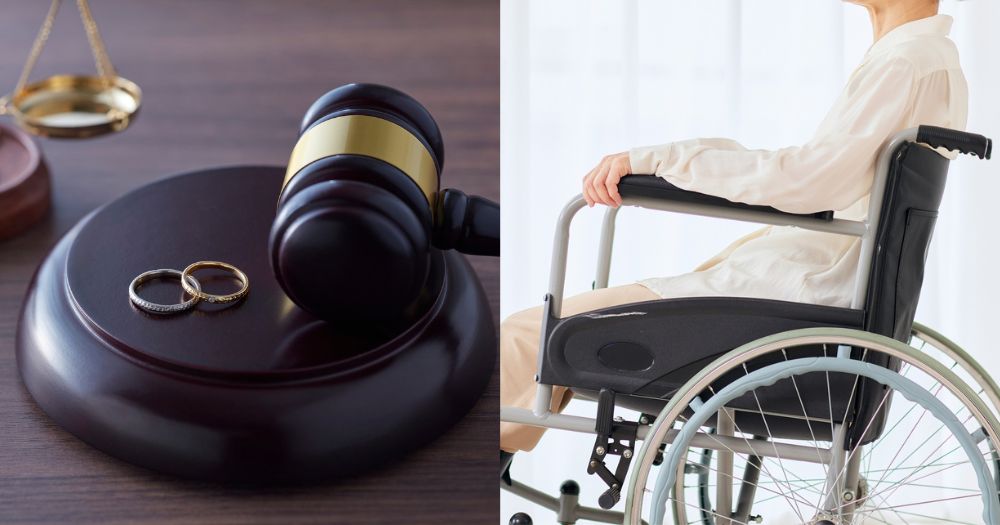
Top photo from Canva


During their divorce proceedings and splitting of matrimonial assets, a Singapore man wanted a share of his estranged wife's S$450,000 critical illness insurance payout after she suffered a double stroke.
The man argued that he should have a cut of the sum as his income was probably used to pay for his wife's insurance policies' premiums during their marriage.
According to court documents seen by Mothership, the wife suffered two strokes, one in 2017 and another in August 2020, which left "her physically incapacitated and unable to walk".
This was despite the payouts being intended for her recovery.
Second marriage of both parties
The couple married on Dec. 12, 2009.
This was the second marriage of both parties, and they have two adult children each from their previous marriages.
The wife was 47 years old, and the husband was 49 years old when the wife commenced divorce proceedings against the husband on Aug. 12, 2020.
The couple have two sons aged 13 and 14 years old; the elder son was diagnosed with autism, and the wife has also given evidence that the younger son has learning difficulties.
The wife was unemployed at the time the divorce commenced; she had previously run a drinks stall in a primary school canteen until March 2018 when her health declined following her stroke.
The stroke left her physically incapacitated and unable to walk.
Matrimonial assets
The husband operated his own companies, while the wife was earning less than S$2,000 monthly running the stall.
However, she had cash savings of over S$400,000, a S$250,000 life insurance policy, and a S$565,000 HDB flat and other inheritance from her previous marriage with her late husband.
The husband only had S$4,342.37 in his own bank account, as his wife managed his income.
According to court documents, the total net assets in the wife's name stood at over S$1.3 million while the husband's was around S$413,000.
Insurance claim
The wife's second stroke occurred around the time of her divorce, and as a result of her condition, four of her critical illness policies paid out more than S$450,000.
A fifth policy pays her S$1,200 a month for the rest of her life.
The husband contended that the payouts should be added to the matrimonial pool.
He reasoned that the payouts "were not intended to compensate the wife for her expenses relating to her disability, but were instead meant to provide a general cash payout to protect and/or provide for the Wife’s family in the event of her becoming critically ill".
Claimed he paid for majority of policy premiums
He noted his wife's low income as a canteen stall operator and said the majority of the policy premiums were contributed by him.
However, the wife said the insurance payouts were not investment profits but meant to provide a policyholder with financial stability during a genuine health crisis.
Since her claims were approved, the wife was using the funds for medical care and living expenses as she could no longer work.
The Family Justice Court also did not award her any spousal maintenance as she was paid the monthly sum of S$1,200 from her fifth policy, and the court considered it sufficient.
Senior High Court Judge Tan Siong Thye agreed with the wife and said the husband's argument had no merit and was "unsupported by any evidence".
Tan said: "It is also inconsistent with the husband’s own characterisation of himself as the 'main or substantial breadwinner of the family'."
Dismissed husband's allegations
Tan noted that the way the couple organised their economic affairs during their marriage also made it unlikely that the insurance payouts would be used for the wife's missing income to support the family if she became critically ill.
The judge also dismissed the husband's allegations that the wife deliberately tried to "launder" matrimonial assets by spending on medical insurance.
According to court documents, life insurance policies purchased by either spouse during marriage, or payouts therefrom, may be regarded as a matrimonial asset.
This would be the case for plans simply held as investments to be encashed for a profit in the future.
However, insurance payouts are different, as the High Court ruled that the husband could not touch his ex-wife's payout as it was compensation for her long-term care.
Asset split
The wife used her fully paid S$565,000 HDB flat from her previous marriage as her matrimonial home for her second marriage, and she was awarded 100 per cent credit for it.
Therefore, the court chose to divide the flat separately from the couple's other assets, which totalled S$1.16 million.
Based on the distribution of household duties, the husband was accorded a higher score of 55 per cent for indirect contributions, while the wife got a score of 45 per cent.
When considered together with her 100 per cent share of the house, she received 72.5 per cent of the flat, or about S$410,000, while the husband received 27.5 per cent, or about S$155,000.
The court ruled that both parties had equal contributions in accumulating their non-property assets.
Resulting in an outcome where the husband received a 52.5 per cent share, or about S$610,000, while the wife received 47.5 per cent, or about S$550,000.
In total, the wife’s share of the matrimonial assets amounted to about S$960,000, while the husband received S$765,000.