



Abroad


US attacks Iran after Iranian drones strike S'pore-flagged cargo ship in Strait of Hormuz
Iran has called the attacks a reckless violation while defending their own actions as "enforcement."
June 27, 2026, 11:56 AM
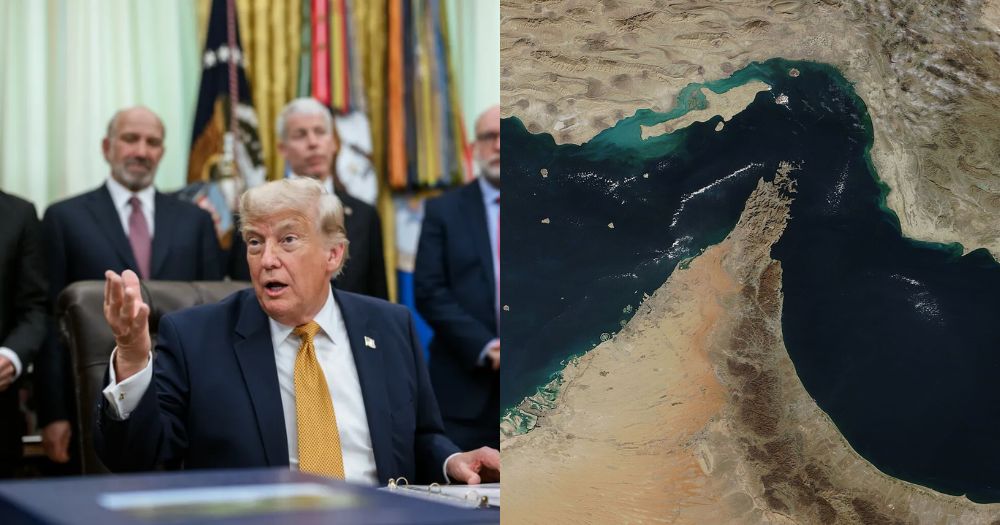
Image via White House Gallery & Wikipedia


The United States has attacked military targets in Iran on Jun. 26, after Iranian drones struck a Singapore-flagged container ship in the Strait of Hormuz the day before.
U.S. president Donald Trump called it a "foolish violation" of the ceasefire.
"Powerful response"
The U.S. Central Command (Centcom) said on Jun. 26 that it had struck missile and drone storage facilities as well as coastal radar positions in Iran, reported the BBC.
Centcom described its attacks as a “powerful response”, and claimed that Iran's dangerous behavior “undermined freedom of navigation” as the Strait of Hormuz reopens after several months of closure due to the Iran war.
The attacks come after a Singapore-flagged container ship, the Ever Lovely, was struck by a “one-way attack drone” on Jun. 25 while it was exiting the strait.
Centcom called the drone attack "unwarranted aggression" against commercial shipping, which "clearly violated the ceasefire".
The container ship did not suffer any casualties and was able to complete its transit.
In response, Iran blamed the "treaty-breaking U.S. regime" for its attack, and claimed that the ship had been using an unauthorised route to transit through the waterway.
'Foolish violation'
Speaking to the press on Jun. 26, Trump was elusive about how the U.S. would respond to the attack on the Ever Lovely.
He did not respond to questions about whether he considered the ongoing ceasefire to be still intact.
Earlier on social media, he described the attack "on the large and very expensive cargo-carrying ship", the Ever Lovely, as a "foolish violation", and that the U.S. had intercepted three other drones in what he said was a coordinated attack.
When asked about the U.S.' response prior to the retaliatory strikes being announced, he simply said, "You'll find out," and that “I didn't like the fact that they took a shot yesterday.”
U.S. vice president J.D. Vance posted on social media, saying that if Iran has “disagreements about how the MOU is being applied, they can pick up the phone", but that violence would be met with violence.
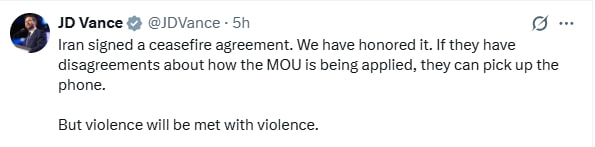 Image via JD Vance/X
In response to the attack on the Ever Lovely, the United Nations International Maritime Organization paused an evacuation program targeted at over 11,000 sailors stranded in the Strait of Hormuz.
Reckless violation
Following the attack, the Islamic Revolutionary Guard Corps said that it had struck the "terrorist U.S. military" in response to a projectile attack in southern Iran.
"The United States, by provoking various fronts, sought to violate [the ceasefire agreement], and the necessary response was given and will continue to be given," they said.
The head of the Iranian Parliament's National Security Commission, Ibrahim Azizi, added in an X post that Iran governs the strait and that ships should "respect the rules".
“This reckless violation of the ceasefire will, as always, lead to retreat and regret on their part,” he said.
Azizi had earlier posted on X, claiming that the Strait of Hormuz is governed by Iran.
This is in contrast to traditional understandings of the Strait of Hormuz, which sees the strait as an international waterway.
He also denied that the drone attack was a violation of the ceasefire, instead calling it "cease-fire management".
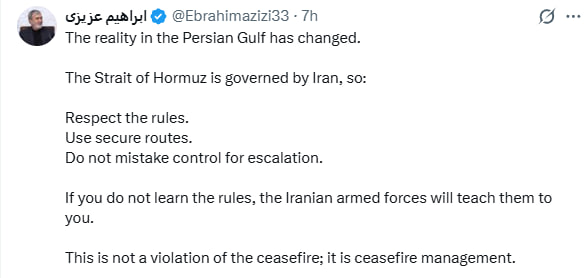 Image via @Ebrahimazizi33/X
Peace deal?
The U.S. and Iran signed a 14-point Memorandum of Understanding on Jun. 17, with the two countries currently in negotiations for a final peace deal.
In the MOU, Iran had committed to the safe passage of ships transiting the Strait of Hormuz, although it also signaled that it intends to exercise more direct control over the waterway.
The Iran-run Persian Gulf Strait Authority (PGSA) had previously issued new designated routes through the strait that differed from the pre-war transit passage regime.
 Image via @PGSA_IRAN/X
It also warned that ships transiting the strait outside of those routes, as the Ever Lovely had been on Jun. 25, were not covered by promises of safe passage.