News


'Servants' not allowed to use S'pore condo gym, domestic worker allegedly told to leave
The topic has resurfaced in 2026.
June 26, 2026, 05:55 PM
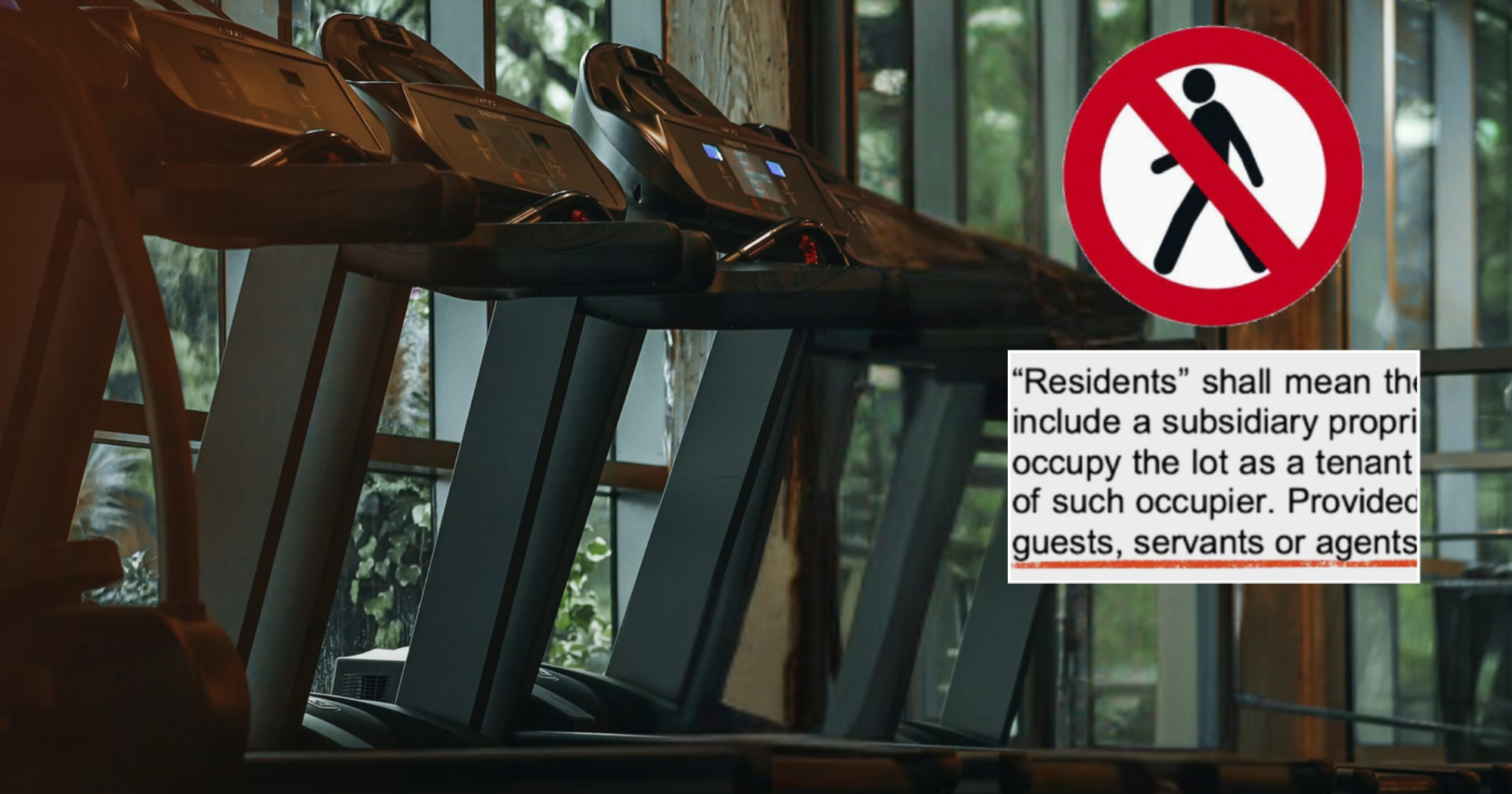
Unsplash, stock image & HOME


Should foreign domestic workers in Singapore use condominium facilities?
One of them was apparently barred from doing so in the condominium she resides and works at.
This issue regarding discrimination was surfaced by the Humanitarian Organisation for Migration Economics (HOME), which raised the topic in a Jun. 22, 2026 Instagram post.
Exclusion allowed?
In the post, the non-profit organisation asked its audience if they were aware that domestic workers "can be excluded from using communal facilities in the very condos they live in"?
HOME said an employer had e-mailed them, recounting an incident where their domestic helper, Angie (not her real name), was not allowed to use the condo's gym.
Angie's employer shared that the incident occurred in April 2026.
The domestic worker was allegedly confronted by a cleaner at the condo's gym and told she was not allowed to use the facilities.
The cleaner also called down a member of the condo management to confirm this.
The cleaner and management member then apparently "stood over her as she packed her things".
Left shaken but by-laws state it clearly
Angie was left “shaken and upset”.
Her employer subsequently looked into the condo’s by-laws.
They found that the by-laws explicitly barred domestic workers from using recreational facilities.
One clause read: “Only residents and their guests but not their employees may use the gymnasium/fitness corner.”

Another line added that “member of the family” does not include “guests, servants, or agents of the occupier”.

An occupier was defined as the tenant and members of the occupier’s family.
As spelled out in the by-law, a domestic worker could be referred to as a "servant" of the occupier.
Angie's employer called out the “intimidating conduct” the domestic worker faced, as well as pointed out how the situation was handled.
She noted that "Angie lives at this estate full-time" but is "excluded from facilities that guests — people with no connection to the building — are permitted to use".
The post added: “Angie was shaken and distressed. I found this deeply troubling, both the existence of the rule and the manner of its enforcement. I am bringing this to HOME’s attention because I understand this reflects a broader pattern affecting domestic workers across Singapore’s private estates.”
Condo policies vary
According to HOME, condominium policies vary and are set by condominium owners.
Some estates allow domestic workers to use facilities with conditions, such as only while supervising children, while others prohibit domestic workers from using the facilities altogether.
Some do not have such by-laws or rules.
“A condo can set rules on overcrowding, safety, noise and cleanliness. But banning someone based on their work permit status or occupation is discriminatory,” said HOME.
"Condo by-laws should target behaviour, not people," HOME added.
HOME stated that migrant domestic workers should be treated as a part of Singapore's residential communities, and called for change, by urging residents to review estate rules to support fair access and propose amendments at future meetings.
Not a new topic
This topic of foreign domestic workers being given access to private property facilities is not new.
In 2016, it made international headlines after it was reported that foreign domestic workers were not allowed to use swimming pools in condominiums in Singapore.
The news was met with outrage, as well as some pushback from private property owners, who cited issues of noise and disamenities as counterarguments.
It was also reported at the time that having by-laws did not necessarily mean that they were enforced.