News

S'pore's stability still a selling point for attracting investments, job creation 'bottom line' of economic growth: Jeffrey Siow
Some findings so far from engagements under the government's Economic Strategy Review.
November 19, 2025, 03:32 PM
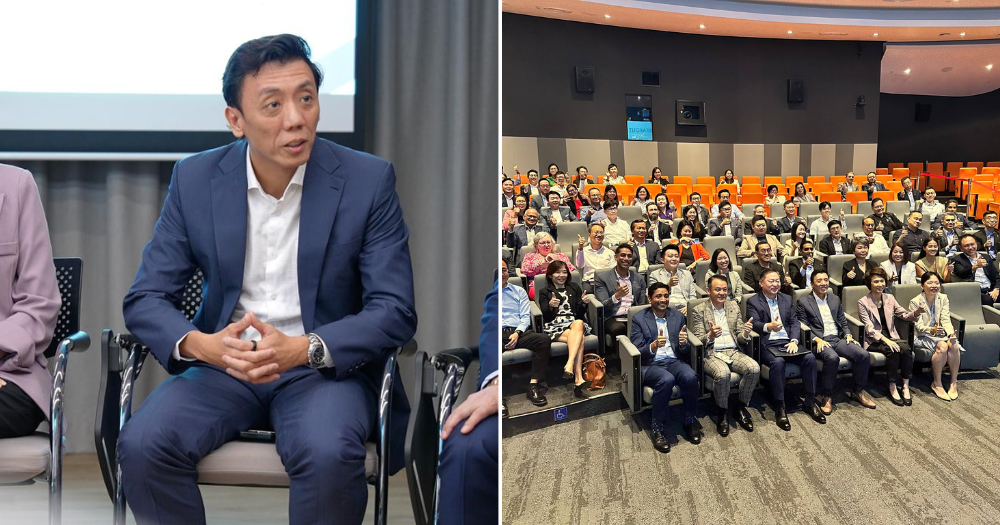


Singapore's stability and business-friendly environment remain strengths that attract investments from multi-national corporations, Acting Minister for Transport and Senior Minister of State for Finance Jeffrey Siow said at a doorstop on Nov. 19.
Siow spoke to the media following a closed-door dialogue with business leaders on Singapore's Economic Strategy Review (ESR) and provided a brief picture of what has been gathered so far.
Stability and business-friendliness
Siow co-chairs the global competitiveness committee of the ESR, which is one of five focal areas.
He pointed out that the recurring message was that Singapore remains valued for its stability and business-friendly environment.
This was gathered from the meetings he has had with local and overseas business leaders.
As such, businesses are prepared to "do new things with us for the long haul".
While businesses have alternatives and competition has become stiffer, these basic fundamentals will continue to help Singapore do well.
"It is even more important in this age where there is so much uncertainty and Singapore stands and oasis of calm," Siow said.
Encouraging local businesses to venture abroad
Siow also gave a brief overview of the ideas the ESR committee has received.
The ideas fall into three main buckets: how to enhance Singapore's value proposition as an investment destination, how to help local companies succeed on the global stage and making Singapore a hub of flows.
Elaborating on the second bucket, Siow said the government has always encouraged local businesses to venture abroad and will look into ways to support those who do.
"Because Singapore is a small market, up to a point, there's only this much you can grow. There's only this much business to do here. For you to really continue to grow, you have to go overseas," Siow commented.
"The more of these companies that are Singaporean-based but global, the more Singapore can have an outsized influence in the global economy," he added.
Global AI hub
Another area of interest is turning Singapore into a global artificial intelligence (AI) hub.
Siow said AI will be the driving force for the economy for the next five to 10 years, and Singapore has the opportunity to be at the "frontier of global AI innovation".
While Singapore is making good progress with the introduction of a national AI strategy, more can be done to coordinate efforts and play to our strengths, he added.
These strengths include good governance, quality assurance, and anti-fraud applications, which serve as Singapore's "premium" in terms of capabilities and trust to encourage more of such industries to operate in Singapore.
If Singapore can become one of a few global AI hubs, the economy will be strengthened and good jobs will be created for the future, he added.
Creating jobs
The ultimate goal of economic growth is to create good jobs for Singaporeans.
Siow said:
"That's the bottom line. And what we are doing is to make sure that for the future, we [can continue] to be able to do that by looking at the strategies that have served us well, looking at what we can do more of and looking at what we will need to adjust.
There will be jobs that we'll create for young Singaporeans, future jobs in future industries that we want to be able to do.
There will also be new jobs that we'll create for existing industries. Because technology is changing, things are moving. There will be job and skills adjustments that need to be made, and we're very conscious of that."
More cautious than optimistic in short-term
Siow said that while he did not have detailed numbers on the number of engagements so far, he assured that the various ESR committees have been meeting with stakeholders and getting a "good feel" of ideas from business leaders, particularly those from the new generation.
Singapore Business Federation's (SBF) vice-chairman, Andrew Kwan, also said at the doorstop that about 3,000 leaders from the business community and from the labour and trade associations have been engaged as part of SBF's outreach efforts.
It is apt for Singapore to conduct an ESR now to find out what still works and what needs tweaking amidst the challenging global environment, Siow said.
"We have to work on this to prepare our economy for the next five to 10 years, and to make sure that our companies, our workers are all well positioned for the future," he continued.
In the short-term, he said the government is "more cautious than optimistic" about the current economic situation, a point that was echoed by Kwan.
"But in the long term, if we are able to get our strategy right, if we are able to make the adaptations we need, we can set ourselves on a good footing and be better prepared for the future," Siow said.
The ESR committees are expected to provide a mid-term update during the Budget and Committee of Supply debates early next year.
A final report is expected in the middle of 2026.
Top image via Mothership