




Branded
James Cook University offering scholarship with up to S$20,000 off tuition fees for local students
Wow.
If you have a child or are a student just about to embark on his or her next stage of studies at the tertiary level, here’s something you can consider.
James Cook University (Singapore Campus) is offering a scholarship, called the Singapore Future Economy Scholarship, which provides up to S$20,000 off tuition fees for eligible local students.
What’s more, this scholarship is available for majors such as a Bachelor of Business and Environmental Science, Information Technology, Psychological Science and Science (Majoring in Data Science), among others.
Under this scholarship, these majors are selected to support students who may be interested in furthering a career in the Green, Digital and Care economies.
These three areas were identified as the high-growth economies in the inaugural Skills Demand for the Future Economy report in 2021 by SkillsFuture Singapore.
The report highlighted, among other things, the trends within each area, such as a rise in jobs related to data and artificial intelligence (AI) for the Digital Economy.
You might be wondering, of course, how useful are the programmes at JCU? Perhaps more importantly, how do their courses stack up against other universities?
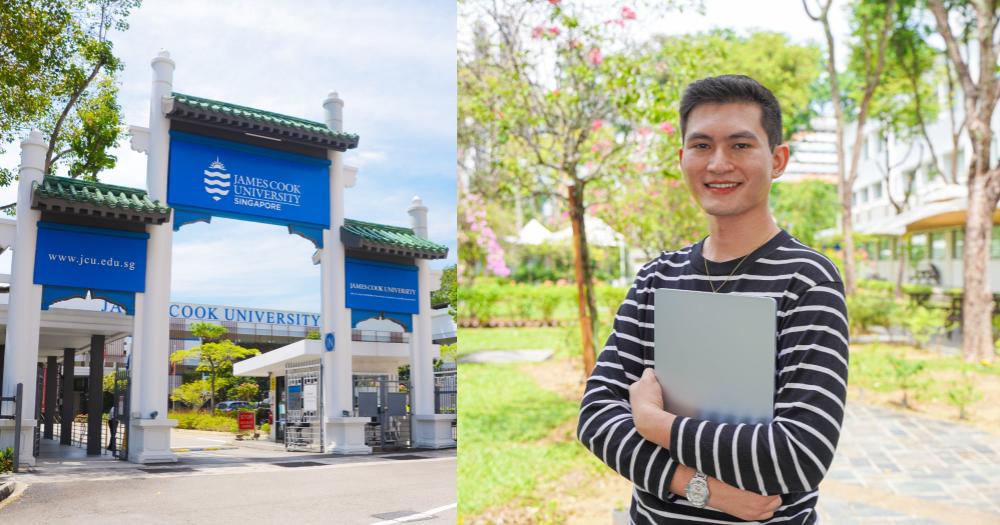
Here’s what 21-year-old Elijah Ang, a first-year student in the Bachelor of Science (Majoring in Data Science) programme at JCU had to say.
 Photo of Elijah Ang by JCU.
Realising the power of data science
For Ang, his experience as an intern with a market research company where he had to essentially translate consumer data into more sales, left a deep impression on him.
After graduation, Ang wanted to pursue further studies in psychology. He sent applications and was accepted by a few universities in the UK and Australia.
However, he grew interest in data science over the course of his internship, so much so that he even extended his stint by a few months.
When asked how his internship eventually spurred this change of heart, Ang said, “When you are doing market research, you are trying to tell a story to big bosses and people who are in charge to help them make better decisions.”
The experience also made him aware of how crucial the use of data science was to psychology research, which means this added skill set will give him an advantage even if he later decides to return to his original field of interest.
Resilience in the age of AI
Exploring the field of data science in greater detail also led Ang to the realisation that data scientists can be more resilient to potential disruptions that Artificial Intelligence (AI) may bring.
Ang thinks that data science sits at the “intersection” of technical expertise, critical thinking, and domain understanding.
While AI can automate parts of a data scientist’s workflow, such as data visualisation or even generating models, the role of a data scientist goes beyond just running algorithms, he added.
A data scientist, however, has to know how to frame the data and translate them into a solvable question to address a real-world issue.
They must also be able to assess whether the data is useful, spot biases and be able to explain insights and limitations to stakeholders who don’t have a technical background, he said.
There’s also the need to ensure that the use of AI in collecting data is done ethically, Ang pointed out.
With all these considerations in mind, Ang added:
“So in that sense, I was thinking if I ever want to jump back into psychology…I can and I think I will always have an advantage, because data is only just becoming increasingly more important.”
 Photo by JCU
Why choose JCU’s programme?
While Ang did consider pursuing data science in the universities that accepted his applications, he eventually chose JCU.
One of the reasons was that the data science programme in other universities may include content that he’s not interested in, such as software engineering and development and debugging.
Another is the duration of the courses; the ones from other local universities in Singapore were honours programmes which require four years to complete.
Ang decided to go for JCU’s Bachelor of Science (Majoring in Data Science) programme due to a combination of factors.
He cited JCU’s “uniquely” science-focused degree with its trimester system, which means that the curriculum can be completed in two years, without subjects such as software engineering and development, and with the flexibility of taking a pause if one wishes to do so.
Compared to studying abroad, he could save on the costs of flights and accommodation.
The fact that JCU has a campus in Singapore also sets them apart from other private institutions here.
“Unlike others, the university does not need to pass information to an intermediary, making administrative processes quick, lessons delivered as intended, and dedicated care and support provided promptly by the school when needed. I have heard horror stories from people [from another private institution] battling disjointed curricula and gross miscommunications that cost them modules they did not actually need to redo. This fact could help prospective students better decide what’s right for them.”
The factor that tilted his choice towards JCU, however, was the Future Economy Scholarship.
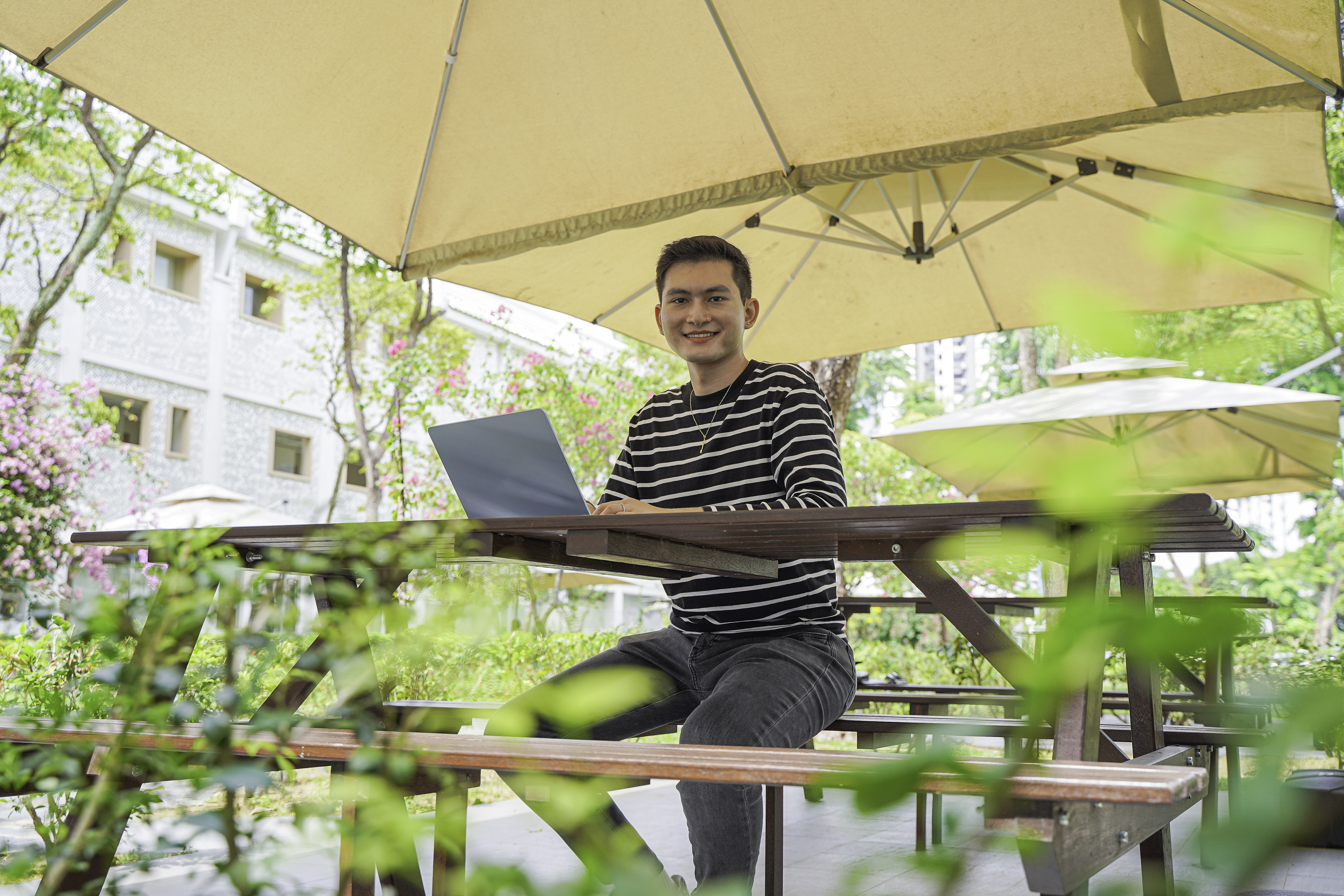 Photo by JCU
Offered the scholarship within a month
Ang said he found out about the Future Economy Scholarship in April 2025 when he made a call to JCU’s admissions office to find out more about the university’s data science programme.
“My impression of the application process was really positive,” he said.
Despite applying for the scholarship about one to two weeks before the start of the term, JCU’s admissions office was able to process his application quickly, he added.
This included submitting financial statements on his household income.
Ang was offered the scholarship within a month of his application.
Notably, applicants who have a monthly per capita household income of less than S$3,000 will be given priority for the scholarship, according to JCU.
How his experience at JCU has been like so far
And if there is one thing that Ang is thoroughly enjoying about his experience thus far, it is that the programme is similar to what he experienced back in Temasek Polytechnic.
Topics are first introduced during the lectures, followed by in-depth discussions during tutorials then assignments to determine if one has understood the subject, he said.
The university also has a support system in place, with a team who will reach out to students who miss out on classes, as well as student tutors who will provide additional help for those who are struggling with specific subjects.
“I find it very helpful, complete and wholesome,” he said.
 Photo by JCU
“Steps are taken in JCU to ensure that students do learn. So as a student, if you just do whatever that’s given to you by the school, you will do well, you will learn. So that’s what I’m enjoying so far, that I’m learning,” he added.
To find out more about the Future Economy Scholarship, and the full list of JCU courses that are eligible for the scholarship, you can click here.
This sponsored article made the author consider studying again.
Top photos via James Cook University (Singapore Campus) Facebook