News

Baseline tariff shouldn't even apply to S'pore as U.S. has trade surplus with us, Vivian Balakrishnan tells U.S. counterpart
Vivian was on a working visit to the UK and U.S. from Jun. 3 to 7.
June 07, 2025, 01:44 PM
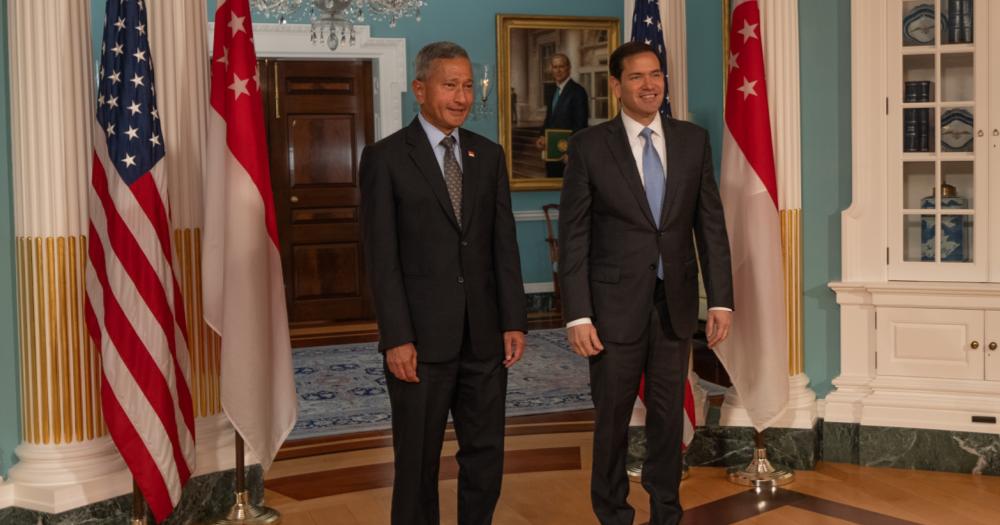


The baseline tariff that the United States has unilaterally applied to trading partners should not even apply to Singapore, Foreign Affairs Minister Vivian Balakrishnan said on the last day of his working visit to the United Kingdom and the United States.
He told the press that the U.S. had a trade surplus with Singapore to begin with and that Singapore "should not be subject to even that baseline tariff".
During his working visit in the two countries, Vivian met his counterparts, the UK's David Lammy and the U.S.'s Marco Rubio.
In the U.S., he met with senior officials, as well as "friends in both current and former administrations".
A time of great change
Vivian said the meetings in the U.S. were especially important as they were the first face-to-face meetings between the new U.S. administration and Singapore.
Vivian called it a "time of great change and, in some cases, uncertainty," and it was necessary for Singapore to "reaffirm the ties" and seek clarifications on a variety of issues.
One of those critical issues were the moves that the U.S. had made on tariffs and trade.
In response, Vivian said he had been assured that those moves were "not directed at Singapore specifically".
Singapore's concerns about the secondary impact of those moves, as any "friction in the system" would have an impact on the country's highly trade-dependent economy, was also made known during the meetings.
Vivian said the U.S. officials he met "understood" these concerns.
U.S. commitment to Indo-Pacific region
Responding to Mothership's query regarding the U.S.'s commitment to the Indo-Pacific, as reiterated by U.S. Secretary of Defense Pete Hegseth during the recently concluded Shangri-La Dialogue, Vivian said the U.S. "had skin in the game".
The U.S. had more investments in Southeast Asia than India, China, and Japan combined, and that the flow in investments and trade both ways have generated "probably half a million jobs in America itself, and good jobs at that".
"So, there are strategic interests which bring mutual benefit to both Southeast Asia and America," he said.
Vivian said he had not been surprised by Hegseth's speech at the dialogue, seeing it as "an affirmation that America recognises that it has a strategic interest in our part of the world".
Vivian said: "The way it is expressed may change, but strategic interest remains unchanged."
Premature conclusion
Vivian was also asked about the state of discussions on specific topics, such as tariffs and student visa restrictions, and if any type of resolution had been reached on either.
Vivian said the tariffs were still subject to numerous revisions and even legal challenges on the U.S. side, and it would be "premature to conclude what the final shape of the tariff regime will be".
The U.S. was looking for multiple rounds of negotiations with its trading partners, which is a drawn-out process.
Trade and other issues, such as investment, intellectual property, and security, among them remained "vital issues", and it was more useful to consider the "primary considerations and anxieties" of policymakers worldwide.
The better approach was "to take the time to carefully consider (a country's) domestic circumstances and then to negotiate", he said.
Singapore remains exposed to only the baseline 10 per cent tariff, but Vivian cautioned: "How long that will remain in place is a point of speculation".
However, Singapore was even more concerned about "sectoral tariffs", and would try to minimise them to the "maximum possible extent", Vivian said.
The minister added that he had made the point to his U.S. counterparts that the U.S. had a trade surplus with Singapore and that Singapore "should not be subject to even that baseline tariff".
Student visa
Vivian also responded to questions about the ongoing state of visa restrictions on foreign students entering Harvard University.
U.S. president Donald Trump had imposed a blanket restriction on Harvard from registering new students, and Singaporeans attending or applying to Harvard had voiced concerns about how such a restriction might impact them.
The restrictions are currently paused pending a legal challenge.
Vivian reiterated that the restrictions were the result of domestic political issues, not specifically targeting Singaporeans.
The MFA would continue to pursue the issue with U.S. authorities and find "suitable solutions", Vivian said.
In a "worst-case scenario" where Singaporeans studying in Harvard would not be able to "physically study in Boston", Vivian said, "we have got some ideas for how we can help them".
Others who were not yet in the U.S. or had yet secure visas "may also need to have back up plans".
He said on a "macro level", it was in both Singapore's and the U.S.'s interest to "keep opportunities open for Singaporeans" who wanted to go to the U.S. to study and work for a few years, expanding their "domain experience and expand their networks".
Related stories
Top image via Ministry of Foreign Affairs, Singapore