News
MHA aims to help inmates maintain family ties & equip them with work skills: Faishal Ibrahim
Minister of State for Home Affairs and National Development Muhammad Faishal Ibrahim shared new and current initiatives to support the rehabilitation of inmates.
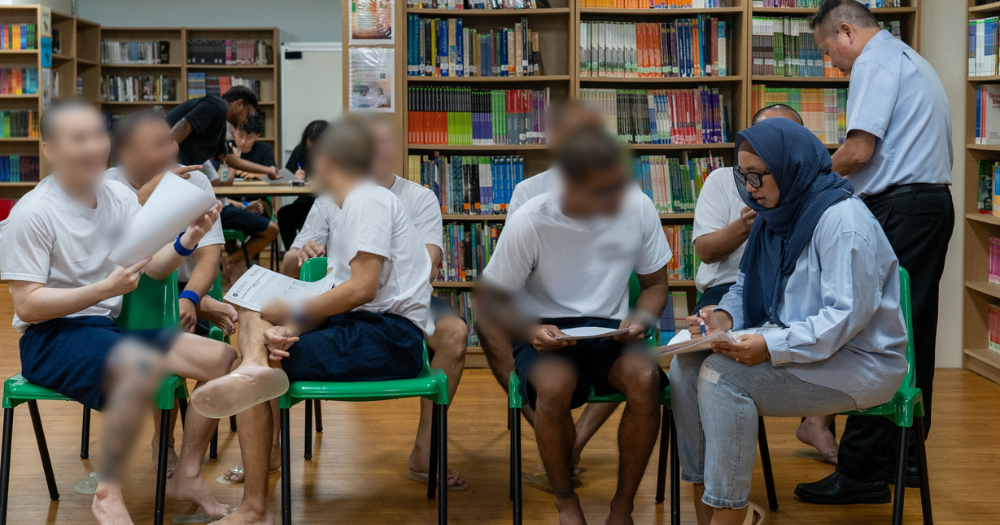


Singapore’s efforts to rehabilitate and reintegrate inmates and ex-offenders were addressed during the Committee of Supply debate on Mar. 4.
Minister of State for Home Affairs and National Development Muhammad Faishal Ibrahim shared new and current initiatives to support the rehabilitation of inmates.
Strengthening family relationships at prisons
Prisons are currently working with 20 family-focused partners to deliver structured family programmes, Faishal said.
A new initiative called the Family Engagement Model is currently being trialed, which aims to strengthen the ability of inmates and their families to build and maintain relationships through family reintegration programmes.
Inmates will also attend support group sessions led by community partners and peer supporters who completed the programme.
The sessions will allow inmates to shift their identity away from being offenders to being role models.
Project Hope: video visits between incarcerated parents and school-going children
In his speech, Faishal also outlined ongoing initiatives by MHA, including Project Hope.
Through the pilot, video visits were conducted between incarcerated parents and school-going children since 2022, allowing inmates to stay involved in their children's lives and understand their progress in school.
The pilot project involving 18 cases and 14 schools found that pilot participants experienced improvements in their relationships, and the schools have also observed positive changes in the students’ behaviour and emotional well-being.
Prisons are working with MOE to expand Project Hope to more schools, said Faishal.
Enhanced Halfway House Service Model
Prisons also introduced an enhanced Halfway House Service Model called HSM+ on Jan. 1, 2025, which has onboarded 11 halfway houses.
The Halfway House scheme provides a more structured environment to support inmates' reintegration back to society gradually with the help of community partners.
Under HSM+, supervisees will undergo a longer duration of aftercare support, said Faishal.
Halfway house staff will be equipped with skills to work effectively with different profiles of supervisees, and infrastructural works will also be carried out to improve accessibility for those with mobility issues.
In 2024, MHA’s halfway house partners provided step-down support for more than 1,200 offenders, said Faishal.
Reintegration Hub with easy access to community partners and volunteers
Prisons have also established the Reintegration Hub to better prepare inmates for release since September 2024.
The centralised facility allows prisons to better implement targeted reintegration-centric programmes for suitable inmates, such as those emplaced in Community-based Programmes, prior to release.
The Hub would provide easier physical access for community partners and volunteers to support the inmates, as they need not travel to separate prison institutions on separate occasions.
The Hub has also implemented pre-emplacement programmes, which include sharing sessions to provide motivation and encouragement, said Faishal.
At a steady state, about 550 inmates and supervisees will be housed at the Reintegration Hub, he added.
Equip inmates with relevant digital and market-relevant work skills
Faishal also said the Singapore Prison Service (SPS) will equip inmates with relevant skills to navigate an increasingly digitalised world, which can impede reintegration.
The Access for Inmate Digital Experience, or AIDE, is a new initiative to allow inmates to familiarise themselves with and independently access citizenry e-services, such as those provided by CPF and HDB, during incarceration.
Since its start in September 2024, more than 400 inmates have benefitted from AIDE.
Yellow Ribbon Singapore, or “YRSG”, is another pillar of the government’s reintegration strategy to equip ex-offenders with market-relevant work skills.
The project will enhance its career facilitation efforts, in particular to assist ex-offenders in attaining their career goals.
This includes refining ‘Career Circles’, a programme piloted in 2023 that comprises facilitated sessions on various career-related topics, such as career planning and addressing common workplace challenges.
Inmates are then equipped with the skills to set career goals and prepare for job searches, said Faisal.
The enhanced version of ‘Career Circles, ’ with a revised curriculum and frequency, was implemented from February 2025.
Over 6,700 employers have also partnered YRSG to hire ex-offenders, which is an almost 20 per cent increase from 2021 to 2024.
Partnerships with social services and government organisations, such as Community Action for the Rehabilitation of Ex-offenders Network, or “CARE Network”, also complement MHA’s rehabilitation and reintegration efforts.
Through CARE Network, more than 16,000 beneficiaries benefitted from the services provided by CARE Network agencies, such as financial assistance and skills training, in 2023.
Spent Regime for Ex-Offenders
MHA periodically reviews the spent regime for criminal records, said Faisal.
Under certain conditions under the Singapore law, an ex-offender’s criminal record may no longer be disclosed for most purposes.
An ex-offender could have his offence spent as early as five years if he or she stays crime-free during this period and fulfils the criteria set out in the Registration of Criminals Act, he said.
MHA’s current assessment is that the criteria and regime remain appropriate in striking the balance between the interests of ex-offenders, employers, and society at large, Faisal noted.
Top image via Singapore Prison Service/Facebook