News

Why did PAP MPs mention Hong Kong so much in their Budget debate speeches?
It has to do with Hong Kong's budget deficit.
March 06, 2025, 08:07 PM
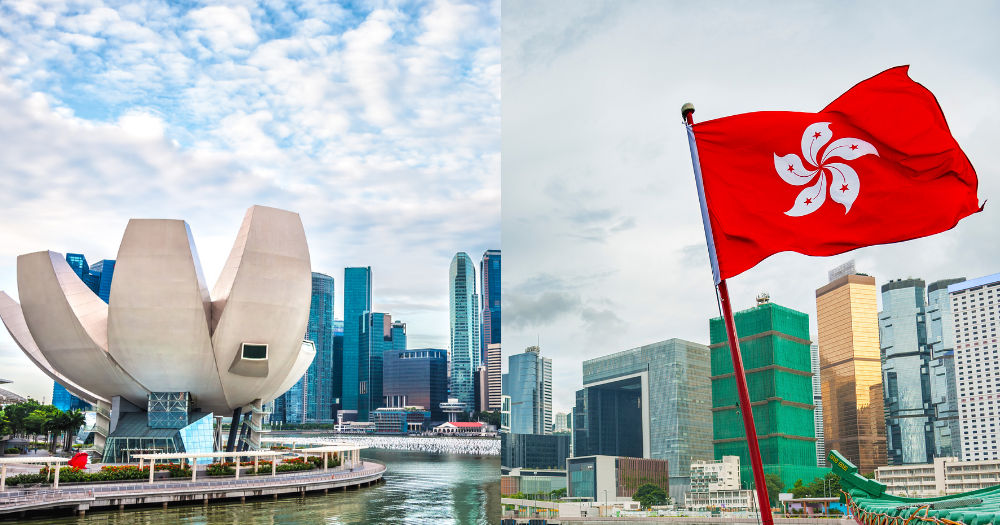


If you were following last week's Budget debate, you might have noticed several People's Action Party (PAP) MPs mentioning Hong Kong.
Timing might have played a part. Hong Kong's financial secretary, Paul Chan, delivered Hong Kong's 2025-2026 budget speech on Feb. 26, 2025, thus coinciding with our budget debates.
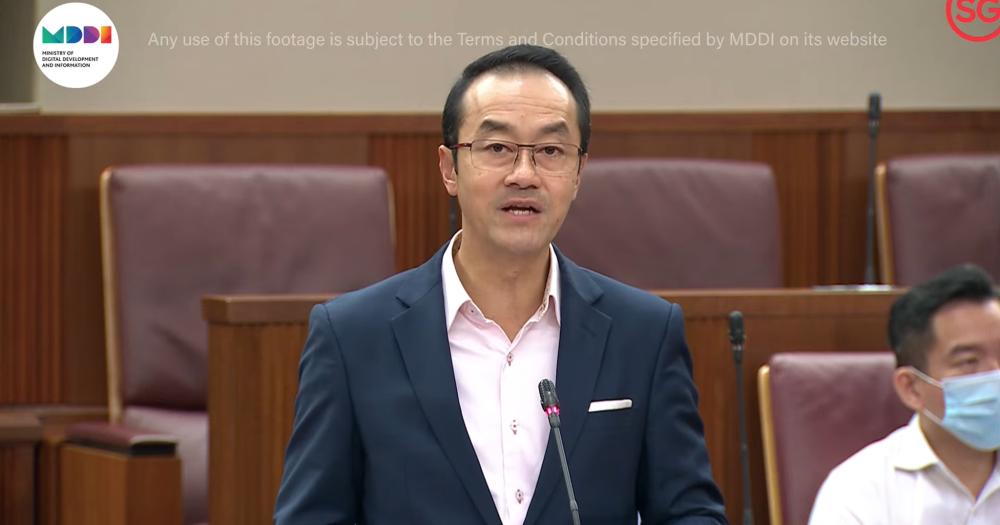
Either way, several MPs like Liang Eng Hwa and Foo Mee Har took the opportunity during the debate, which lasted two-and-a-half days, to contrast Hong Kong's financial situation to our own.
Singapore came out of Financial Year (FY) 2024 with a surprisingly large budget surplus of S$6.4 billion, far exceeding the S$0.8 billion surplus that was estimated during Budget 2024.
According to the Ministry of Finance (MOF), this surplus was thanks to a "larger-than-expected" operating revenue due to strong economic growth.
HK budget deficit
Hong Kong, meanwhile, has been experiencing a budget deficit for several years now. Chan revealed in his speech that as of 2025, Hong Kong continued to record an even higher deficit of HK$100 billion (S$17.26 billion).
Prime Minister (PM) Lawrence Wong, in his closing Budget speech on Feb. 28, also referenced Hong Kong's financial situation:
"Look nearer to home at what’s happening in Hong Kong, which several Members also talked about.
It used to have a healthy fiscal position. But look how quickly the situation can turn and how they have to take such drastic steps to consolidate their position.
So really, we should appreciate all that we have here in Singapore."
Why the comparison?
Hong Kong and Singapore do share certain similarities as small yet thriving entrepots, albeit with differing social and political contexts.
Liang, for instance, described Hong Kong as a "city economy and a financial centre like Singapore," and felt that "learning points" could be drawn from Hong Kong's current economic situation.
Understanding the source of this deficit, and how Hong Kong plans to reshape its operating revenue structure moving forward, can serve as an interesting foil to Singapore's fiscal regime.
Why is Hong Kong in a deficit?
Real estate has long been a vital revenue source for the Hong Kong government. And for the longest time, a pretty profitable one too.
Just like Singapore, virtually all land in Hong Kong is leased from the government.
The government generates large sums of wealth by auctioning off this land to wealthy developers, as well as squeezing revenue from property sales through stamp duties.
In this way, land revenue has filled Hong Kong's coffers for years, and formed a large chunk of the territory's revenue.
This reliance on land revenue also allowed the government to keep taxes low while still maintaining government spending.
Hong Kong thus was able to develop a reputation as a tax haven. Hong Kong, for instance, has no local, state, or provincial income taxes. Hong Kong also does not impose a VAT or sales tax like GST.
The low taxes, however, mean that Hong Kong is heavily dependent on land revenue. As Foo pointed out, in FY 2017, the Hong Kong state drew 27 per cent of its government revenue from land sales.
Foo contrasted this to Singapore's relatively more "resilient and diverse revenue base".
Low interest rates and a surge in demand
Hong Kong experienced a property crash after the 1997 Asian Financial Crisis, but quickly bounced back for three reasons.
Low interest rates in the United States (U.S.), since Hong Kong's currency has been pegged to the U.S. dollar since 1983, encouraged larger loans and thus bigger property purchases.
With Hong Kong's return to China in 1997, there was also growing demand for properties from businesses and individuals in mainland China.
Added to the mix, as the Financial Times put it, was Hong Kong's "very high population density, challenging topography and economic dynamism".
These three factors, in turn, caused a massive boom in property prices for the next few decades.
The 2010s in Hong Kong has been called the "crazy" era by some property agents, economists and developers, due to skyrocketing home and office property prices. Illustrative of this boom, between 2003 and 2021, residential prices surged by 500 per cent.
Back in 2017, Hong Kong was ranked the most expensive housing market in the world.
For youth in Hong Kong, this meant owning a house could be incredibly challenging and, for some, an "impossible dream".
For the government's coffers, however, this housing crisis was a great source of profits.
Covid-19 and high interest rates strike
Then, Covid-19 struck; and in the years since, Hong Kong's property market has been experiencing a steady decline.
China's stringent zero-Covid policies might have played a role in the eventual property downturn in Hong Kong.
More pertinently, U.S. interest rate hikes in 2022 and 2023 dampened property sales, since it became costlier to take out loans for big purchases.
Major property developers in the city are now struggling with plummeting property prices.
Slowing property purchases, lower rentals and dropping prices meant revenue from the Hong Kong state's biggest cash cow began to lag.
In 2018, Hong Kong reaped a whopping US$21.2 billion (S$28.4 billion) in land-related revenue, the Business Times reported.
In 2024, that number dipped to just US$2.5 billion (S$3.35 billion).
Ageing population and higher spending
In addition to a dip in land sales revenue, Hong Kong is also faced with the prospect of higher public spending due to its ageing population.
Population ageing has been moving at an "unprecedented pace" across the Asia-Pacific region, a United Nations report noted.
The proportion of elderly persons in Hong Kong aged 65 and over is projected to increase from 20.5 per cent in 2021 to 36.0 per cent in 2046.
Ageing populations can strain government budgets and slow economic growth.
As President Tharman Shanmugaratnam, in a dialogue with Tommy Koh back in 2018 at the Institute of Policy Studies, put it:
"Hong Kong is living on borrowed time - the property market has been doing well, but Hong Kong is going to be an aging society like us and they are going to need revenue just like we need revenue."
Is Hong Kong's situation really that bad?
Liang noted that the government would likely have to either raise taxes and fees, or significantly cut expenditures, or do both to combat the budget deficit.
Hong Kong is obligated, by the constitution, to work towards a "fiscal balance".
At stake is also Hong Kong's international credit rating, which can affect the city's ability to draw investments.
Hong Kong will likely pursue cost-saving measures to narrow the deficit gap. One such measure being floated is a review of the civil service, including salary reductions, Reuters reported.
It is worth noting, however, that Hong Kong still has a fairly low government debt-to-GDP ratio compared with most economies around the world.
Hong Kong also has ample fiscal reserves which can serve as a "solid backup force" against headwinds and external risks.
Could Singapore get into a similar situation?
"What happened to Hong Kong, in terms of running multi-year budget deficits, can happen to Singapore as well," Liang argued.
Liang, for instance, noted that Singapore has big-ticket spending items that Hong Kong does not have, such as defence, foreign affairs, and water and energy security.
Hong Kong also has China to serve as a "backstop to the economy", Liang highlighted. Singapore does not have such a hinterland.
Foo highlighted proposals by the Progress Singapore Party (PSP) to use land sales revenue to fund recurrent spending, and suggested that such an approach could put Singapore in the same position as Hong Kong today.
PSP member Hazel Poa, in 2023, argued that land sales proceeds should be treated as revenue divided over the period of the lease to alleviate "unnecessary tax burden on taxpayers".
For now, Singapore's revenue streams are more diversified than Hong Kong's, which means that potential property downturns are not likely to have as large an impact on our coffers.
All the same, Singapore is not immune to global uncertainties.
Hong Kong's revenue model seemed to be working fine, after all, till it was shocked by unpredictable external events like Covid-19.
However, due to Singapore's fiscal policies and our investment returns, we are in a good position to weather such unpredictable events.
As PM Lawrence Wong put it in his Budget roundup speech, "In contrast to many other countries which are using their revenues to service interest payments, we have the opposite. We receive a boost to our revenues from our investment returns...Our fiscal strength is a vital source of competitive advantage in these turbulent times."
Top photo from Canva.