







With the Electoral Boundaries Review Committee (EBRC) publishing its report for the upcoming election, one might wonder when the general election will be called.
The EBRC published its report on Mar. 11, recommending 18 Group Representation Constituencies (GRCs) and 15 Single Member Constituencies (SMCs).
Out of 15 SMCs, there are six newly formed SMCs —Bukit Gombak, Jalan Kayu, Jurong Central, Queenstown, Sembawang West and Tampines Changkat.
Yuhua, Bukit Batok, Hong Kah North, MacPherson and Punggol West SMCs have been absorbed into GRCs.
Out of 18 GRCs, there are five newly formed GRCs — Pasir Ris-Changi, Punggol, Jurong East-Bukit Batok, Marine Parade-Braddell Heights, and West Coast-Jurong West.
Based on these proposed changes, the Committee recommended increasing the number of MPs to 97 from the 93 that were elected in the last General Election.
The next big question on everyone's mind is when we can expect the general election to be called.
For that, we can look at the processes involved, and patterns in previous elections.
Dissolving Parliament
The next milestone we can expect once the EBRC report is issued is the dissolution of Parliament.
Upon the advice of the Prime Minister, the President will dissolve Parliament.
The Parliament can be dissolved at any time before the expiry of its five-year term, or it will automatically dissolve at the end of the term.
According to Singapore's constitution, the five-year term is from the date of its first sitting, which was in August 2020 for the current Parliament.
Looking at patterns
So when can we expect Parliament to be dissolved?
Looking at the past elections, this can happen as early as one month after the EBRC is published.
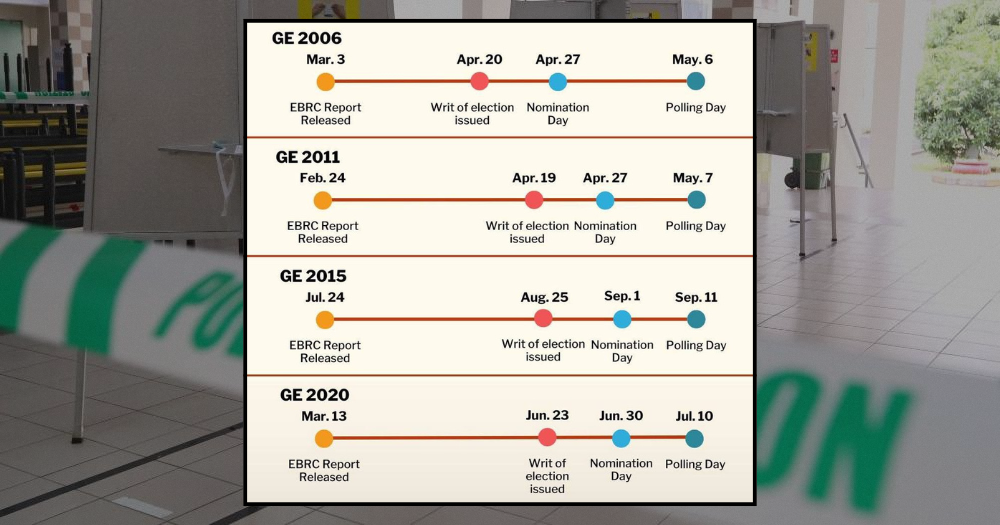
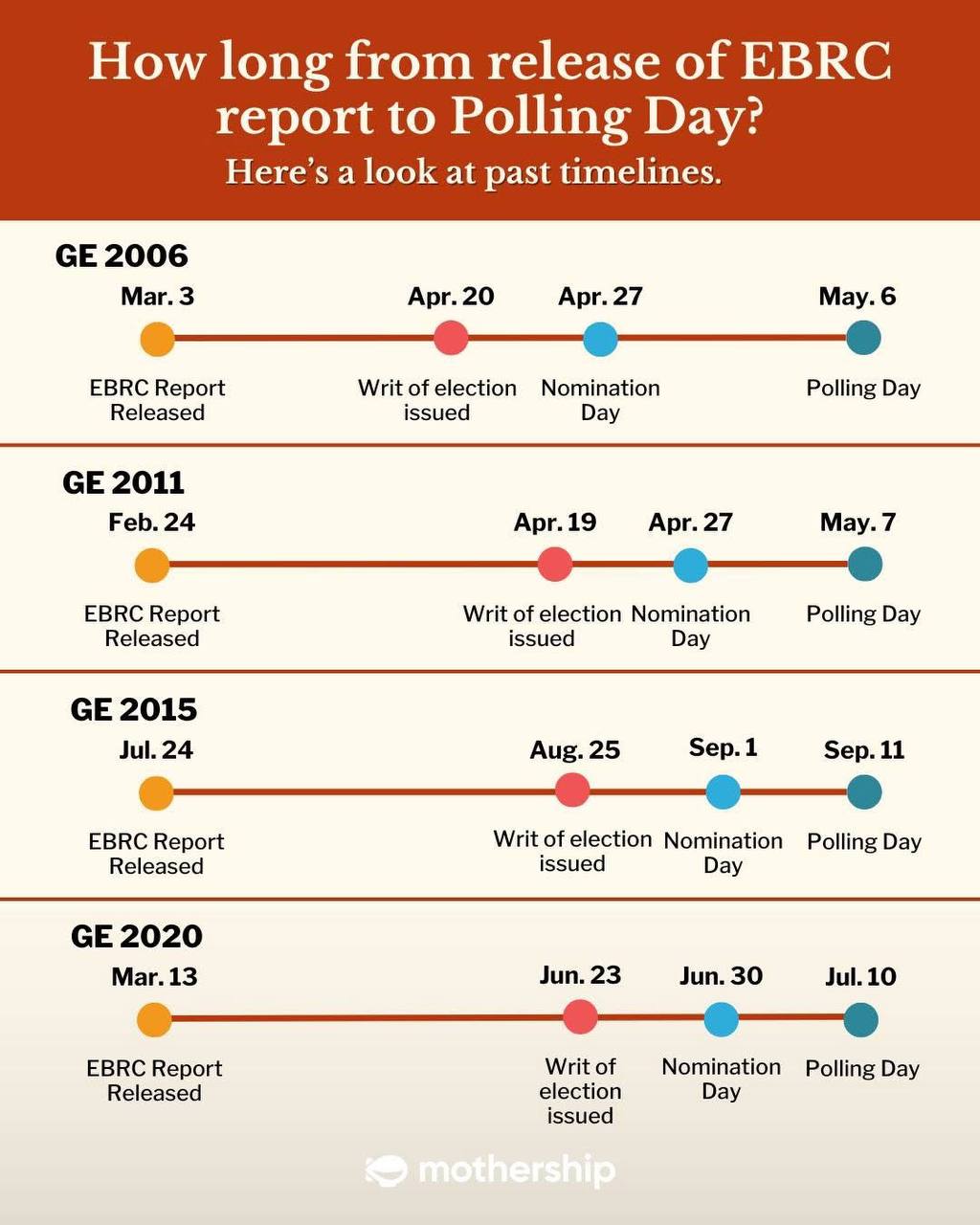
By examining the 2006, 2011, 2015, and 2020 elections, after the EBRC report was published, it took between one month and slightly over three months before Parliament was dissolved and the Writ was issued.
In 2006, Parliament was dissolved 48 days after the EBRC report was released.
In 2011, the Writ of Election was issued 48 days after the report was released.
In 2015, it took only one month for Parliament to be dissolved and the Writ of election to be issued, following the EBRC report.
During the last elections in 2020, the EBRC report was published on Mar. 13, 2020.
Parliament was dissolved on Jun. 23, 2020, about three months after the report was published.
While there was one instance in 2001 when Parliament was dissolved one day after the report was released, it is safe to guess that it would be a couple of months before Parliament would be dissolved.
The law also states that the general election must be held within three months of the dissolution of Parliament.
This means, realistically, Parliament could be dissolved really soon.
Writ of Election
The next step after Parliament's dissolution is for the Writ of Election to be issued.
The Writ is a public document which specifies the Nomination Day and the place of nomination.
It is typically issued on the same day, after Parliament is dissolved.
After that, the Returning Office will issue the Notice of Election, which states the date, time, and place for the nomination of candidates.
Nomination Day must occur between five days and one month from the Writ of Election.
Nomination Day
Nomination Day is when prospective candidates produce themselves at an assigned centre to submit their nomination papers, election deposits, and certificates.
If more than one individual or group of candidates are nominated for a particular electoral division (i.e. a GRC or SMC), a notice of contested election is issued, indicating when Polling Day will occur.
Campaign Period
Once Nomination Day ends, the campaigning begins.
The campaign period runs from after the notice of contested election is issued until the start of Cooling-off Day, the day before Polling Day.
The law dictates that Polling Day must take place between 10 and 56 days after the notice of contested election is published.
However, the campaign period has typically been nine days long, based on the past few elections.
Cooling-off Day
The day before Polling Day is known as Cooling-off Day, where election campaigning is prohibited for 24 hours.
This one-day "campaign silence period" is meant to give voters time to "reflect rationally on issues raised during the election before going to the polls."
There is a list of prohibited activities and exceptions on Cooling-off Day here.
Polling Day
Then comes the big day, Polling Day.
Polling Day is a public holiday and may fall on a Saturday.
Voters will vote at their allocated polling stations between 8:00am and 8:00pm.
Overseas voters will also go to the polls at overseas polling stations but these stations must close before polling ends in Singapore.
Sample Count & Counting Votes
The counting for votes will begin with a sample count of a random bundle of 100 ballots, which provides an early indication of the possible electoral outcome of an electoral division.
According to the Elections Department (ELD), the sample count prevents speculation and misinformation from unofficial sources while counting is underway and helps election officials check against the electoral division's election result.
After the ballots are fully counted at one counting centre, the results are transmitted to the principal counting place, where the results from all of the counting centres in Singapore are compiled.
If the number of overseas votes has no impact on the election, the candidate or group of candidates with the greatest number of votes are declared to be elected.
If the overseas votes could impact the outcome, the number of votes cast in Singapore in favour of the candidate or group of candidates is announced, and the declaration of their election is deferred until the day that the overseas votes are counted.
After the overseas votes are counted, the final results will be published in the Singapore Government Gazette.
Destruction of Ballot Papers
Once the vote count ends, the ballot papers and other documents used in the election are sealed and kept in a secured place for six months.
After six months, they are destroyed unless otherwise directed by the President.
This is done to ensure the secrecy of the vote.

Top photos via MDDI & Mothership