News

Ng Eng Hen: Image of US in Asia has changed from liberator to disruptor to landlord seeking rent
This will have an impact on trade and the question will be on the extent of the impact, he said.
February 15, 2025, 03:01 PM


The image of the U.S. in Asia has changed, Defence Minister Ng Eng Hen said on Feb. 14.
For Asia, the moral legitimacy of the U.S.' presence in the region could be summed up by the inaugural speech of the late John F. Kennedy, "that one form of tyranny (colonial control) will not be replaced by an iron tyranny," Ng said.
However, America's primacy has now become the overriding consideration in its foreign policy, he noted.
"Not that it never was, but I think that it has now become the Pole Star of foreign policy, even at the expense of bilateral ties or multilaterals. It is a great disruption, so we have got to recognise that," Ng said.
As a result, because of its "willy-nilly" behaviour, the image of the U.S. in Asia has changed from liberator to great disruptor to a landlord seeking rent.
Trade will be affected
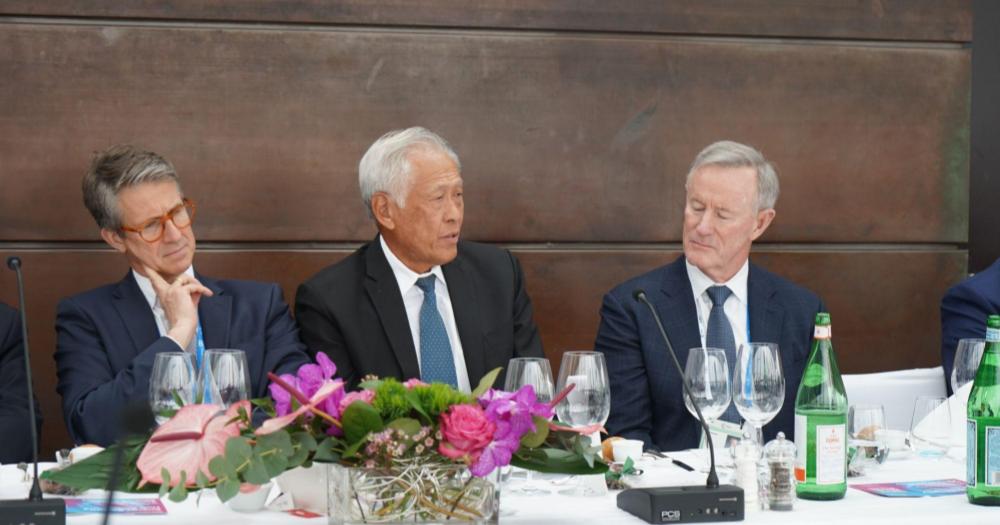
Ng made his remarks during his speech at the BMW Foundation Herbert Quandt Annual Leaders Roundtable in Munich, Germany.
He added that how countries and regions respond to this significant shift in U.S. foreign policy bears watching and that in any scenario, China will be a key player.
In addition, there will also be an impact on trade and that it will just be a question of how much.
Ng then noted that during Trump's first term, between 2018 and 2019, bilateral trade between the US and China fell about 10 per cent.
Europe also imposed tariffs to correct its trade imbalance with China and the trade deficit did come down in 2023, he said.
While the trade deficit came down from about €396 billion to about €292 billion, Europe's real GDP growth also fell from 3.5 per cent to 0.4 per cent, although this was not entirely due to the tariffs.
Ng then said:
"Now there are fresh salvos of tariffs from the U.S. omni-directionally. The question is how much our trade will be affected. It has been said that trade and security are two sides of the same coin, and one assumes that as trade dependencies shift, security alliances will follow."
He also pointed out that China accounts for 80 per cent of the world’s solar manufacturing capacity, and more than half of electric vehicles) produced worldwide are Chinese-made.
"And I think this dichotomy going forward between the U.S. and China will put pressure on trade and security," he added.
Progress and well-being of the global commons will suffer
Within Asean, most of the countries gained independence in the 1960s and 70s, which makes them "young democracies", he pointed out.
"And I think any major shift in this great power balance is likely to alter the trajectory of Asean," he said.
Collectively, the group's 10 nations has about 700 million people, and a combined GDP of about 4 trillion, the fifth largest in the world.
Ng then elaborated:
"So in this indeterminate phase, in the absence of a leader to protect our global commons, I think we must all expect that the progress and well-being of the global commons will suffer. To me, that is a given. It is just how much. That includes any global regime to deal with climate change. That includes any system that wants to deal with other aspects."
Why was Ng in Munich?
Ng was in Germany for the 61st Munich Security Conference.
While on the sidelines of the conference, he called on German Federal Minister of Defence Boris Pistorius.
During their meeting, both Ng and Pistorius reaffirmed the strong and substantive defence relations between Singapore and Germany.
Ng also expressed appreciation for the German Federal Ministry of Defence’s support for the Singapore Armed Force’s training in Germany since 2009.
Both sides also exchanged views on geopolitical and security developments.
He also had a bilateral engagement with Italian Minister of Defence Guido Crosetto.
Also gave a speech on AI
Apart from his speech at the BMW Foundation Herbert Quandt Annual Leaders Roundtable, Ng also spoke at the Aspen Strategy Group (ASG) and Amazon Web Services roundtable.
Speaking on the advent of AI systems, Ng shared about the creation of the Digital and Intelligence Service (DIS) in 2022 as the fourth service of the Singapore Armed Forces, now on par with the Army, the Navy and the Air Force.
One of the DIS' main priorities is to optimise the application of new technologies, particularly AI, across the SAF’s spectrum of operations, he said.
To this end, the SAF has increased linkages with Singapore's closest partners on military AI.
With the U.S., Singapore signed a Memorandum of Understanding for Defence Innovation Cooperation and a Statement of Intent regarding Data, Analytics and Artificial Intelligence Cooperation in 2023.
Singapore also established a Joint Research Laboratory with France in 2023.
This Joint Lab is led by the National University of Singapore and the French National Centre for Scientific Research, and will focus on developing AI capabilities for impactful defence applications.
Singapore also supports initiatives such as the U.S.-led AI Partnership for Defence, and the Responsible AI in the Military Domain (REAIM) process, led by the Netherlands and the Republic of Korea, and has also endorsed the US-initiated Political Declaration on Responsible Military Use of AI and Autonomy, Ng pointed out.
He added, "But the jury is still out, if a global consensus on civilian applications, let alone military, can be agreed upon."
Top photo via MINDEF