News

France's President Macron vows to double defence spending, will attend S'pore security conference
Macron will visit Singapore in May, to give the 22nd Shangri-La Dialogue's keynote speech.
February 06, 2025, 09:39 AM

 France’s president, Emmanuel Macron, has said that his country will double its defence spending in upcoming years, as he urged European leaders to increase their own defence spending.
Macron’s security concerns appear to be broader than just European in nature, as his comments come after announcing that he will be a keynote speaker at the Shangri La Dialogue, a security conference, to be held in Singapore at the end of the year.
Underfunded
The topic of European defence spending is a perennial one, with allies such as the United States often complaining that most European countries did not pay their fair share towards defence.
This was illustrated by the newly confirmed U.S. Secretary of State Marco Rubio once again criticising European allies for under-investing in defence, as reported by Reuters.
Rubio made his comments on Jan. 31 and was swiftly rebutted by France’s foreign ministry, which said that France, along with 23 of 32 NATO member states, met or exceeded the two per cent spending target.
The foreign ministry statement also added that France intended to double its defence spending in upcoming years.
Double double
This was reiterated by President of France Emmanuel Macron, speaking to the press at the Informal EU Leader’s Retreat.
Macron said that France intended to double its defence spending, currently 2.1 per cent of its GDP, in upcoming years, and that France had implemented several military programmes to enable that.
France will double its defense budget, – Emmanuel Macron.
He urged other EU members to join this effort, and "identified seven key factors where Europe must act together."
— Anton Gerashchenko (@antongerashchenko.bsky.social) 3 February 2025 at 20:36
But he also spoke about the need for different instruments to help raise the funds needed for that spending, such as the European Investment Bank.
He invited fellow European states to do the same.
While France may have taken umbrage at Rubio’s comments the week before, it has held similar views about the need for EU states to spend more on defence.
In a speech to France’s military on Jan. 21, Macron said that the expected changes in the U.S.’s foreign policy were an "opportunity for a European strategic wake-up call”, according to the Associated Press.
Toil and trouble
Saying that such changes would likely affect U.S. support for Ukraine, as it fights against an invasion by Russia, Macron said that Europe had to provide “lasting support to Ukraine”, indicating that he considered Russia a significant risk.
Macron urged his fellow European leaders to consider what might happen if the U.S. were to turn its attention away from Europe.
He asked hypothetically “What if (the U.S.) send their fighter jets from the Atlantic to the Pacific”, referencing expectations that the U.S. would once again attempt to focus on the Indo-Pacific as its primary region of concern.
Reuters reports that EU leaders, including United Kingdom Prime Minister Keir Starmer, agreed to increasing defence spending, focusing on "critical gaps" such as in air and missile defences.
EU president Ursula von der Leyen said that "Europe needs, basically, a surge in defence", and that its defence industrial base needed to be strengthened.
Shangri La
However, the Indo-Pacific remains of interest to France and Macron as well.
A 2022 report published by the ISEAS - Yusof Ishak Institute said that France had over 8,000 military personnel in the region, spread across five bases, mainly in the South Pacific.
France has also regularly taken part in military exercises in Australia, and at one point had a deal to sell the Australian navy submarines, although this was eventually supplanted by AUKUS.
A better understanding of France’s policy approach to the Indo-Pacific will likely be gained later in the year.
The International Institute for Strategic Studies (IISS) announced on Jan. 20 that Macron would deliver the keynote speech on May 30 for the 22nd edition of the IISS Shangri-La Dialogue, which is Asia’s premier defence summit.
Previous keynote speakers included then-Prime Minister of Japan Fumio Kishida, Philippines President Ferdinand Marcos Jr, and Australian PM Anthony Albanese.
These leaders have taken the dialogue as an opportunity to state their nation’s vision for Indo-Pacific security.
Macron will likely do the same and will do so at a time when the region and the world's traditional order continues to be roiled, for good or for ill.
Related stories
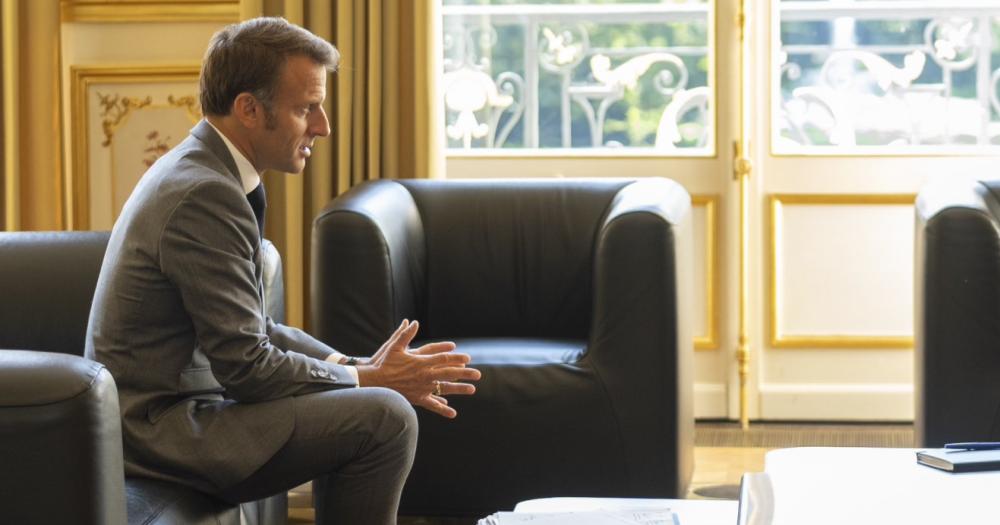
Top image via Emmanuel Macron/X