



Abroad

S'pore & China sign MOUs on transport, green industry; AI frameworks mapped
Explore new opportunities and deepen cooperation.
November 22, 2026, 04:23 AM
Photo from MDDI and PMO.


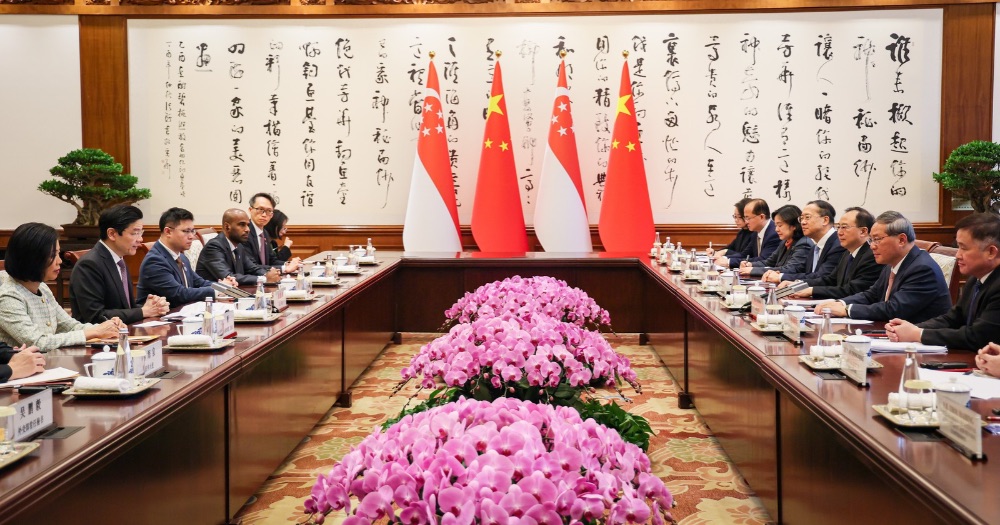
Singapore and China have signed two more Memorandums of Understanding (MOUs), on transport and green industry development, and will sign a third on education.
The Infocomm Media Development Authority (IMDA) and China's Academy of Information and Communications Technology (CAICT) also completed a joint mapping of their AI governance frameworks.
"As China embarks on its 15th Five-Year Plan and Singapore takes forward the recommendations of our Economic Strategy Review, there is much scope for us to find new areas of cooperation that support our respective development priorities," Prime Minister Lawrence Wong said in a Facebook post after meeting Premier Li Qiang in Beijing.
Transport MOU
Singapore's Minister for Transport and Second Minister for Finance Jeffrey Siow and China's Minister of Transport Liu Wei signed an MOU to deepen transport cooperation.
Cooperation will take the form of high-level dialogues, technical and academic exchanges, capacity-building, joint seminars and project cooperation.
Areas include:
- Facilitating the movement of goods and people;
- Transport safety;
- Green, low-carbon and sustainable transport, including supporting the implementation of Green and Digital Shipping Corridors between Singapore and China;
- Intelligent transport systems, artificial intelligence and other transport technologies and innovations, and
- Any other areas of transportation cooperation mutually agreed by both parties.
A Joint Ministerial Steering Committee co-chaired by the two ministers will meet every two years, alternating between Singapore and China, and oversee the MOU's implementation.
Green industry MOU
Singapore's Minister for Sustainability and the Environment Grace Fu and Zheng Shanjie, chairman of China's National Development and Reform Commission, signed an MOU on cooperation on green industry development.
It sets up a bilateral framework led by the Ministry of Sustainability and the Environment (MSE), involving other Singapore ministries and agencies.
It aims to help both countries build low-carbon and climate-resilient economies through policy exchanges, technology and research collaboration, and industry partnerships.
Areas include energy-saving and carbon-reduction industries, green upgrading of infrastructure, environmental protection industries, green and low-carbon energy transition, the circular economy, biodiversity conservation and green services.
Education MOU to be signed
Singapore and China's education ministries will sign an MOU on educational technology (EdTech) and AI in education on the sidelines of the 22nd Joint Council for Bilateral Cooperation in end-November 2026.
Under the MOU, both countries will deepen policy exchanges and practical cooperation on EdTech, AI, and digital education to develop solutions and good practices for better learning outcomes.
The National University of Singapore's AI Centre for Educational Technologies and East China Normal University's Shanghai Institute of AI for Education will be the lead institutions.
Areas of cooperation will include:
- Testing EdTech and AI tools;
- Exchanging AI-enabled teaching and learning practices;
- Developing assessment frameworks for vocational and human skills; and
- Short-term exchange visits, joint workshops and conferences.
The MOU will also facilitate exchanges between the teams behind the Singapore Student Learning Space and the Smart Education of China platform.
The teams will share their experiences in platform and resource development, system operation and maintenance, and explore opportunities to share learning resources to develop AI literacy.
The two countries will also build on existing capacity-building programmes for school leaders and on school twinning arrangements to strengthen exchanges in EdTech and AI.
A Joint Working Group on AI in Education will be established to support the implementation of the MOU.
AI frameworks mapped
IMDA and CAICT also completed a joint mapping of Singapore’s AI Verify Testing Framework (AIVTF) and China’s AI - Safety and Governance - Capability Requirements for System Risk Management Standard (YD/T 7173-2026).
The mapping shows how safeguards and checks under one framework correspond to the other, which can help businesses work across both, avoid duplicated effort and deploy AI more safely.
The AIVTF is an open-source testing framework and toolkit that helps companies make their AI systems more transparent through standardised testing and process checks aligned to OECD principles.
It was launched by IMDA in 2022 and updated in 2025 to include process checks related to Generative AI.
It has also been mapped to frameworks from the United States, the ISO, the Hiroshima Process and Asean.
China's standard was approved and published by its Ministry of Industry and Information Technology in July 2026.
It sets out risk management requirements for organisational capacity-building, process management and risk assessment.