




Branded

Girl, 17, loses over S$2,000 to job scam promising commission for writing hotel reviews despite initial successful withdrawal
“There is no such thing as a free lunch,” the girl said.
Image via Canva and Sophia.
17-year-old Sophia (not her real name) was scrolling through Instagram on Jul. 6, 2026 when she came across an advertisement for a job.
The job was simple — get paid commission in exchange for writing hotel reviews.
Curious, Sophia signed up for the job and entered her personal information, including her email and phone number.
Later, she was contacted by an agent on Telegram who informed her that she had been selected for the job.
Writing a hotel review
The job required Sophia to “make” a hotel review in exchange for a commission.
In order to do that, Sophia had to make an account on their website, where she was required to key in her phone number and create a password for her account.
Upon creating an account, Sophia was told she needed to fulfil two “boost orders” on the website.
There are two different kinds of orders one can complete on the website — a normal order and a boost order.
The normal order could be completed using available account balances without needing additional top-ups, though they have lower commission rates.
The boost order is a special order which promises higher commission, but requires one to top up an additional fund to their account in order to fulfil.
Every new user must complete two boost orders before they can complete other orders, requiring them to deposit money into their empty account.
The agent also warned Sophia that she would not be able to withdraw any money if she did not complete the boost orders.
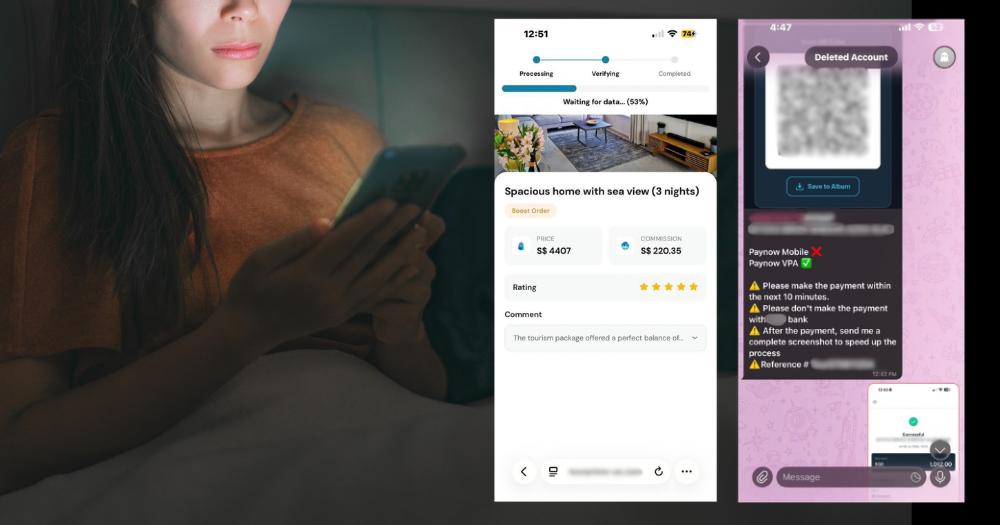
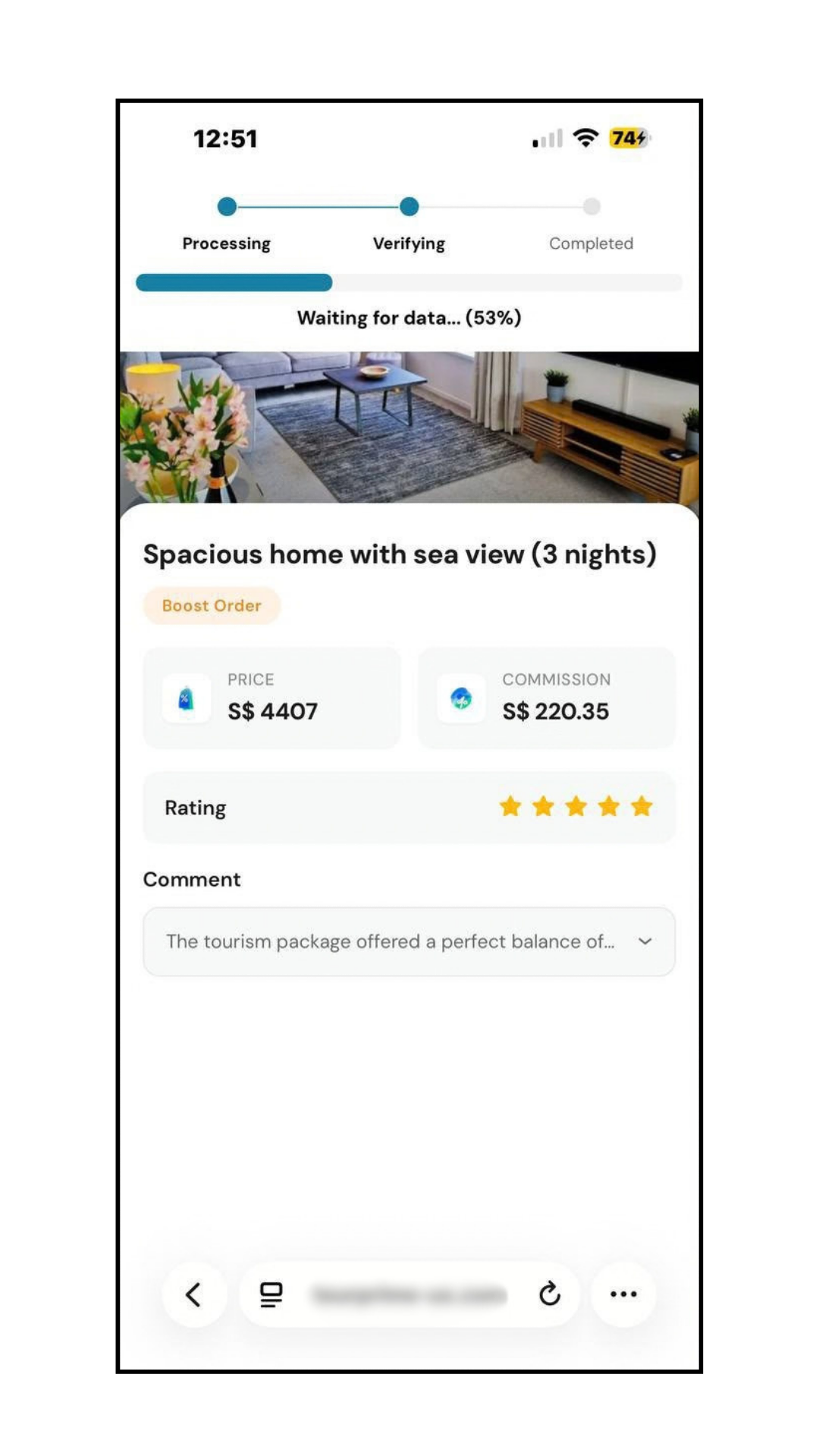 An example of a boost order. Screenshot courtesy of Sophia.
Making the first deposit
Sophia geared to complete her boost orders and deposited S$50 through PayNow QR into her account on the website on Jul. 6.
Around the same time, the same agent added Sophia to a Telegram group chat which consisted of several other members.
She was also made aware of a customer service account available via Telegram, where she can make a deposit or withdrawal to her account.
She tried reaching out to other members of the group, but no one responded to her message except for one person.
The member who responded, Alice, made small talk with Sophia, and even asked her at one point: “Do you think this (the job) is real?”
Feeling unsure but keen to try the job out, on Jul. 7, Sophia deposited S$70 and S$87 into her account.
On the same day, Sophia requested to withdraw the full account balance of S$285 from her account. This was the amount she had deposited into her account thus far along with the commission.
A customer service agent then alerted her via text that her withdrawal was successful and that the sum was credited to her PayNow-linked bank account.
Successful in her withdrawal, Sophia was convinced about the job’s legitimacy.
On Jul. 8, Sophia deposited S$505 and S$1,012 into her account through PayNow QR separately.
She did not think much about the steep jump in the amount she needed to deposit as she thought it was normal.
Completing orders
At that point, Sophia had completed one boost order, leaving her with another boost order to complete.
Completing the order would mean that she needed to deposit money into the website.
After thinking about the matter, and having come to trust Alice, Sophia asked if she could borrow money from her.
Sophia believed she could immediately return the owed sum to Alice after receiving the commission from the website.
Alice asked Sophia to send a photo of the back of her IC before lending her the sum.
Upon receiving the photo, Alice told Sophia that she had transferred S$787 to the website directly on Sophia’s behalf.
Sophia checked her account balance on the website and confirmed that the sum had been transferred.
Believing that she would get her money back, Sophia proceeded to deposit another S$989 to her account.
After that deposit, she was asked to make another top-up of S$5,187 to her account.
Realising that she had no money left to make a deposit, Sophia attempted to borrow money from her mother, who stopped her from making another transfer as she realised the whole thing could be a scam.
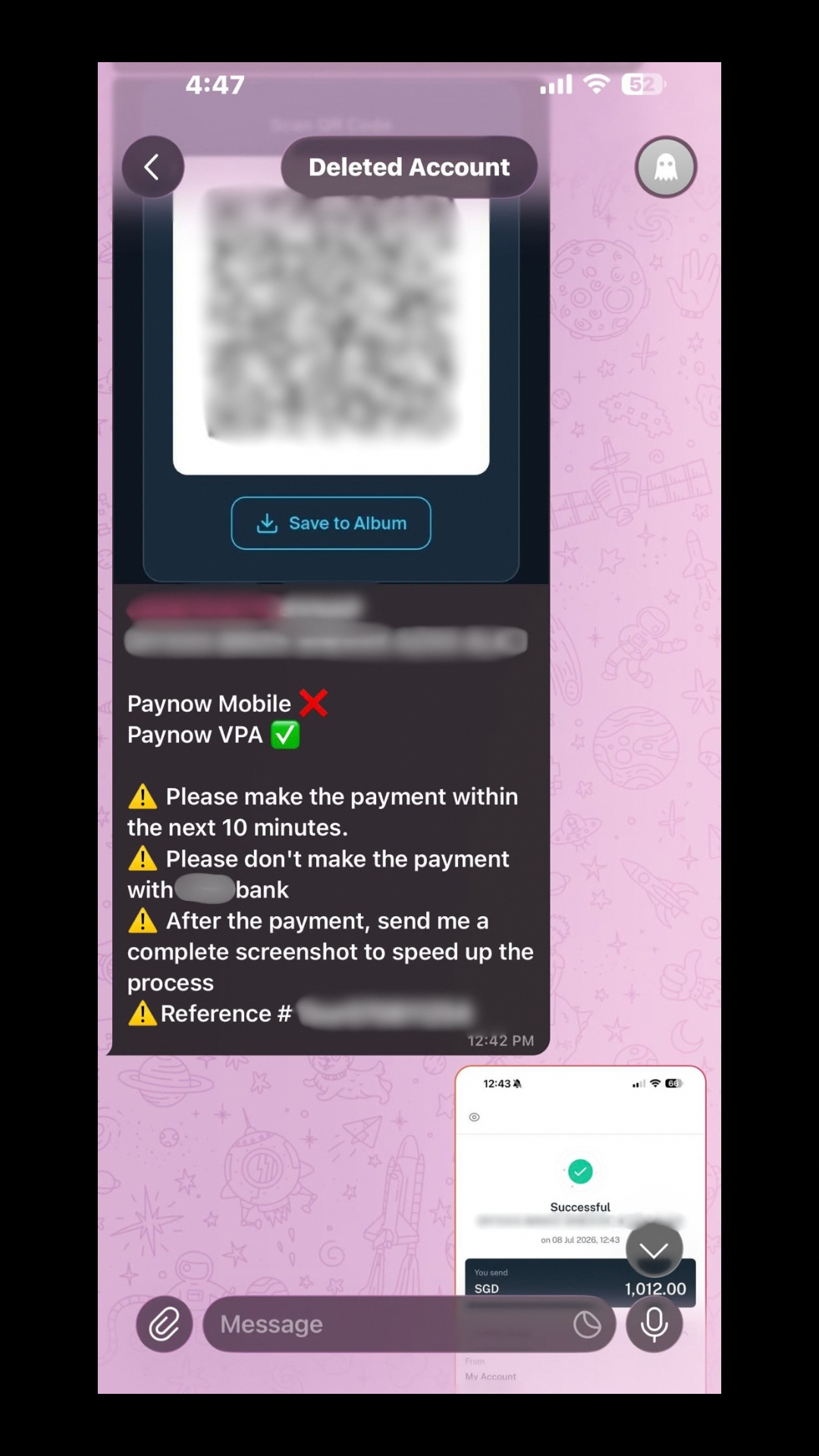 Screenshot courtesy of Sophia.
Unable to trace and recover funds
Sophia promptly lodged a police report on Jul. 10, four days after she came across the job ad on Instagram.
By the time she made the report, she had lost more than S$2,000 to the scam.
After talking to the police, Sophia realised that her exchanges with Alice could have been a ploy to get her to trust the legitimacy of the entire scheme.
On the same day, at the advice of the police, Sophia went to make a new bank account, as the scammer had her bank details.
Five days later, Sophia’s investigating officer told her that they were unable to trace and recover her funds as the monies had been fully dissipated and could not be recovered.
A few days after she lodged a police report, Sophia realised she had been removed from the group chat.
The agent and customer service’s accounts became deleted accounts, while Alice had deleted their chat.
There is no such thing as a free lunch
Prior to this experience, Sophia had thought that she wouldn’t fall for a scam as there are many cautionary tales out there about scams.
With so many stories out there, she thought she knew the ways scammers work, and would have avoided any scam attempts.
Sophia said she wanted to share her story so that others could “be more alert”.
“To all the people out there [reading my story], please take me as an example and try not to fall for these kinds of scams anymore,” she said.
“In life, the only way we can earn money is only [through] hard work and [studying] hard. There is no such thing as a free lunch.”
What to do if you encounter such a scam
According to the mid-year Scams and Cybercrime Brief 2026, job scams are among the top five scam types in Singapore, with losses exceeding S$64 million in the first half of 2026 alone.
Victims are often offered jobs to complete simple tasks in exchange for easy commissions, before being asked to pay as part of the job.
While victims may receive commissions initially, they are subsequently asked to pay more to complete additional tasks or unlock higher earnings.
Victims will realise that they had been scammed when they failed to receive their commission, could not withdraw their monies, or when the scammers became uncontactable
The SPF reminds members of the public that online jobs that require you to use your own money to do the job are a scam.
If unsure if something is a scam, call the 24/7 ScamShield Helpline at 1799 to check.
This branded article made the author more wary about job ads on Instagram.