




Abroad


Jensen Huang & Nvidia have been selling chips to China, there’s no need to create a spy saga
Nvidia didn't really need any motivation to sell AI chips to an AI powerhouse.
November 18, 2026, 02:14 PM
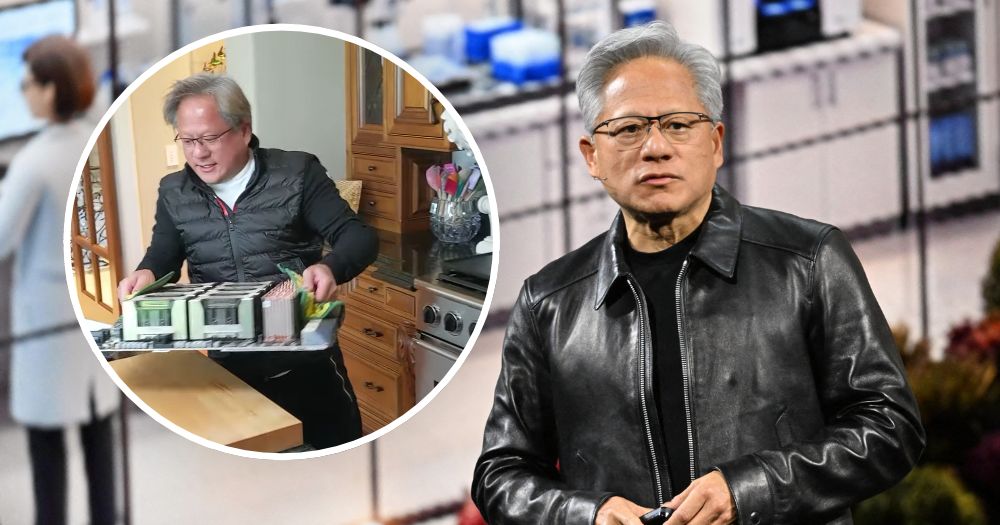
Image via Nvidia & AFP

 The saga of Jensen Huang’s alleged affairs is a tale with so many twists and turns that it feels like watching a K-drama.
The former Nvidia CEO is embroiled in a triple (alleged) affair that is also a spy saga and, somehow, a culture war.
First, an affair; then it turns out the affair is with an alleged spy; then another affair, and another affair, and then the affairs are with employees; then he’s fired (or did he quit?), he’s distraught, maybe he’s not fired, on and on.
The affair certainly is a juicy piece of news, especially with the spy angle.
Alice Huang, the initially reported affair partner, is accused of being a spy for China, although the allegation remains unproven.
The company she worked for, Megaspeed International, was suspected of being used to help China circumvent a U.S. export controls on Nvidia’s cutting-edge GPUs, critical for pushing the frontier of Artificial Intelligence. Megaspeed has denied the allegations.
Her role as a spy, it should be said, is an accusation that has yet to convince everyone in the U.S. establishment, according to CNN.
Singapore's Ministry of Home Affairs has also said she was not investigated for espionage here.
Police found insufficient evidence to establish offences involving suspected inaccurate declarations linked to Megaspeed. However, she was issued a stern warning and barred from re-entering the country after police assessed that she had knowingly provided inaccurate information to downplay her role in the company.
The affair, in both senses of the word, has divisions among some US political and business figures.
One side includes U.S. Secretary of State Marco Rubio, whose memo on Jensen’s relationship with Alice Huang reportedly helped bring about his exit. On the same side are China hawks from both parties in Congress, who have long pushed for tighter chip controls.
The other side includes business leaders such as Tesla’s Elon Musk, Epic Games’ Tim Sweeney, Y Combinator’s Garry Tan, Replit’s Amjad Masad and Shopify’s Tobi Lütke, who have signed a petition to have Jensen reinstated as Nvidia boss.
Profit motive
But the debate over the saga misses the forest for the trees because Nvidia has already sold (certain types of) chips to Chinese firms for profit. There isn't really a need to hunt for further motivation.
Jensen Huang has never been shy about his desire to also sell high-end chips to China.
Nvidia is not a primarily manufacturer of finished consumer products in the way that we might be used to.
For instance, take Apple. Apple designs products, contracts with factories to manufacture its designs, sends them to its stores all across the world and then sells those products to consumers.
There’s some variation; for example, the store is not always theirs, but fundamentally, Apple sells finished products under its own brand.
Nvidia, on the other hand, designs high-end graphics processing units (GPUs), relying on external manufacturers to produce them.
It then sells chips and computing systems to various customers, including third-party manufacturers, cloud service providers and system integrators (and I’m simplifying a complicated process here)
Some manufacturers assemble Nvidia's GPUs into graphics cards and sell them to consumers, while others incorporate Nvidia technology into servers and AI infrastructure.
Nvidia has an outsized amount of control in this process, so in some ways it can feel like they’re the ones selling the final product.
But the upshot of this is that many of the third-party manufacturers they sell to are in China and in Taiwan.
It’s part of the reason why when you trawl through Nvidia’s own reports, they show that customers headquartered in China, including Hong Kong, accounted for about 20% of its revenue in FY2024, 19% in FY2025 and 9% in FY2026.
These figures are based on customers' headquarters locations, rather than where Nvidia's chips were ultimately shipped or used. Nvidia also restated the earlier figures using its FY2026 geographical reporting methodology.
Gigawatts of chips
But when discussing the current spy saga, it's clear that what’s being discussed is not simply Nvidia’s production line, no matter how you define its relationship with third-party manufacturers.
It's about where its finished GPUs end up.
There’s no way to know for sure exactly how many of Nvidia's chips ended up in China illicitly, but there are estimates.
SemiAnalysis estimates that more than 1.5 gigawatts (GPUs are now measured by the energy they consume) worth of GPUs of computing power capacity associated with restricted Nvidia GPUs ended up in China. Their report suggests those chips should not have been in China, due to export restrictions… but stick a pin in that.
Gigawatts measure power, not energy. The figure is SemiAnalysis's estimate, rather than a verified count of illegally imported chips.
But suffice it to say, 1.5GW represents a sizeable amount of computing infrastructure, illustrating the scale of China's demand for Nvidia's technology.
Biding his time
In a podcast appearance earlier in 2026 where he advocated for U.S. technology (Nvidia chips) in China’s tech stack, he also angrily refuted the idea of pulling out of the country, comparing it to “giving up the world.”
He emphatically said that he did not “wake up a loser,” and would not accept that outcome.
But there are many in the United States' security establishment who believe that China's AI capability was, at least in part, built on U.S. technology, and who wanted that transfer of capability to stop.
This was most pronounced under former U.S. president Joe Biden's administration, which introduced restrictions on exports of certain advanced computing chips to China in 2022, before tightening semiconductor-related controls in 2023 and 2024.
The restrictions initially affected advanced Nvidia chips such as the A100 and H100, and subsequently covered newer products, including the H200 and B200. However, the rules were based on technical performance thresholds rather than targeting specific Nvidia models.
Jensen repeatedly criticised these restrictions and in 2025, complained that they risked damaging U.S. businesses in China, as quoted by CNBC.
China's demand and its continued reliance
Jensen has advocated strongly for continuing GPU sales to China, having said on multiple occasions that the advantage of doing so is that it keeps China reliant on the U.S.’s “tech stack.”
Basically, China continuing to use an AI technology ecosystem dominated by American companies could give the U.S. some leverage over China’s AI progress.
For those who think that the most dangerous situation between the two superpowers was one where dialogue and trade are totally uncoupled, Nvidia’s chips being a core component of China’s advancement could help prevent the worst possible future.
Jensen’s Nvidia didn’t really need some salacious reasoning to justify why Nvidia would continue to sell chips to China, although it might explain the specific way it was done.
And as for that point we stuck a pin in earlier: Nvidia’s chip sales to China are not entirely illicit either.
In December 2025, U.S. President Donald Trump announced that Nvidia would be allowed to export its H200 GPUs to approved customers in China, subject to conditions, in exchange for a 25 per cent cut of those sales, according to The Hill.
The BBC reported Trump saying that the 25 per cent cut would be “paid to the United States of America”. It followed a similar deal in August 2025 that allowed Nvidia to sell the H20, a cut-down chip designed for the Chinese market, in exchange for a 15 per cent cut of revenue.
The Trump administration formally approved H200 exports under certain conditions in January 2026. By July, a U.S. Commerce Department official confirmed that a small number of H200 chips had been shipped to China.
It should be noted that by December 2025, the H200 was no longer Nvidia’s top-of-the-line product. It had been surpassed by newer Blackwell-generation chips, including the B200, which remained barred from China.
It started way earlier
And Nvidia is not the only player in the AI space, even if it is the biggest.
Companies like AMD, ironically run by Jensen’s distant cousin Lisa Su, jostle in the space as well.
A 2019 Wall Street Journal article suggested that a cash-strapped AMD received a significant financial boost from a 2016 deal licensing its chip technology to Chinese partners, a deal that went on to alarm U.S. national-security officials.
This shows that China's importance as a market for American chipmakers far predates any allegations between Jensen and Alice Huang.
Nvidia’s selling to China has long been a company-wide strategy, which this article only scratches the surface of.
The idea that he needed to be persuaded by a femme fatale to supply chips to one of the largest, if not the largest, markets for Nvidia’s product borders on absurd, so much so that it could only fit in a soap opera.