




Abroad


Comment: For the Democrats, the last easy day was yesterday. Tomorrow will be tougher.
The most important thing to do is to moderate your expectations for what’s going to happen over the next two years.
November 05, 2026, 02:28 PM
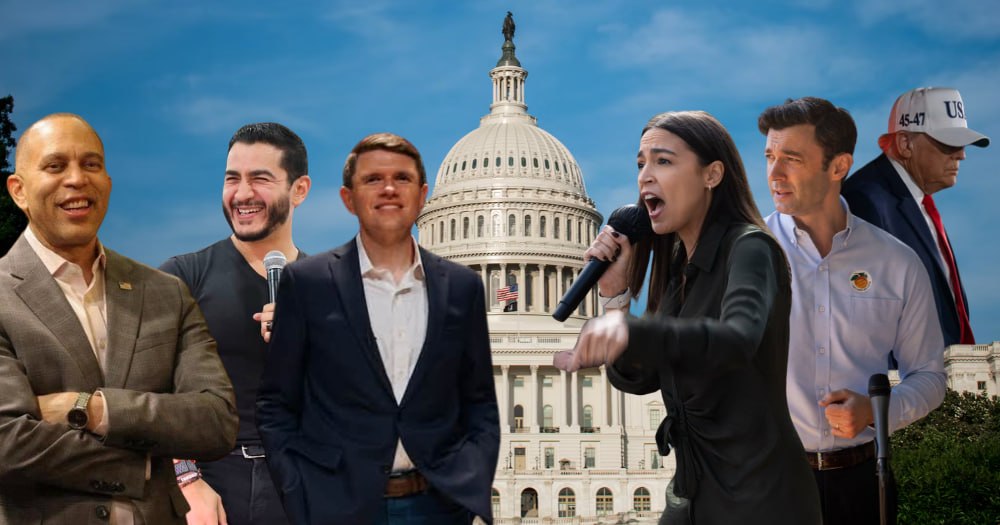
Image via Unsplash, White House Gallery, & John Ossoff, Abdul El-Sayed, James Talarico, Alexandra Ocasio-Cortez, Hakeem Jeffries/Facebook


On Nov. 3, the United States held its midterm elections, where Democrats were expected to take back the House of Representatives.
This was partly because Republican President Donald Trump was massively unpopular for a number of reasons, including tariffs, the war in Iran, and the subsequent cost-of-living crisis that worsened; it was expected that his party would be punished in the polls for it.
It is also a matter of course that the party of the U.S. president should lose seats during midterms, with there being only three exceptions in the past century.
But the scale of the losses was larger than most were expecting.
By the end of Nov. 4 (Singapore time), NBC News projected that Democrats would have around 258 seats in the House and at least 54 seats in the Senate, with two seats too close to call but with Democrats leading.
As someone who regularly writes about politics, curious friends have asked about the result, whether things like the war in Iran might be over because of the strength of the Democratic victory.
To those friends, I hope you had a good day yesterday, watching the results come in. Tomorrow is going to be tougher.
First things first: moderate expectations.
The most important thing to do tomorrow is to moderate your expectations for what’s going to happen over the next two years.
Mothership spoke to Adrian Ang, the coordinator of RSIS’s U.S. programme, just before the midterms were held on Nov. 3, and he cautioned that “basically what we’re looking at is principally gridlock for the next two years.”
“The president’s domestic agenda,” Ang said, “will face significant roadblocks.”
The "domestic agenda" portion is important as Trump faces far fewer restrictions in his foreign policy, save that a Democratic House can make it more difficult to appropriate money for some actions.
And Trump has made it clear that the way forward will be difficult, posting an image of his trademark red hat with the word "VETO" embroidered on it.
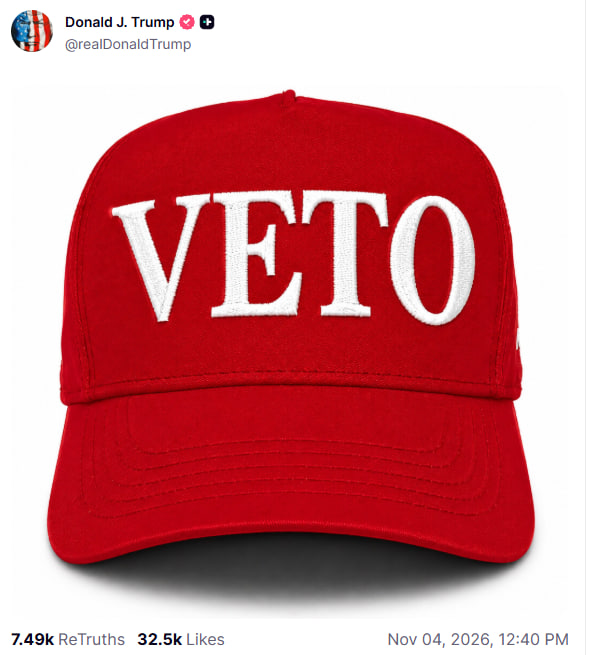 Image via Donald Trump/Truth Social
U.S. legislation that passes the House of Representatives and the Senate still requires approval from the president, who could otherwise veto the bill.
Both bodies can pass the legislation again, but would need a supermajority in both houses in order to overcome the veto: 290 votes in the House and 67 in the Senate.
So as impressive as Democratic performance in the election was, it is still not enough to surpass a presidential veto.
But can't the Democrats impeach Trump?
Yes, the requirement to impeach Trump, or any member of his cabinet, is a simple majority in the House: 218 votes.
But to convict them afterwards, which then results in their removal, requires 67 votes in the Senate, so that’s unlikely to happen as well.
Bilahari Kausikan, the former Permanent Secretary of the Ministry of Foreign Affairs, said as much in a social media post around noon on Nov. 4, before most of the results were out.
He said that “substantive policy changes over China, Iran or tariffs are unlikely. If the Democrats take both Chambers, the main constraint on Trump will be his ability to make new appointments, a relatively inconsequential matter.”
He also warned of what I will deem point two.
“Never underestimate the capacity of the Democrats to self-destruct”
Bilahari said one should “never underestimate the capacity of the Democrats to self-destruct.”
“A sweep of both Chambers will likely trigger a vicious internal debate over whether victory was due to ideological purity or dislike for the incumbent.”
Ang likewise warned that the Democratic leaders will now have to face two factions, their progressive and centrist wings, and that attention will have to be paid by Democratic leadership in managing what Ang called a “diverse”, “heterogeneous” coalition.
The case of Abdul El-Sayed warns of what those fights might look like, and what they might be about, with battle lines drawn in blue and white.
El-Sayed endured a late betrayal by his Democratic primary opponent Haley Stevens, who, after much hemming and hawing over several months, surprised many by endorsing El-Sayed’s Republican opponent, Mike Rogers.
The Democratic Party coalesced around El-Sayed, with the consensus being that Stevens’s career in Democratic politics (she is a Representative prior to running for the Senate nomination) is over.
But the bad blood between Stevens and El-Sayed is at least in part due to differences over support of Israel, with El-Sayed favouring cutting U.S. support, and his opponents, including Stevens, suggesting that he was anti-Semitic, and barbs were traded over donations to the Stevens campaign by pro-Israel groups.
El-Sayed and Stevens are not the only Democrats (or in Stevens's case, former Democrats) hashing it out over Israel, with a clear fracture existing between progressive and centrist Democrats which is far from being resolved.
This unity
There is no end to the number of things Democrats have traditionally been willing to tear themselves apart over, with the party disagreeing on many consequential and foundational issues, like wealth taxes or support for law enforcement.
In fact, even where Democrats agree, the degree of support is something they have been willing to fight over in the past.
For example, one of the reasons former Democratic president Barack Obama’s endorsement of El-Sayed was so consequential was because El-Sayed had spent years, from 2012 onward, criticising about how ineffectual Obama was, particularly on healthcare.
This was after Obama had managed to pass one of the most consequential healthcare bills in modern American history.
They disagree on so much, and so vehemently at times, it can be easy to forget how much the party has in common, and the challenge will be to focus on the things that hold the party together while their opponents try to prod them with what sets them apart.
Executive powers
Trump will also hardly be the first U.S. president to govern without the support of both houses of the legislature.
Most recently, Barack Obama had to do so in his final two years as president when he too lost the Senate, adding to his loss of the House in the 2010 midterms.
He governed by way of executive actions, a practice that Trump derided when he was first running for President in 2016, but turned to almost immediately upon taking office in 2017, so he will have no compunction about doing so again.
But Trump has also offered an olive branch to the Democrats, suggesting that he was willing to work with them, even complimenting them for having "fought hard” during the midterms.
Trump is capable of bipartisan governance, shown most notably in 2020, when he initiated Operation Warp Speed, the fast-tracking of the Covid-19 vaccine.
Republicans lost, Democrats did not win
What might drive the Democrats to the bargaining table is the knowledge that they didn’t really win the midterms; the Republicans lost.
Democratic popularity is only marginally better than the Republicans; according to RealClearPolling, there is literally just about two percentage points between them.
Both parties’ unfavourability ratings are in the mid-50s, with the Democrats squeaking ahead by less than two percentage points.
This view is borne out in the AP Voter Poll, as reported by PBS.
The poll highlights anger at Trump and the Republicans, particularly over inflation, tariffs, the Iran war, and corruption, as well as the fact that favourability for Democrats was barely higher than that of the Republicans.
Two in 10 said neither party was better equipped to deal with issues like economy, foreign policy, healthcare, taxes, and immigration.
If Democrats, and Republicans for that matter, hope to turn things around in time for the 2028 presidential elections, their main priority will be to bring about meaningful policy that helps their constituents.
The politics of strength
And, in a perverse way, the Democrats might be in a good spot to do this.
Critics of Trump often accuse him of practising the politics of strength rather than any actual ideological position, displaying this in his admiration for strong leaders like Vladimir Putin, Xi Jinping…
… and Zohran Mamdani, the leftist Mayor of New York City.
When the pair met in 2025 after Mamdani had spent months lambasting Trump, many expected fireworks.
But Trump appeared complimentary of Mamdani, and the pair have been able to work together to some degree.
Mamdani's pitch of a US$21 billion federally funded housing project in New York City is reportedly being favourably considered, although not yet approved.
Trump even recently said that Mamdani was "off to a start" to being a great mayor in the same week he was decrying other Democrats as "communist", and Mamdani's high approval ratings probably help.
So if Trump respects strength, then there are few parties that look stronger now in the U.S. than the Democrats, warts and all.
So while it might be that we should not mistake what is possible for what is likely, it is by no means a call to expect nothing.
As we said, moderate expectations.