Abroad


What is the Thucydides Trap, & why does Xi keep talking about it?
Xi uses a distinctly American idea, to explain his position to a U.S. audience.
October 02, 2026, 09:44 AM
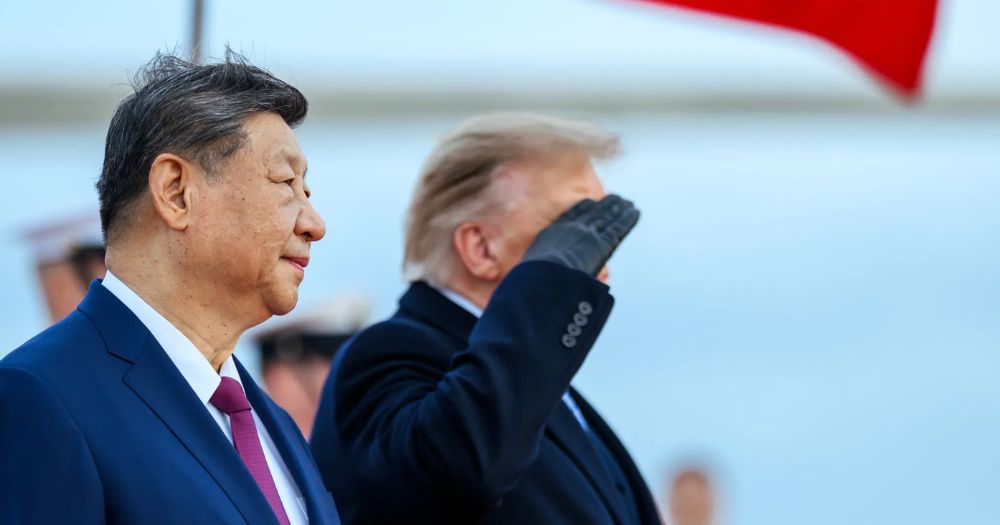
Image via White House Gallery


Chinese President Xi Jinping has met U.S. President Donald Trump twice in 2026, with a possible two more lined up later in the year.
When they met, Xi returned to a theme that he has visited consistently throughout the past decade, that of the Thucydides Trap:
"China and the United States must hold the line of no conflict and no confrontation between us, and we can certainly find the right path for our two great countries to get along on this planet we both call home..."
"The Thucydides Trap can be overcome."
The Trap references Classical Greek historian Thucydides's History of the Peloponnesian War, an account of the devastating war that saw the rising power of Athens take on the established power of Sparta.
It is a distinctly American interpretation of the war, originating with American thinkers, and first referenced between China and the U.S. by U.S. political scientist Graham Allison over 10 years ago.
So what is the Trap, why does Xi keep referring to it, and is it as straightforward as it seems?
What is the Thucydides Trap
The Thucydides Trap is the idea that a declining power’s fear and suspicion of a rising power would inevitably lead to war.
The name of the Trap alludes to the account of the Peloponnesian War by the Greek historian Thucydides, the 5th century conflict between the rising power of Athens and the established power of Sparta.
The Trap is essentially the devastating war that two powers and their allies fought, and that war was made nigh on inevitable due to the fear and suspicion felt by Sparta in response to Athens’ growing power and influence.
In the post-Second World War period, political scientists and historians developed the theory that stated that most, but not all, similar situations in history likewise led to war.
12 in four, leads to war
Allison refers to 16 examples, spanning the 17th century all the way to the 2000s, and notes that in 12 cases war was the result.
Recent examples of this include the first world war, where the rising power of Germany warred with the established British and French empires, the Second World War where the, er, rising power of Germany warred with the established powers of British and French empires, but also the rising power of Japan fought against the established power of the United States.
But war is not the only outcome, the rise of the U.S. replacing the imperial power of Britain, and to a lesser extent France, was without the globe-spanning conflict of the World Wars, and while the rising power of the Soviet Union was fraught with conflict, it did not result in global all-out war.
But Allison had a dim outlook for the future of the relationship, saying in 2015:
“War between the U.S. and China is more likely than recognised at the moment. Indeed judging by the historical record, war is more likely than not.”
But as even Allison acknowledged, it was possible to avoid this conflict, but “escaping this trap requires tremendous effort.”
Seeing the trap
Xi appears to have first publicly referenced the trap in 2014, and usually in the context of U.S.-China relations, while on a visit to the U.S. or involving a U.S. leader.
In 2015, Xi’s modus operandi was to say that the Trap did not exist, saying while visiting Seattle that:
“There is no such thing as the so-called Thucydides Trap in the world. But should major countries time and again make the mistakes of strategic miscalculation, they might create such traps for themselves.”
By the 2020s, he appears to acknowledge the Trap’s existence, but insists that:
“The ‘Thucydides’ Trap’ is not inevitable, and Planet Earth is vast enough to accommodate the respective development and common prosperity of China and the United States.”
The declining power
Xi clearly sees China as the rising power of the present trap, with the U.S., and to a lesser extent, the West as a whole, as the established or declining power.
The idea that the Trap was possible to overcome was a theme that he would revisit in his most recent visit to the U.S. in Sep. 2026, saying that U.S.-China competition should be “a healthy one and should be kept within bounds.”
But others have snidely noted that Xi’s use of the term has allowed him to call the U.S. a declining power to its face.
Even Trump appears to have noticed, writing about it on social media, although he has chosen to interpret his words to mean a declining power... before Trump returned to power.
Allison himself remarked on Xi’s use of the term to describe the relationship, saying that “Both Xi and Trump realise that structurally, their two nations are destined to be the fiercest rivals in history.”
It is a natural fear that the fiercest rivals might become the fiercest enemies, leading to the fiercest of wars.
The Great
But Allison is not the originator of the Trap, nor is he the only political scientist to have drawn lessons from the war between Sparta and Athens.
Robert Gilpin wrote about the clash of dominant, hegemonic powers, and, TL;DR: it doesn’t always work out the way you think it will.
Conflict at that level is resource-intensive, it's devastating, it shakes up the very foundations of the regional or world order, and more to the point: it exhausts the powers involved.
Neither Athens nor Sparta won in the end; their war destroyed their societies and economies, allowing the rise of the third power: the kingdom of Alexander the Great, Macedon.
This might be among Xi's underlying worry, that even if it were able to withstand a conflict with the U.S., it might wipe out its achievements of the past five decades.