Abroad


What caused the travel chaos at the Sepang F1 race?
Last Bus to KLIA.
October 06, 2026, 03:26 PM
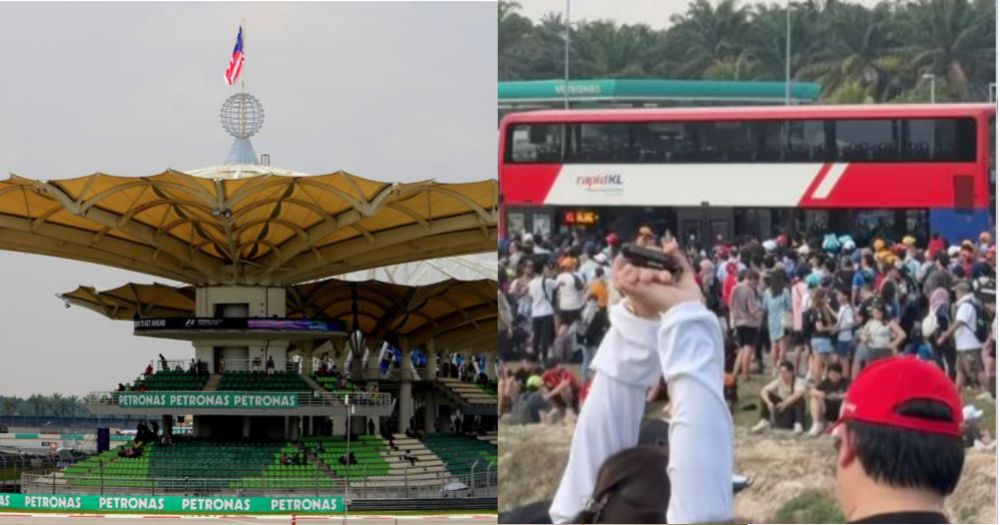
Image via Gajen Nad on Instagram & Wikipedia


Malaysia’s Sepang International Circuit made a triumphant return to Formula 1 over the weekend, after nine years off the schedule.
The race was not without incident, from software glitches to rain delays, but still managed to deliver a memorable race.
Off the track, however, the race was memorable for other reasons, with many of the traditional gripes about the track returning to the fore, but not all.
With the transport situation at the circuit so bad that one Malaysian decided it was more practical to hoof it back to Kuala Lumpur rather than wait, and others compared the first day’s footrace for bus places to scenes from “Train to Busan”, why was the event so chaotic?
Nine-year gap
First things first: the Bahrain Grand Prix in Malaysia is, by most measures, a remarkable achievement.
First announced 10 weeks ago in Jul. 2026, when, due to the ongoing conflict in the Middle East, it was no longer feasible to hold the Grand Prix in Bahrain.
The plan was to hold Bahrain’s F1 race in Malaysia, meaning that while the race would be physically held at Sepang, the branding and organising would belong almost entirely to Bahrain.
It also meant that a year’s worth of planning had to be done over the span of two and a half months.
Anticipation and difficulties
It is hard to overstate how highly anticipated this race was, and how excited local and international fans were at the news.
The Sepang International Circuit is a unique track, not just because of what is almost universally considered an excellent layout, but also because, unlike many tropical or desert races, it is held entirely during the day, making the running very challenging.
Also, it's Malaysia: torrential rain at any time is always a possibility, meaning that races are often held in less-than-ideal conditions, making racing more exciting.
But for these reasons, the race is also challenging to attend, and towards the end of its tenure, while the race was beloved by those watching on TV, local attendance had dipped to around 40,000 to 50,000.
Total attendance over the whole race weekend saw a record-setting 261,000 spectators, with over 100,000 attendees a day on Saturday and Sunday, as reported by Bernama.
This is considerably higher than even the crowd that shows up for the Malaysian Motorcycle Grand Prix (MotoGP), which is just shy of 200,000 attendees.
Three-hour waits
F1 fans from across the region and the world took the chance to return to Sepang, and while they were rewarded on the track, it appears the organisers were unprepared for how many of them there were.
Personal testimony shows punters stuck at the circuit as many as 3 hours after the event ended, even on the final race day.
While it was possible to drive to the circuit, parking space was limited and costly, and motorcycles were barred from the circuit.
This essentially left one way out: the buses. (Or walking)
Limited arrangements
Accounts on social media showed some attendees blindsided by the public transport arrangements.
While buses were available, they were not available from the centre of KL, instead going to and from the KLIA Terminal 2 building, where attendees were meant to take the airport train back to KL.
This is in contrast to the transport arrangements during the 2025 MotoGP, organised by Sepang, which saw shuttle buses heading to KLIA Terminal 2, but also to KLCC, in the heart of the city.
Some attendees of the recent MotoGP events might have expected the same arrangements, but this was, of course, never going to be a like-for-like, due to the aforementioned administrative differences.
Organisers were required to ensure the race was in adequate condition, that the technical facilities for the F1 teams were available, from garages to client hosting facilities.
And by many measures, they did a really good job, with the venue hosting recreations of a Bahraini market, although issues such as a technical glitch and rain delay did pop up.
But when it came to transport, they appear to have fallen short.
Food and water
Transport was not the only source of chaos.
Food and drink became an issue as well, with many Malaysians complaining about the steep price of food at the circuit.
One example from Scoop showed fried rice being sold for RM50 (S$ 15.70), rather than the RM7 (S$2.20) it might have cost elsewhere.
But perhaps the most concerning was the price of water, with bottles reaching RM10 (S$3.14) at the main grandstand area.
Organisers also allegedly prevented attendees from bringing their own water bottles, leading to pictures of piles of discarded water bottles at the entry areas, as reported by The Rakyat Post.
To rub salt into the sunburnt wounds, there appears to have been no shade provided in the areas where attendees were meant to queue for water and food.
Suffering from success
Most of the issues appeared to stem from short timelines, unfamiliarity with local conditions, and perhaps most of all, the event suffering from a severe bout of success.
The quality of racing was never in question. It was just that the track was always just a little too far, a little too hot, and a little too uncomfortable to go back to.
So while the race was a must-watch on TV, in-person attendance dwindled.
There remains the lingering worry that what once happened to Sepang might happen again. But even the most hardy pessimist who just witnessed the crowds from this year's Sepang might wonder if attendance could ever dwindle to that extent.
With everyone from Prime Minister Anwar Ibrahim to F1 commentators declaring their love for Sepang, the chances of the track making a permanent return have never been higher. Although, according to ESPN, due to the deals in place, the earliest it could theoretically return is in 2030.