



News


Once ‘Asia’s stock market darling’, Indonesia facing removal from MSCI emerging-market indexes
MSCI’s consultation closes on Apr. 30, 2027, with a final decision on Indonesia’s emerging-market status due by June 30.
October 21, 2026, 06:28 PM
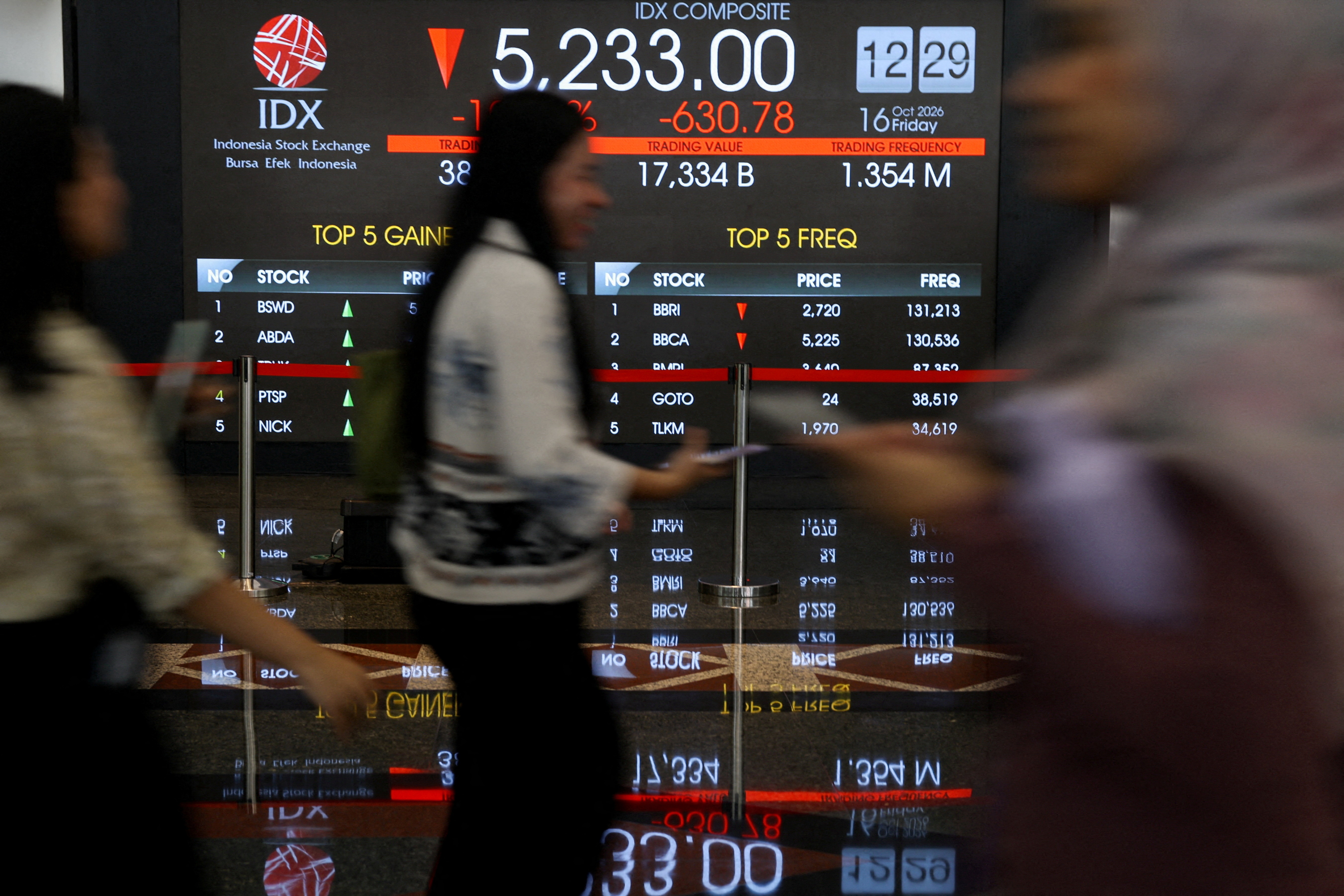
Cover via Ajeng Dinar Ulfiana/REUTERS


Just two years ago, London Stock Exchange Group (LSEG) described Indonesia as “a compelling global investment proposition”.
Now, global index provider MSCI is proposing to remove the country’s stock market from its emerging-market classification over concerns about transparency and trading practices.
The warning triggered an 11.57 per cent plunge in the Jakarta Composite Index on Oct. 16, its biggest one-day decline since January 1998.
Asia's stock market darling
Indonesia’s appeal to international investors stretches back well over a decade.
In December 2010, Reuters reported: “Indonesia has been a darling of emerging market investors this year.”
At the time, its stock market had risen about 40 per cent that year, driven by strong domestic consumption.
Its fortunes subsequently fluctuated. By 2013, Indonesia had been grouped among the “Fragile Five” economies vulnerable to capital outflows and currency depreciation when global interest rates rose.
But in 2022, Reuters reported that its economy and capital markets were showing resilience during another round of global monetary tightening, helped by booming commodity exports.
Indonesia’s benchmark was then approaching a record high as many markets elsewhere struggled with rising U.S. interest rates.
It finished 2022 up 4.09 per cent, with foreign investors buying a net 60.6 trillion rupiah (S$4.3 billion) of shares, according to Indonesian financial authorities.
The positive assessments continued as recently as 2024.
In an analysis published on Apr. 30, 2024, titled “Indonesia: A Hidden Gem?”, LSEG highlighted the country’s abundant natural resources, growing role in the electric vehicle supply chain, and strong trade and investment flows.
The report noted that the market capitalisation of its FTSE Indonesia Total Cap Index had grown 19.6 per cent in 2023 to US$452 billion (S$577.73 billion).
These factors supported its assessment that Indonesia remained an attractive destination for global investment.
MSCI proposes standalone-market status
In an Oct. 15 statement, MSCI announced a consultation on a proposal to reclassify the MSCI Indonesia Indexes from emerging-market to standalone-market status.
The global index provider said investors remained concerned about opaque shareholding structures, suspected coordinated trading and a lack of meaningful enforcement.
“Accordingly, MSCI considers Indonesia’s continued classification as an Emerging Market no longer appropriate,” it said.
MSCI acknowledged reforms announced by Indonesian authorities, including greater shareholder disclosure.
However, investors wanted evidence that the measures were being consistently implemented and would be producing lasting improvements.
It added that feedback suggested even a downgrade to frontier-market status would inadequately reflect the depth of the problems.
Broader policy concerns have also weighed on sentiment.
In February 2026, Reuters reported that investors were worried about government spending, fiscal discipline and central-bank credibility under President Prabowo Subianto.
A frontier market is a market status indicating that a country’s stock market is generally smaller, less actively traded and less accessible to international investors than an emerging market.
A standalone market, as proposed by MSCI for Indonesia, is a classification that would place its stocks outside both MSCI’s emerging-market and frontier-market indexes, potentially triggering substantial investment outflows.
Billions of dollars could leave Indonesian stocks
MSCI’s indexes are used by investment funds worldwide to construct portfolios and measure performance.
Standalone markets sit outside its emerging-market and frontier-market index products.
Removal would require funds replicating the affected indexes to sell Indonesian holdings, while active fund managers could also reduce their exposure.
UBS estimated about US$4 billion in passive outflows, with potentially another US$15 billion (S$19.17 billion) from active investors, according to Reuters.
Indonesia moves to respond
After meeting MSCI on Oct. 19, the Indonesia Stock Exchange said it would exclude stocks with highly concentrated ownership from its benchmark index.
The financial regulator also pledged to continue reforms addressing transparency, liquidity and enforcement against trading violations, Reuters reported.
MSCI’s consultation ends on Apr. 30, 2027, with a final decision due by Jun. 30, 2027.
It expects to proceed with the reclassification unless there is clear evidence of meaningful improvements.