



Abroad

Who's Abdul El-Sayed, the 41-year-old who could become the 1st Muslim US senator
El-Sayed will be one of the youngest U.S. senators if he wins on Nov. 3.
October 29, 2026, 10:30 AM
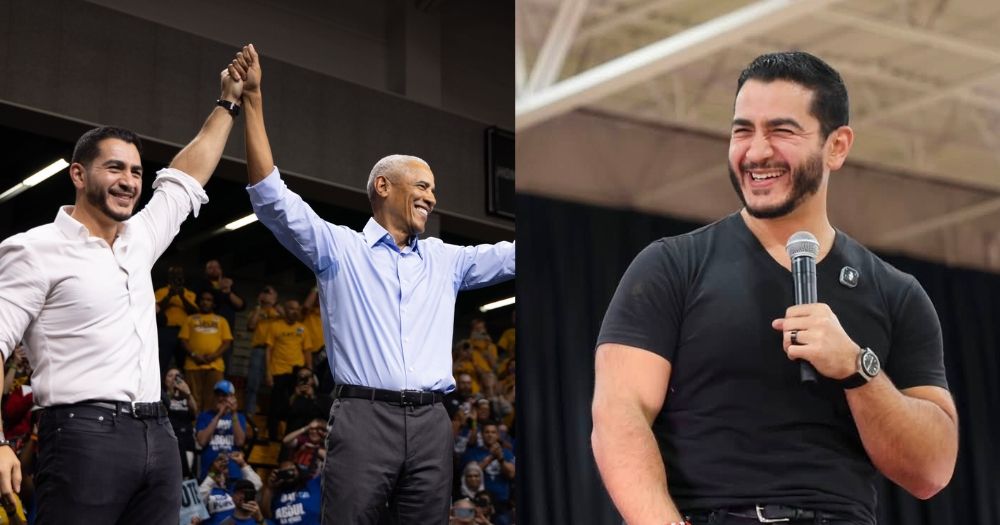
Image via Abdul El-Sayed/Facebook

 Abdul El-Sayed is a very qualified individual.
The 41-year-old, who is running to become a U.S. senator to represent the state of Michigan in the Nov. 3 midterm elections, is a trained medical doctor, but also has a PhD from Oxford. He also has a history of public service, having served as a health director ffor the city of Detroit when he was only 30.
If elected, he would be one of the youngest members of a Senate where the majority are over the age of 65.
He would also be the first Muslim senator in U.S. history, and is one of only two to have attempted to win the role.
Naming distractions
Ever since he won the Democratic nomination for senator for Michigan in August, he has faced discrimination that specifically targets his religion through ads, U.S. President Donald Trump mocking him from the rally stages, and being confronted at events for things that happened before he was born.
So whether he wanted it to be or not, El-Sayed’s religion has been put front and center, and his contest against Republican Mike Rogers has become as much about how he deals with it as it has been about his policy positions.
Over the past month, he has faced two distinct strands of attack regarding his religion: one from President Trump and another regarding purported links to an Egyptian fundamentalist religious group, the Muslim Brotherhood.
Trump has insulted El-Sayed on multiple occasions throughout October, including in a Truth Social post where he misnames him as Mohamed El-Sayed, only to "correct'"himself at a later rally by mocking his name again from the rally podium.
El-Sayed bit back, issuing a statement saying “He (Trump) knows my name is Abdul,” but that Trump was pretending to forget in order to distract voters from Trump’s own bad policies that had led to increased energy prices, grocery prices, and medical costs.
Muslim Brotherhood
He has also faced accusations of ties to the Muslim Brotherhood. The claims centre on social media posts from 2012 and 2013 by his half-sister, who wrote that their mother was active in the Brotherhood in the early 1970s, before El-Sayed was born.
Reports say there is no evidence he was personally involved. He has denied any ties, and said he wasn’t raised by his mother
El-Sayed was also the target of a Republican audience member who challenged him to disavow the Muslim Brotherhood at a town hall. The exchange quickly went viral, with El-Sayed praised for the nature of his takedown.
CNN quotes him as telling the man that “You assume… that because I am Muslim, that somehow I would have some allegiance to something that is not our Constitution.”
In his rebuttal, he referenced the reply of John F. Kennedy, who, as a Catholic, was accused of having a dual loyalty to the Vatican.
Kennedy had said at the time that he was not running to be a Catholic president; he was running for president and happened to be Catholic.
El-Sayed said that he was not running to be “a muslim senator; I am running for Senate and happen to be Muslim.”
Polling...
But whether he wants religion to be front and centre for his campaign, it is.
As election day looms and early voting in much of the U.S. has started, he continues to be a target for Republican figures like Trump.
El-Sayed, as of Oct. 28, is leading his race by 3.3 percentage points at 48.8 per cent according to the Silver Bulletin, just outside the margin of error, although it should be noted that Michigan voted for Trump over Kamala Harris in 2024.
This is in an environment where a generic Democrat is more popular than their Republican counterpart by 9.2 percentage points, implying that El-Sayed is lagging in popularity.
... and policy positions
He has, on numerous occasions, said that he should be judged on his actions rather than his religion.
His main campaign policy is a call for universal healthcare, or “Medicare-for-all”, complaining about the dismal state of public healthcare in the U.S.
He is labelled a progressive and is often accused of being a socialist, but the latter is a label he rejects.
El-Sayed has been endorsed by several figures on the Democratic Party’s left, Bernie Sanders and Alexandria Ocasio-Cortez, but he has called himself a “capitalist”, although he has said that the U.S. is not a capitalist economy, but a "corporatist" one.
In his view, corporatism has eliminated competition in the U.S., locking in consumers to a mere handful of different options, essentially forming an oligopoly.
He has also called for a wealth tax, saying that he’d rather have an economy of “1,000 millionaires than one billionaire.”
He is also, like many progressive Democrats, critical of U.S. support for Israel, although he said he would support any outcome that "a free Palestinian people and a free Jewish Israeli people decide is the right outcome."
Religious attacks
These are positions that would single him out for attack as a socialist by Republicans, and indeed many others with similar positions have been.
But for El-Sayed, the dominating narratives are about his religion, and to a lesser extent, his ethnic background.
His response has been consistent throughout, saying that attacks on his faith are distractions from economic policy failure.
Trump, in recent days, has renewed his verbal assaults, calling him a jihadist who would be the only senator that will have to go through a metal detector before he’s allowed to go in the Senate, as quoted by the BBC.
El-Sayed has refused to shy away from Trump's attacks, defiantly telling a rally crowd that Trump could call him whatever he wanted, but that he could call him senator after November.
“I’ll be Senator Mohamed to you, bro”